
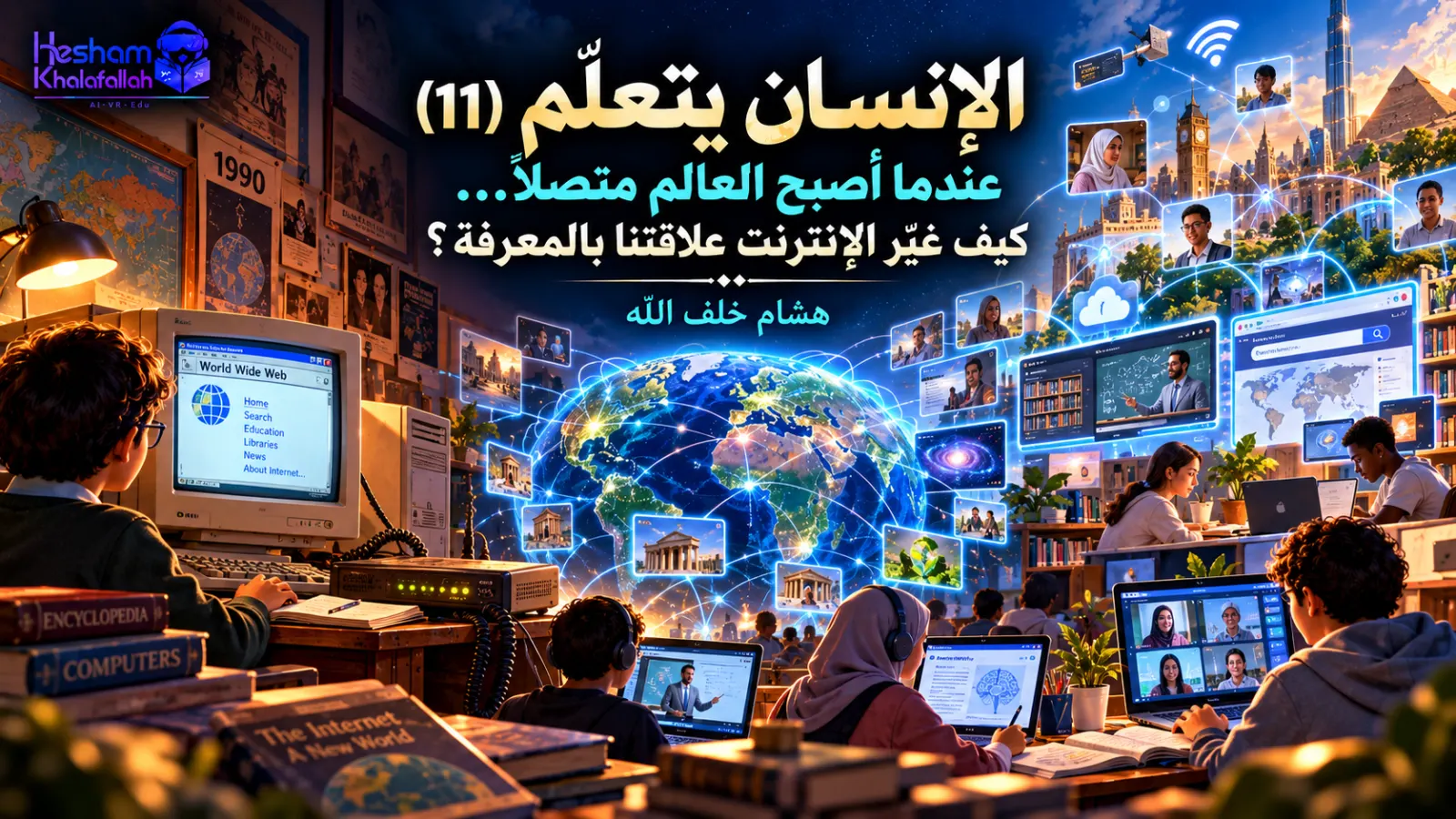
When the Computer Was No Longer an Island
In the previous article, we reached an important moment in the journey of education. The computer had become capable of combining text, images, sound, and video, while learners could click, type, choose, experiment, and receive a response. We added a new element to the education system: digital interaction.
Yet the computer was still, in many cases, an island. What you could learn through it depended on what was already stored inside it: a program, a file, a CD-ROM, an encyclopedia, or educational material someone had previously installed.
If you wanted new knowledge, a new source somehow had to reach you.
Then these islands began to connect.
One computer connected to another, then to a network, and eventually networks connected to other networks until an entirely different world appeared before us:
the Internet.
The real change was not simply that computers had acquired another feature. It was much deeper.
For the first time, the question began to shift from:
What is inside this computer?
to:
What can this computer reach?
And here we add another element to the education system we have been building:
Connectivity and access to digital knowledge.
From Owning Knowledge… to Being Able to Access It
Before the Internet, access to knowledge was largely connected to what was physically close to you: the books you owned, the library in your city, the teacher in front of you, the encyclopedia you could afford, or the university or institution you were able to enter.
The Internet began to change the very meaning of a “source.”
You could sit in one place while accessing information located somewhere entirely different. You could read a newspaper from another country, visit a university website, search an encyclopedia, communicate with someone you had never met, and find information that had never existed on your own computer.
This created what I consider one of the greatest shifts in the history of knowledge:
The Internet did not give every human being ownership of all knowledge, but it brought access to knowledge closer than ever before.
As websites and search engines developed, the experience changed even further.
Previously, it was important to know where information was located. Now, you could type a few words and begin searching for it yourself.
A new skill therefore entered the learning system:
searching for knowledge.
But, as we have seen at every previous stage, every new solution creates a new problem.
Finding information does not mean that the information is correct.
I Remember the Sound of Connecting… Before Knowledge Became Instant
I remember my early experience with the Internet, when connecting to it was an experience in itself.
That familiar dial-up sound, waiting for the computer to connect, and then waiting again as the page gradually appeared.
Today, that experience may seem extremely slow and primitive.
But at the time, speed was not the most remarkable thing to me.
What fascinated me was that the computer in front of me could now reach something that was not stored inside it at all.
I might wait for a single page, but behind that page was an entire world.
A child using high-speed Internet and a smartphone today may find it difficult to imagine that we once waited for an image or a simple text page to load.
But the greatest transformation was not simply that the Internet became faster.
Human expectations toward knowledge also changed.
We began to expect information now.
The image now.
The video now.
The person or source now.
This is why Internet speed is not merely a technical detail.
It determines what kind of educational experience can actually be delivered.
A limited connection may support text. A better connection makes images and audio practical. Then video becomes possible, followed by live streaming and real-time interaction.
Therefore:
Connection speed did not only change how quickly knowledge could arrive; it changed the kinds of learning experiences that could be delivered at all.
But… Is the Internet Available to Everyone?
This is where we need to stop.
Discussions about the Internet sometimes make it easy to say:
“Knowledge is now available to everyone.”
But is that really true?
Even as this article is being written in 2026, the world has not achieved equal digital connectivity.
According to the International Telecommunication Union’s latest estimates, around 6 billion people used the Internet in 2025—roughly three quarters of the global population—while approximately 2.2 billion remained offline. Internet use was estimated at around 94% in high-income countries, compared with about 23% in low-income countries.
The difference is also no longer simply between being “connected” and “not connected.” It includes speed, reliability, affordability, digital skills, and the quality of the device available.
The International Telecommunication Union also notes that although Internet prices have generally declined, connectivity remains unaffordable according to international affordability targets in many economies, while rural populations can face higher costs relative to their income for lower-quality services.
At this point, the Internet stops being merely a technology issue and becomes an educational equity issue.
Imagine two students at the same educational level studying the same curriculum.
One has a modern device and a fast, reliable connection and can watch videos, search, and access platforms at any time.
The other may live in an area where the service is unavailable, too expensive, unstable, or where the entire family shares a single phone.
Can we really say that both students have been given the same educational opportunity?
Certainly not.
This is why the phrase “Internet access” is no longer enough.
We need what the International Telecommunication Union describes as meaningful connectivity: service that is available, sufficiently reliable, affordable, and supported by appropriate devices and skills so that people can actually benefit from it.
The Internet Is an Important Tool… But It Is Not a Condition for Learning to Exist
Here we need another important distinction.
The Internet has become one of the most important tools for knowledge and education in the modern world.
But it is not a condition for learning itself to occur.
A child can learn from an excellent teacher, a book, an experiment, and a conversation without being connected to the Internet.
A school can achieve meaningful learning despite limited technology.
At the same time, a learner may have the fastest connection and the newest device and still experience very little deep learning.
I therefore do not see the Internet as having replaced the school, teacher, or book.
It added a new capability to the system.
However, once an education system places assignments on platforms, turns textbooks digital, delivers lessons through video, and conducts assessments electronically, the Internet moves from being an optional tool to becoming part of the infrastructure on which the educational process depends.
At that point, a question of fairness becomes unavoidable:
Is it fair to make a service that is not equally available to every learner a basic requirement for accessing education?
The problem does not concern homes alone.
Available global comparative data on schools continue to show major inequalities in connectivity for educational purposes. UNESCO has highlighted that many schools, particularly at basic education levels and in lower-income environments, still lack adequate connectivity, devices, or supporting infrastructure.
When planning digital education, therefore, we should not design only for the student with the best connection.
We must also think about the learner standing at the weakest point in the system.
When the Book Became a PDF… Did Education Become Digital?
This brings us to one of the most important distinctions in the article.
As computers and the Internet spread, books began turning into digital files.
Instead of a printed textbook, we could receive a PDF.
Notes became files.
Images became digital.
Video became part of the content.
This was an important development in content.
But does converting a printed book into a PDF mean that we have created digital education?
I do not think so.
If a teacher once said:
“Open your textbook to page 25.”
and later says:
“Open the PDF to page 25.”
what has actually changed in the learning process?
The book may now be easier to carry.
Distribution may be faster.
Copying costs may be lower.
But the learning experience itself may remain almost unchanged.
This is why we need, for the first time in this series, to distinguish clearly between concepts that are often treated as though they mean the same thing.
Digital Content Is Not the Same as Digital Education
Digital content is knowledge that has been converted into, or created in, a digital form.
A PDF book, an image, a video, an audio file, a presentation, a digital encyclopedia, or a test stored on a device.
All of these are digital content.
But their existence alone does not mean that we have digital education.
Digital education, by contrast, is an organized educational process that uses digital tools to deliver and manage education.
There are objectives, a teacher, a learner, content, activities, communication, assessment, and feedback.
Technology helps connect these elements and allows them to function together.
Then there is digital learning.
For me, this is the most important concept because it concerns what actually happens to the human learner.
Did the learner use the digital environment to search?
Explore?
Compare?
Experiment?
Receive feedback?
Solve a problem?
Collaborate?
Build new knowledge?
The distinction can therefore be summarized as follows:
Digital content is what we provide. Digital education is how we organize its delivery using technology. Digital learning is what actually happens to the learner within that environment.
And there is a fourth level that is broader than all of these:
digital transformation in education.
Digital transformation does not mean converting textbooks into PDFs, purchasing devices, or creating a platform.
It means rethinking how the system itself operates: student management, communication, curriculum, assessment, data, services, decision-making, and the overall experiences of both teachers and learners.
This leads to one of the central principles of our journey:
Not every use of technology is digital education, and not every form of digital education represents digital transformation.
We Can Digitize Education… Without Changing Learning
This distinction is extremely important.
A school may have modern devices, fast Internet, screens, PDF textbooks, and a platform.
Yet the teacher may still teach in exactly the same way, the learner may still receive information in exactly the same way, and assessments may still measure exactly the same things.
In this case, we have changed the form of the tools, but we may not have changed the nature of learning.
We explored the same idea in the previous article when we said that a computer could become nothing more than an electronic book.
The Internet can likewise become simply a faster road to the same book.
Its greater potential appears when connectivity enables something that was previously difficult or impossible.
The learner can access multiple sources, compare information, communicate, search, collaborate with people in different places, and reach content that changes continuously instead of waiting for the next edition of a textbook.
This is when connectivity truly begins to change the learning experience.
And the question we will continue carrying with us remains:
What can the learner now do that they could not do before?
When the Teacher Was No Longer the Only Gateway to Knowledge
Perhaps this was one of the most significant psychological and professional transformations created by the Internet.
For a long time, the teacher was one of the learner’s most important gateways to knowledge.
The teacher knew.
The learner asked.
And beside them stood the textbook selected by the education system.
Then the learner could go home and search for the same topic.
They might find dozens of articles, images, videos, competing viewpoints, and materials produced by universities, institutions, and individuals around the world.
The question facing the teacher therefore changed.
It was no longer only:
How do I give the learner information?
It became:
How do I help the learner deal with the amount of information they can now access?
This does not reduce the importance of the teacher.
It changes it.
When information became greater than any individual could possibly memorize, the teacher’s value became less connected to how much they could remember and more connected to their ability to help learners access, understand, distinguish, verify, and use knowledge.
A learner may find ten different answers to one question.
But who helps them determine which answer is more reliable?
Who explains the context?
Who notices when the learner has found accurate information but misunderstood it?
The Internet did not eliminate the need for teachers.
Once again, it began redefining their role.
From the Problem of Scarce Knowledge… to the Problem of Abundant Knowledge
Before the Internet, a learner might struggle because they could not find a source.
Today, they may struggle because they find thousands of sources.
Something strange happened.
At one historical stage, the question was:
Where can I find knowledge?
Now, one of the central questions has become:
Which knowledge should I choose?
And whom should I trust?
Is the website in front of me a scientific source?
Or a personal opinion?
Is the information current or outdated?
Has someone copied it from another source?
Is the image real?
And was the page created to teach me, sell something to me, or influence the way I think?
This is where digital and information literacy became increasingly important.
Learners no longer need only to know how to read and write.
They need to know how to search, compare, verify sources, and distinguish among fact, opinion, and advertising.
Here lies one of the great paradoxes of the Internet:
When knowledge was scarce, the challenge was reaching it. When knowledge became abundant, the challenge became choosing it and verifying it.
This ability will become even more important when our journey later reaches social media and artificial intelligence.
Does Having Internet Access Mean Knowing How to Learn From It?
There is another form of the digital divide that goes beyond having a connection.
Two children may both have smartphones and Internet access.
One knows how to search for information, use different tools, compare sources, write, create content, and protect personal data.
The other may spend hours online without knowing how to use the Internet effectively for learning.
The International Telecommunication Union also points to inequalities in digital skills. Being connected does not automatically mean possessing the abilities needed to use connectivity effectively and safely.
We therefore have at least two levels of digital inequality:
the access gap
and the use-and-benefit gap.
This distinction matters because we may look at a student holding a smartphone and assume that they are naturally “digital.”
But knowing how to use applications does not necessarily mean knowing how to learn digitally.
As we have said before:
Having the tool does not mean that learning has occurred.
The Family Faces an Open Door to the World
Once again, the family returns to the story.
When television entered the home, the number of channels and programs was relatively limited.
When the computer entered, the files and software stored on it were often easier to identify and control.
The Internet opened a door to an almost limitless world.
Education.
Entertainment.
Games.
News.
Communication.
High-quality content.
Poor-quality content.
Accurate information.
False information.
The family’s questions therefore became more complicated.
Should we prevent?
Monitor?
Limit screen time?
How do we protect the child?
And at the same time, how do we help them benefit from one of the most important tools for knowledge in the modern world?
I do not believe prohibition alone can be the answer.
The goal is not merely to keep children away from risks.
It is to help them build the ability to use the tool consciously and responsibly.
This brings the family back into the education system even in an age when knowledge can appear highly individual and available on every person’s phone.
The Internet Changed Place… But It Had Not Yet Created a Complete Digital Classroom
So what did the Internet add to our journey?
The computer made knowledge interactive.
The Internet made it connected.
Learners could now access sources beyond their textbooks, schools, devices, and countries.
Teachers could reach resources that had previously been unavailable to them.
Knowledge could travel at a speed humanity had never experienced before.
Yet there was still a difference between having Internet access and having a complete educational system operating online.
A book placed on a website does not create a school.
Watching a video does not create a curriculum.
Searching Google does not, by itself, create an organized learning experience.
But the Internet made something enormously important possible:
At scale, the learner, teacher, and content could now exist in different places and still connect with one another.
This is where the traditional boundaries of the classroom began to shake.
If the teacher can send content from one place and the learner can receive it somewhere else…
If the learner can ask a question and receive an answer…
If assignments can be submitted and corrected without both people standing in the same room…
must a classroom always be a place surrounded by four walls?
And this is where the next stage of our Human Learning journey begins:
Human Learning (12): When the Classroom Moved Beyond Its Walls… How Did E-Learning and Distance Learning Change the Meaning of Place?