
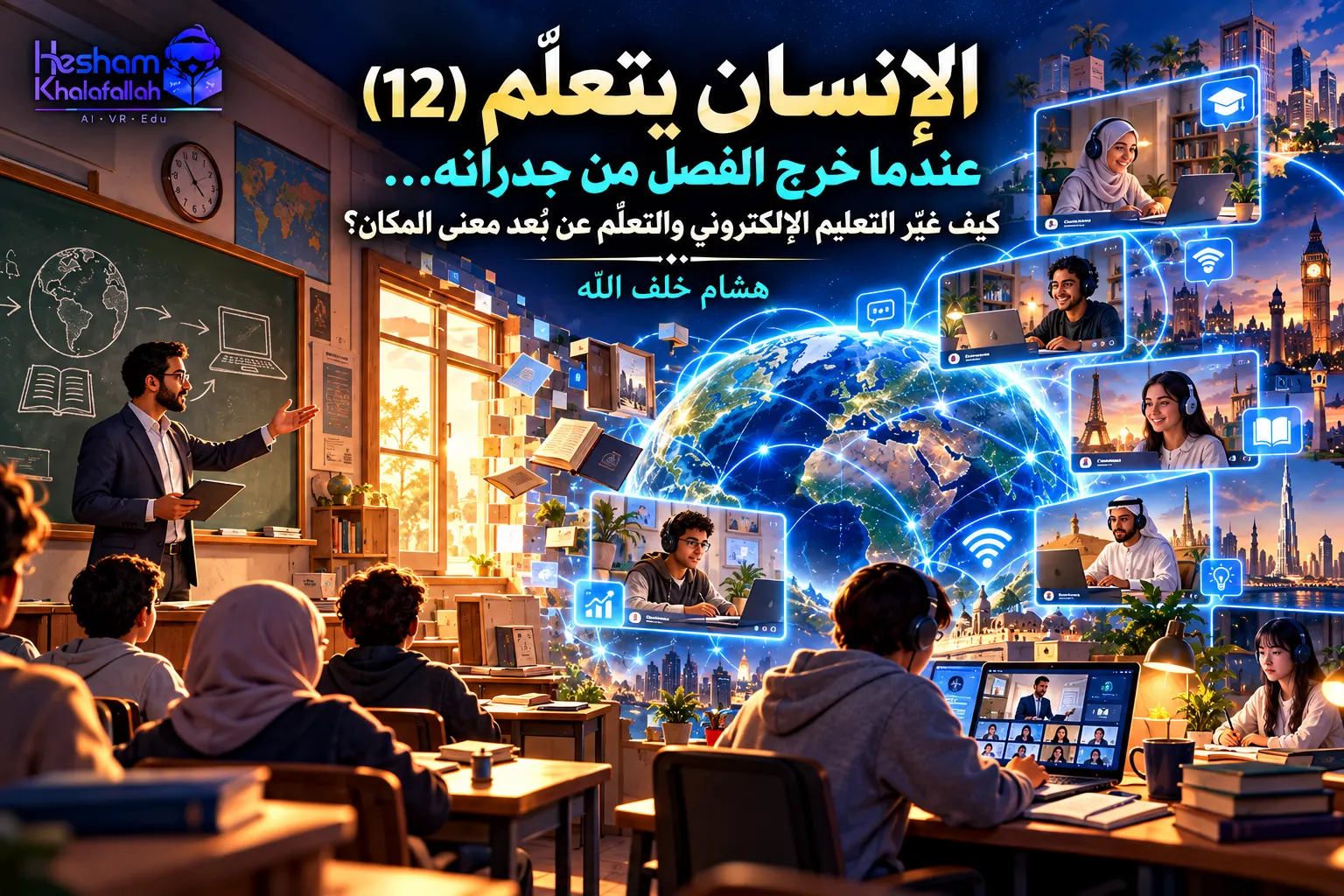
When Access to Knowledge Was No Longer the Only Question
In the previous article, we reached a moment when the computer became connected to the world.
The learner was no longer limited to what existed inside the device, the textbook, or the school library. They could now access sources located elsewhere, search, communicate, and retrieve information that had not been in front of them moments earlier.
This led to a natural question:
If knowledge can reach the learner wherever they are, must the learner always go to the same place in order to learn?
For a long time, formal education was associated with a familiar image: a school, a classroom, a teacher, students, a timetable, a bell, and a fixed time when everyone gathered together.
Place was a fundamental part of the educational model we knew.
But technology gradually began separating learning from place.
And here, we add a new element to the education system:
Flexibility of place and time.
Distance Learning Did Not Begin with the Internet
Today, when we hear the phrase “distance learning,” it is easy to imagine an online platform or a Zoom lecture.
But the idea is much older than the Internet.
There were forms of correspondence education in which learning materials were sent to students, who studied them away from the institution and later returned assignments or completed work. Later, radio, television, recorded materials, computers, and eventually the Internet were also used.
Even universities specializing in distance education existed long before the Internet. The Open University in the United Kingdom, for example, has been delivering distance education for more than fifty years and has served millions of learners throughout its history.
So:
Distance learning did not begin with the Internet, but the Internet made it faster, more interactive, and easier to scale.
In correspondence education, days or even weeks might pass between sending material and receiving a response.
The Internet reduced that delay to hours, minutes, and sometimes seconds.
And at this point, it was not only place that began losing its control over education.
Time also started becoming more flexible.
When the Teacher and Learner No Longer Had to Share the Same Place
In the traditional model, the main elements of education usually come together in the same place and at the same time:
Teacher + learner + content + classroom + same time.
Distance learning allowed these elements to separate.
The teacher may be in one city, the learner in another, and the content hosted on a server in a third country.
Everyone may participate at the same time.
Or the teacher may upload content today and the learner may access it tomorrow.
This is a bigger change than it may first appear.
We were not simply changing the way a lesson was delivered.
We were beginning to change the conditions required for education to take place.
The Internet moved knowledge beyond the limits of place, while distance learning moved the educational process itself beyond the walls of the classroom.
Distance Learning Is Not the Same as E-Learning
Here we need an important distinction, because these terms are often confused.
Distance learning mainly refers to the physical separation of teacher and learner during part or all of the educational process.
It may use mail, television, recorded materials, or the Internet.
E-learning, on the other hand, means using digital technologies and media to design, deliver, and manage education.
E-learning can therefore take place inside the classroom itself.
Students and the teacher may all be physically present in school while using a digital platform, simulations, electronic assessments, digital resources, and interactive activities.
That is e-learning, but it is not distance learning.
Then we have online learning, which depends directly on Internet connectivity to access content, activities, and interaction.
So:
Not all e-learning is distance learning, not all distance learning began with the Internet, and being connected to the Internet does not by itself mean that learning has occurred.
This brings us back to the idea we established in the previous article: technology is not learning itself. It is an environment through which learning may happen.
Not Only Place Became Flexible… Time Did Too
With online education came another important distinction.
Learning can take place synchronously.
The teacher and students are present at the same time, talking, seeing one another, and discussing directly, even if they are in different locations.
Here, place has changed, but time remains shared.
Learning can also take place asynchronously.
The teacher uploads a lesson, video, reading, or activity, and the learner accesses it at another time.
They read.
Watch.
Complete tasks.
Submit work.
Discuss.
Return later.
Now both place and time can be different.
This is a major shift:
Distance learning did not only free learning from place; it also began to free it, at least partially, from time.
But, as always in our journey, every new freedom creates a new responsibility.
When Freedom Required Discipline
Inside a school, the student’s day is structured.
There is an arrival time.
A class schedule.
A teacher in front of them.
Classmates around them.
A bell marking the beginning and end.
A system that determines what should happen and when.
As learning becomes more flexible, part of this responsibility moves to the learner.
When will I study?
Will I watch the lesson now or postpone it?
Did I complete the task?
Did I understand what I watched?
Do I need to go back to the previous section?
This makes skills such as time management, self-directed learning, and discipline increasingly important.
The more flexible learning becomes, the more learners need the ability to manage themselves.
This flexibility may be a major advantage for an adult or a learner who can organize their time, while becoming a real challenge for a young child who requires constant support.
Once again, technology does not work in the same way for every learner.
The Platform: Did the Classroom Gain a Digital Space?
As e-learning developed, learning platforms and Learning Management Systems began bringing many parts of the educational process together in one digital environment.
Content.
Assignments.
Announcements.
Grades.
Tests.
Attendance.
Discussions.
Communication between teachers and students.
Students gained accounts through which they could enter a digital environment connected to their school or university.
In a sense, the classroom began to acquire a digital extension.
But here we need to remember the distinction we discussed earlier.
Having a platform does not automatically mean having high-quality digital learning.
A platform may simply be a place to upload files, a system for homework and messages, or a genuinely interactive learning environment.
A platform can organize education, but it cannot guarantee that learning takes place.
We will return to this point in greater depth in the next article, because it raises a major question: why do so many schools and education systems have advanced digital tools while the core of teaching remains traditional?
Does Moving a Lecture to a Screen Mean That We Changed Education?
This brings us to one of the most important conceptual problems.
Imagine a teacher who used to stand in a classroom and speak for an hour.
Now we place a camera in front of the teacher.
Students watch the teacher for an hour from their homes.
What has changed?
The place has certainly changed.
But has the way learning happens changed?
Not necessarily.
We may simply have taken the same model and moved it from the classroom to the screen.
Just as we said in the previous article that converting a textbook into a PDF does not automatically make education digital.
We can also say:
Moving a lecture from the classroom to a screen does not necessarily mean that we have redesigned learning.
Digital environments can be used differently: short activities, discussions, varied content, questions, collaboration, tasks, feedback, and learning at an appropriate pace.
But this requires designing the learning experience, not merely sending a meeting link.
This distinction became especially clear when the world faced one of the greatest tests in modern education.
When COVID-19 Forced the World Out of the Classroom
Distance learning existed long before 2020, as did e-learning, digital platforms, and virtual classrooms.
But the COVID-19 pandemic created a different situation.
Distance learning was no longer an optional model or a limited project for selected institutions.
Schools and universities across large parts of the world closed within a short period, and institutions had to find any possible way to continue education.
At the height of the crisis, more than 1.6 billion learners were affected by school closures worldwide.
Some countries used online platforms.
Others used television or radio.
Many schools turned to video meetings, messaging applications, and digital materials.
Suddenly, the home became the classroom, the screen became the board, and the camera became the window connecting teachers and students.
But the experience revealed something very important.
In many cases, what happened was not online education designed from the beginning to work digitally.
The primary goal was simply to maintain educational continuity during an unexpected emergency.
This is why an important term appeared:
Emergency Remote Teaching.
Researchers discussing the experience in 2020 distinguished carefully between well-designed online learning and the temporary, rapid shift to remote teaching caused by the crisis.
Good online education requires planning, design, preparation, and support.
It is not simply a matter of moving materials online within a few days.
That distinction is fundamental.
COVID-19 Did Not Invent Distance Learning… It Tested the System
One of the most important outcomes of that period was that it exposed the difference between having digital tools and being ready for digital education.
A school may have computers.
It may have a platform.
Teachers may use email.
But that does not necessarily mean the institution can move the entire educational process online the next morning.
Suddenly, questions emerged with much greater force.
Is the teacher ready?
Does the learner have a suitable device?
Is the Internet connection reliable?
How should the lesson be delivered?
How do we know whether the student is engaged?
How do we assess them?
How do they interact with classmates?
How does a young child learn from home?
The pandemic also exposed inequalities that already existed rather than creating them.
Technology became a test of the whole system, not just the device.
When the Home Became Part of the Classroom
Before distance learning, it was relatively easy to separate school and home.
The student went to school.
Learned.
Then returned to the family.
But when the lesson moved into the home, those boundaries changed.
The home Internet connection became part of education.
The device in the house became part of education.
A quiet place became part of education.
And the role of the family became more visible, especially with younger children.
Who makes sure the child joins the lesson?
Who helps when the sound does not work?
Who organizes the child’s time?
Who keeps distractions away?
Who steps in when the child does not understand what they are supposed to do?
This leads to another important idea:
When the home became a classroom, the conditions of the home itself became part of the conditions of education.
This also explains why distance learning cannot be an equal experience for all children, even when they study the same curriculum.
And the Teacher Faced a Classroom They Could No Longer See in the Same Way
The teacher’s experience changed as well.
In a physical classroom, teachers can look at their students.
They can see who is paying attention.
Who looks confused.
Who wants to ask a question.
They can feel the rhythm of the room.
On a screen, students may become small boxes.
Some cameras are turned off.
Some connections fail.
A student may be physically present in front of the screen while being mentally elsewhere.
This makes it clear that online teaching requires skills beyond simply knowing how to operate the software.
How should the lesson be divided?
How do you maintain engagement?
When should you speak?
When should the learner work?
How do you know whether they understood?
How do you design an activity for someone sitting in another place?
This leads to an important principle:
A digital teacher is not a traditional teacher with a camera placed in front of them; they are a teacher who needs to redesign communication, explanation, activities, and assessment.
Is Face-to-Face Education Better Than Distance Learning?
Perhaps the question itself is too simplistic.
The answer depends on the goal, the learner, the subject, and the circumstances.
Some content can be learned very effectively at a distance.
Other forms of learning require a laboratory.
A workshop.
Hands-on practice.
Or direct human interaction.
A young child is not the same as a university student.
A learner developing surgical skills is not the same as someone studying language or management.
So perhaps the more useful question is:
Which learning environment is most appropriate for this learner, this objective, this content, and these circumstances?
From this question came the growing importance of a model that combines both worlds.
Blended Learning… When We No Longer Had to Choose
Why must education be either fully face-to-face or fully digital?
A student can read or watch material before class.
Then come to school to discuss, experiment, and apply.
They can carry out a practical or collaborative activity in the classroom.
Then return to the platform to continue research, complete an assignment, or join a discussion.
Here, the screen is not trying to replace the school.
And the school is not trying to ignore the digital world.
Instead, the learning experience is distributed across both environments.
This is the central idea behind blended learning.
Perhaps the future of education is not about replacing the classroom with the screen, but about deciding what should happen inside the classroom, what can happen outside it, and why.
Technology then becomes a way of extending the learning space, not simply moving the classroom somewhere else.
But If the Tools Exist… Why Did Education Remain Traditional?
We have now reached a contradiction worth examining.
We have computers.
Internet.
Platforms.
Video.
Virtual classrooms.
Digital content.
Tools that teachers and learners could hardly have imagined a few decades ago.
And yet, when we enter many schools around the world, we still see a very familiar picture:
A teacher in front of students.
A textbook or curriculum.
Explanation.
Homework.
An exam.
A school may even have a highly advanced digital platform, but use it mainly to send instructions, homework, grades, and messages, while the actual teaching remains largely traditional.
So if the tools already exist, and crises have shown that they can be used, why has education not changed at the same speed as technology?
Is the problem the technology?
The teacher?
The curriculum?
The exam?
The institution?
Recognition and certification?
Or does the school itself perform functions that a screen cannot replace?
Perhaps the problem is deeper than all of these.
Perhaps we changed the tools faster than we changed the philosophy of education.
And this becomes the question of the next stage in our Human Learning journey:
Human Learning (13): When Technology Entered the School… Why Did Education Remain Traditional?