
In the previous article, we reached a stage where knowledge had found a place.
Books gathered it, libraries preserved it, and indexing helped people organize it and find it. As knowledge accumulated, different fields began to expand, and specialization and source verification became increasingly important.
Yet one major problem remained.
A book could contain extremely valuable knowledge, perhaps even knowledge capable of changing a person’s life. But what if only one or a few copies existed? What if producing another copy required a great deal of time and effort?
In that case, knowledge existed, but access to it remained limited.
A new challenge therefore emerged in the journey of learning:
How could the knowledge we had succeeded in preserving reach a larger number of people?
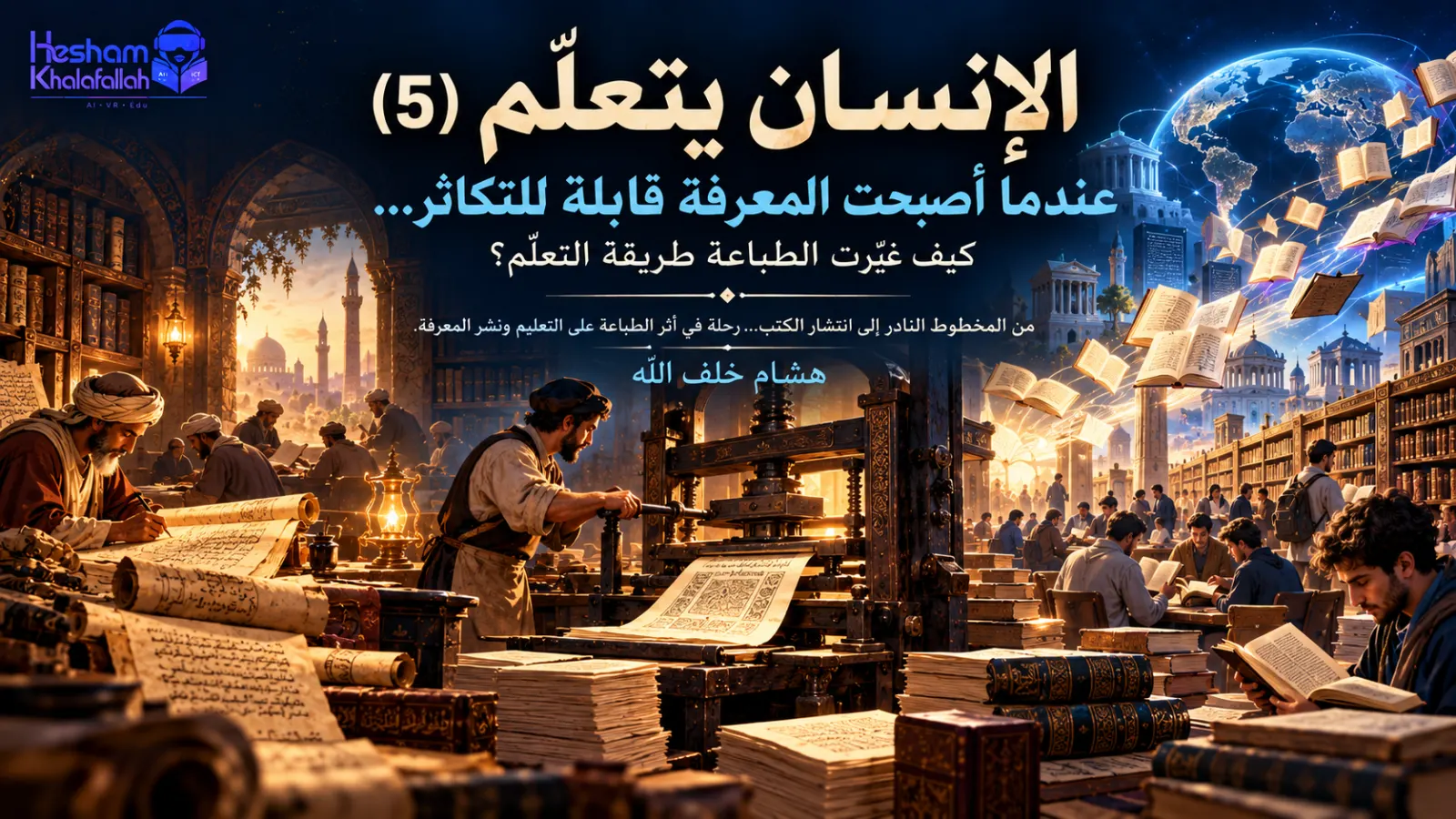
This is where the story of printing begins.
But, as in the rest of this series, what interests me most is not only who invented the printing press or when it appeared. What matters more is what happened to education when the same text could be reproduced many times.
When One Copy Became Many
Different parts of the world knew forms of printing before its widespread expansion in Europe, and early techniques appeared in East Asia before printing developed further across different periods and civilizations.
But the transformation that matters most to our discussion of learning was simple in principle and enormous in impact:
Producing another copy of a text no longer always required rewriting the entire work by hand.
One copy could become many.
Writing had allowed an idea to survive. The book made it portable. The library gathered and organized it. Printing made knowledge far more reproducible and distributable.
This changed an important equation in education.
The value of a learning resource does not depend only on the quality of what it contains, but also on whether learners can actually access it.
You may possess the finest knowledge in the world, but its educational value remains limited if only a small number of people can reach it.
Printing therefore did more than expand the circulation of books. It gradually expanded the number of people who could learn from them.
As the number of copies increased, more people could read the same text.
This helped create more consistent educational content. A teacher and a group of students could refer to the same book, and the learner could return to the text after the lesson and read it again.
Over time, books became central learning resources, and educational texts, curricula, and textbooks developed in different forms.
But here, another challenge appeared:
If all students study from the same book, does that mean they all learn in the same way?
A common source can help organize and expand education, but it can also encourage us to assume that learners are alike in their pace, understanding, interests, and ways of learning.
The distinction matters.
Standardizing the source of knowledge does not mean standardizing the human being who learns from it.
The Book Did Not Replace the Teacher… It Changed the Teacher’s Role
Every new tool for transmitting knowledge raises the same question about the role of the teacher.
When knowledge was closely tied to the person who carried it, the teacher was a primary source of information.
But once the learner had access to a book containing that knowledge, the teacher was no longer the only path to it.
Did that make the teacher unnecessary?
Of course not.
But the teacher’s role began to change.
The task became less about simply transferring information and more about explaining what was written, interpreting it, connecting ideas, asking questions, helping the learner understand, and turning words into usable meaning.
What is striking is that we are still asking the same question today in new forms.
When the internet appeared, people asked: if information is available through search engines, what is the role of the teacher?
Now, with artificial intelligence, we ask again: if a machine can explain, answer, and summarize, what remains for the teacher?
History offers an important clue:
The easier knowledge becomes to access, the teacher does not necessarily disappear; the role of the teacher changes.
The teacher may become less important as a transmitter of information and more important as someone who helps learners understand, question, connect, evaluate, and apply it.
This leads to another question.
What is the value of producing thousands of books if large numbers of people cannot read them?
As written material became more widely available, literacy became more valuable. Reading and writing grew increasingly important in daily life, and educating larger numbers of people became more significant for societies.
But it would be too simplistic to say that printing alone created mass education.
The expansion of education depended on many social, economic, religious, political, and institutional factors, as well as changes in work and society.
What printing did was change the environment in which education took place, making written texts more present and potentially accessible to larger numbers of learners.
This leads us to an essential idea:
Access to knowledge is an important condition for learning… but it is not learning itself.
Owning a book does not mean understanding it.
Reading a text does not mean being able to evaluate it.
Memorizing its content does not mean knowing how to use it.
When Wider Distribution Became Both an Advantage and a Problem
Printing could spread knowledge.
But it could also spread error.
In the age of manuscripts, an inaccurate idea might remain confined to a small number of copies.
Once texts could be reproduced on a larger scale, the same incorrect idea could reach many more people.
The machine itself does not distinguish between truth and error.
It simply increases the capacity to publish.
This made the author, source, publisher, review process, and critical evaluation even more important.
The learner now needed another skill:
not to believe something simply because it appeared in a printed book.
That idea feels remarkably modern.
In the past, the appearance of a printed book might have given information a certain authority in the eyes of a reader.
Today, authority may come from appearing at the top of a search result, from having millions of views, from professional design, or even from a confidently written response generated by artificial intelligence.
But the appearance of information does not guarantee its accuracy.
The easier knowledge becomes to publish, the more important our ability to evaluate it becomes.
And here begins a broader transformation in the history of learning.
For a long time, one of the main challenges was scarcity of knowledge resources.
Where could the book be found?
Who owned the copy?
How could someone reach it?
Gradually, the problem began to shift from scarcity to abundance.
The question became less about “Where can I find knowledge?” and more about “What should I choose from all this knowledge?”
We can see a clear line reaching all the way to the present:
Printing reduced the cost of reproducing knowledge.
The internet reduced the cost of distributing knowledge.
Artificial intelligence is now reducing the cost of producing content itself.
At each stage, the skill required from the learner changes.
When books were scarce, access itself was valuable.
When information became abundant, searching and selecting became more important.
And when answers and content become easy to generate, verification, judgment, and critical thinking become more important than simply obtaining an answer.
Does Having More Sources of Knowledge Mean Better Learning?
It is easy to view printing as a complete victory for knowledge.
And there is no doubt that it had an enormous impact on the spread of books, ideas, culture, and education.
But it is important to distinguish between three things:
The existence of knowledge.
Access to knowledge.
Learning from knowledge.
They are not the same.
Knowledge may exist and still be inaccessible.
I may reach it and still fail to understand it.
I may understand it and still not know how to use it.
And this is not only a problem of the past.
A student today can carry a device that provides access to millions of books, lectures, articles, and learning resources, yet this does not automatically make that student a better learner.
Curiosity, attention, practice, experimentation, questioning, connection, and application remain essential parts of learning.
Technology can support learning.
But technology alone cannot make a human being learned.
Perhaps one of the biggest mistakes we make whenever a new technology appears is to confuse easier access to knowledge with learning itself.
Technology can remove an obstacle.
It cannot remove the learner from the learning process.
When Educating Larger Numbers Became Possible
As books became more widely available, reading expanded, and content became easier to reproduce, societies could begin thinking differently about educating larger numbers of people.
If one book could be used by dozens, hundreds, or thousands of learners, the question was no longer only about the source of knowledge.
A new question emerged:
How do we organize the learning of all these people?
We would need a place.
A schedule.
A teacher.
Content.
Stages of learning.
And ways to determine whether learners had actually understood.
A new phase in the history of education was beginning.
Until this point, our journey had focused largely on the development of sources of knowledge:
the human being, storytelling, writing, the book, the library, and then printing.
The next phase would focus on something different:
How did education itself become a system?
Printing helped knowledge reach larger numbers of people.
But once society wanted to educate large numbers of children and young people in a regular and organized way, the book alone was no longer enough.
A new question appeared:
How do we organize the education of thousands—and eventually millions—of people?
And this is where the next stage of our “Human Learning” journey begins:
When Education Became a System… The Story of the Classroom and the Modern School.