
For years, as I became more involved in education, technology, training, and digital transformation, one question kept returning in different forms:
Are we really developing education, or are we constantly redesigning the way we teach and learn to keep pace with social, behavioral, economic, and technological change? And sometimes, are we simply replacing one tool with another?
We moved from the blackboard to the screen, from the book to the platform, and from the classroom lecture to virtual classes and online meetings. Then came virtual reality, the metaverse, and artificial intelligence.
With every new wave of technology, we quickly begin talking about the “future of education.”
But over time, and through experience, I began to realize that the issue is much deeper than a new device, a more advanced platform, or a technology with a new name.
Education did not begin with schools, and learning did not begin with books.
Human beings were learning long before writing was invented, before classrooms existed, and before there were universities, certificates, or formal curricula. We learned through observation, imitation, trial and error, experience, and storytelling—and then passed what we had learned on to those who came after us.
A Generation That Lived Through the Change
Perhaps I belong to a generation that could be described as fortunate… or perhaps less fortunate!
Fortunate because we witnessed one of the fastest technological transformations in modern history, and less fortunate because we had to adapt again and again to a world that seems to change before it ever settles.
In the year 2000, I was still a high school student, and I clearly remember the first computer I owned. At the time, its capabilities seemed extraordinary to me.
I also remember my first internet connection through a modem—that distinctive sound before the connection was established, and the waiting that has now become a shared memory for an entire generation.
What seemed like a major technological leap back then feels remarkably simple today compared with smartphones, fiber-optic networks, modern connectivity, and the ability to access knowledge almost anywhere and at almost any time.
I also remember going to what we called the “Knowledge Resources Room” to watch an educational film or a lesson using a projector. Simply leaving the classroom and going there felt almost like a small trip.
Moving images themselves created a different learning experience.
Searching for knowledge usually meant going to the library, looking through shelves, borrowing a book, and returning to it again and again until we found the information we needed.
Today, a child can ask a phone a question using their voice and, within seconds, receive text, images, video, and perhaps even a personalized explanation generated by an artificial intelligence model.
The difference is not simply speed.
The real difference is that our relationship with knowledge itself has changed.
When Humans Changed, the Question Changed
Through these memories and experiences, I came to realize that searching for one fixed answer was no longer enough.
Change is accelerating across almost every aspect of life, while the learner is changing too: attention patterns, sources of knowledge, the speed at which information is accessed, and the way people interact with it.
So for me, the issue is no longer simply about finding better ways to use technology in education. It has become an attempt to understand how life and technology have changed human beings, and how this changing human being forces us to rethink the way we teach and learn.
The person who lived in a world built around oral storytelling was not the same as the person who grew up with books.
The person who grew up with television was not the same as the person who grew up with the internet.
And the person who once went to a library in search of information is not the same person who now carries a smartphone and moves within minutes between a message, a notification, a short video, a search engine, and an AI assistant.
As the learner changes, it becomes natural for the way we present knowledge and design learning experiences to change as well.
The Human Journey with Knowledge
This is why I believe education cannot be understood only through schools, universities, and platforms.
We first need to understand the human journey with knowledge: how we acquired it, preserved it, passed it on to others, and how our relationship with it changed whenever a new form of communication or learning appeared.
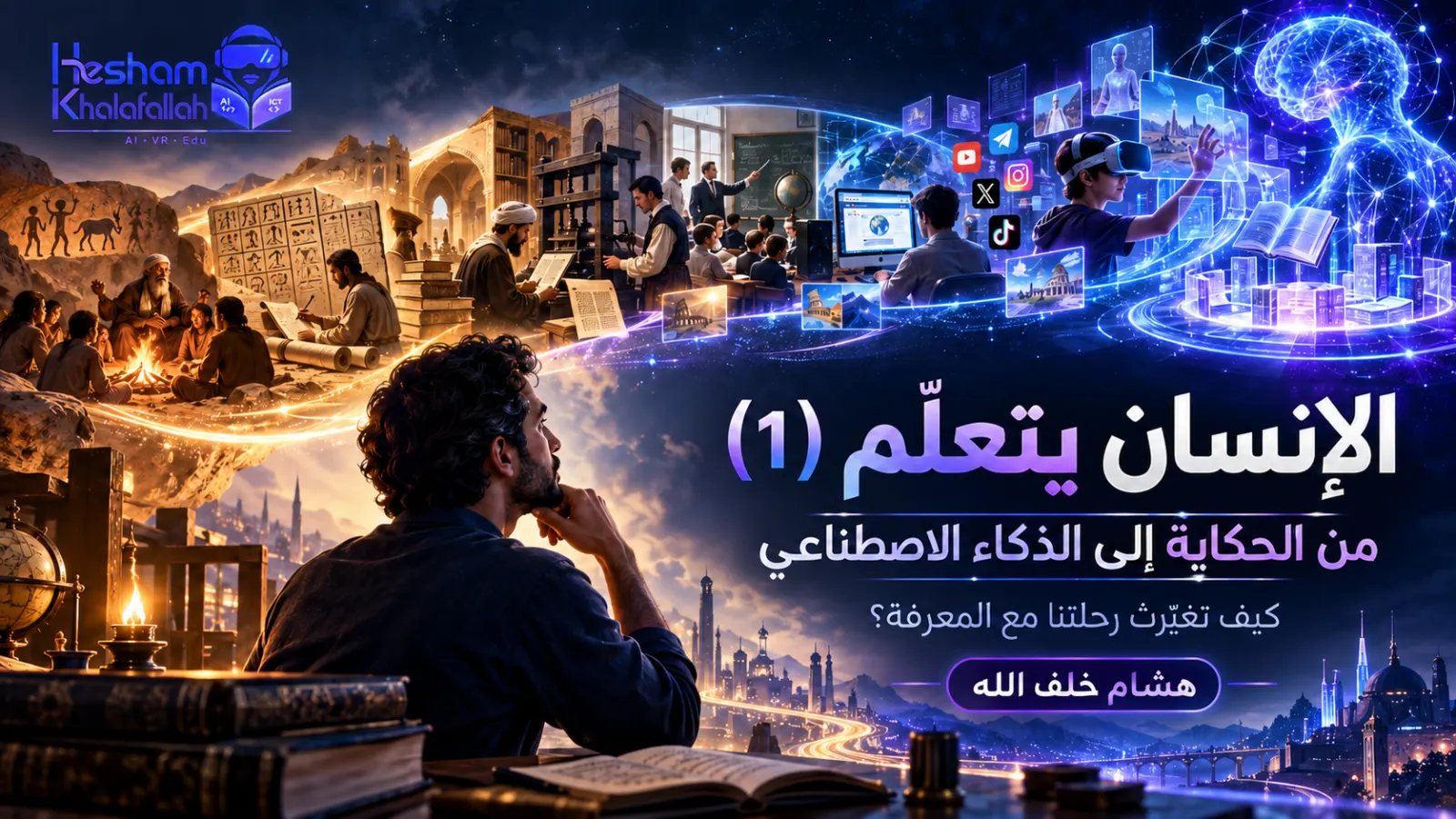
From storytelling to writing, from books to printing, from screens to the internet, and then to the digital world and artificial intelligence, it was never only the tools that changed. Human beings changed with them, along with the way we access and interact with knowledge.
And this is where the journey begins.
Whenever the way humans create, preserve, transmit, and access knowledge changes, the way we learn changes as well… and with every change in learning, human beings themselves change.
Before we reach artificial intelligence and the future of education, perhaps we need to return to the very beginning:
How did human beings learn before schools even existed?