
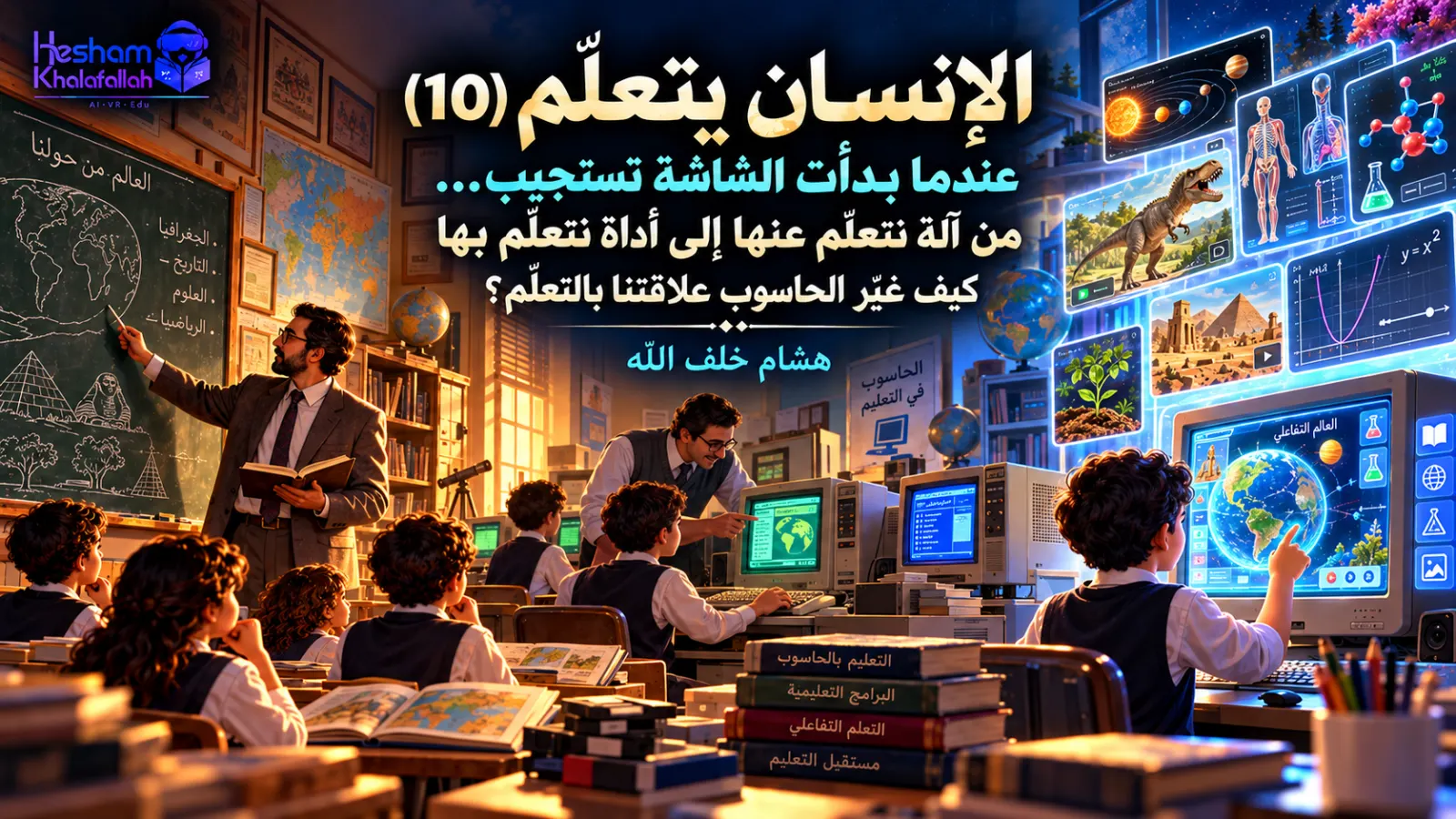
From Watching to Interacting
In the previous article, we added a new element to the education system: the educational medium.
Teachers could now use images, sound, film, television, and video to bring into the classroom parts of the world that words alone could not easily convey. Students could watch animals move, hear real sounds, and see experiments, cities, and natural environments instead of relying only on descriptions.
Yet the relationship with most of these media remained largely one-directional.
The medium presented.
The learner watched or listened.
Even when the content was excellent, the screen did not know who was sitting in front of it. It did not know whether the learner had understood, and it did not wait for an answer.
Then a different kind of device entered the picture.
It had not originally been designed to become a teacher, nor had it entered schools primarily so that we could learn through it.
It was the computer.
And with it, a new stage began, because the screen was no longer something we simply looked at.
It began responding to what we did.
When the Computer Was Not an Educational Tool
Today, it is easy to associate computers with education, research, and information.
But that is not how computers began.
Early computers were large, complex, and expensive machines designed primarily for calculation and data processing. They were used by scientific institutions, governments, universities, and companies in activities far removed from the everyday experience of ordinary students.
Nevertheless, very early attempts were made to explore the educational potential of computers. Around 1960, the University of Illinois began developing the PLATO system as an experiment in computer-based education. It could deliver educational content, receive learner responses, and provide feedback. Yet in its early stages, it remained an advanced and expensive system far from the daily reality of most schools.
This is an important point in our journey.
The appearance of an idea does not mean that it has become widely available.
A remarkable technology may exist in a laboratory or university for years before it reaches an ordinary child in an ordinary school.
The larger transformation began when computers became smaller and less expensive, particularly with the spread of personal computers from the late 1970s and early 1980s.
But even when computers entered schools, they did not immediately become tools we learned with.
In many cases, they first became something new that we had to learn.
At First… We Were Learning the Computer Itself
Many people from my generation may remember this stage.
The question was not yet: How can the computer help me understand science or mathematics?
The simpler question was:
What is a computer in the first place?
What is the monitor? What is the keyboard? What is the system unit? How do we turn the computer on? How do we open a program? How do we type? How do we save a file?
Sometimes we also learned how to use an operating system, enter simple commands, or understand the basics of programming.
This is how the computer lab became part of many schools, and computer studies became a separate subject, almost as though we were dealing with a new science that required its own room and equipment.
And that made sense.
How could we use a tool for learning if students and teachers did not yet know how to use the tool itself?
This is why I see the educational journey of the computer as a major transformation:
At first, the computer was something we learned about. Gradually, it became something we learned with.
We will see almost the same pattern with other technologies later.
First, we learn the tool.
Then we become comfortable with it.
Eventually, we almost forget that it was once new and begin using it to accomplish something else.
A New Element in the Education System: Interaction
This is where I believe the computer added something fundamentally different from the media that came before it.
Radio gave us sound.
Film and television gave us sound, images, and movement.
The computer added:
interaction.
For the first time, the relationship began to resemble a continuous loop:
The learner does something → the device responds → the learner sees the result → the learner takes another step.
A student types a word and something appears on the screen.
They answer a question and discover whether the answer is correct.
They choose from a menu and move to different content.
They change a value in a program and observe the result.
They make a mistake and try again.
This created a fundamental difference.
The screen no longer only said:
Look.
It also began to say:
Do something.
In my view, this was the real transformation the computer introduced into education.
The computer was not important to education simply because it added another screen. It was important because it allowed the learner to do something with knowledge and see the result of that action.
When Knowledge Became Something to Explore
Consider the difference between a printed map and a map inside a computer program.
A paper map shows you a place.
A digital map can allow you to search, zoom in, move between regions, and display different layers of information.
Now think about a scientific experiment.
A textbook can describe it.
A video can show it.
But a simulation can allow the learner to change one variable and observe what happens.
What if the temperature rises?
What if the speed changes?
What if we change the angle?
The learner is no longer only watching someone else’s experiment.
They begin to experiment themselves.
This does not mean that a simulation can always replace a real experiment. But it created a new type of learning, particularly where real experiments may be expensive, dangerous, or difficult to perform.
The same shift appeared in language, mathematics, writing, and drawing.
Programs began to present exercises, wait for answers, and provide immediate responses.
This was important because students no longer always had to wait for the teacher to discover whether their attempt had succeeded.
Technology began providing what we now call immediate feedback.
And the computer began taking on another function that had previously been closely associated with the teacher.
From Books and Video… to One Program That Could Bring Everything Together
Another important change followed.
In the previous article, the media were separate.
A book carried text and images.
A recorder carried sound.
A television carried video.
A calculator handled calculations.
A map might hang on the wall.
But gradually, the computer began bringing many of these things together in one device.
Text.
Images.
Sound.
Video.
Drawing.
Calculation.
Movement.
Interaction.
Then came CD-ROMs, digital encyclopedias, and educational software, making it possible to place large amounts of information and multiple media formats inside a single program.
I believe this was one of the important moments in the history of educational media.
We were no longer simply adding one new medium beside an older one.
We were beginning to see a medium capable of absorbing many of the others and bringing them together.
And it added something else:
the learner could choose what to explore.
This gave the learner more space within the learning experience.
Does Interaction Automatically Mean Better Learning?
Here we return to the approach we have followed throughout this series.
Every new solution creates a new possibility, but it also creates a new question.
The computer made interaction possible.
But:
Does every interaction mean learning?
Not necessarily.
A student can click dozens of buttons without understanding anything.
They can move quickly between images and screens without building deep knowledge.
An educational game may become so entertaining that the learner becomes more interested in winning than in understanding the concept the game was designed to teach.
This is why we must distinguish between two kinds of interaction.
There is interaction with the device.
And there is interaction with knowledge.
The first may mean clicking, choosing, dragging, and typing.
The second means thinking, connecting ideas, experimenting, understanding, changing one’s mind, or gaining a new capability.
So we can add another principle to our journey:
A high level of interaction with a screen does not necessarily mean a deep level of interaction with knowledge.
This is a natural extension of what we said in the previous article:
An attractive medium does not necessarily produce high-quality learning.
The tool may become more sophisticated, but the question remains the same:
What happened inside the learner’s mind?
And What Happened to the Teacher?
Once again, the teacher returns to the center of the story.
With books, images, and video, the teacher chose the medium and explained what it showed.
But computers could do more.
They could ask the learner a question.
Receive an answer.
Tell the learner whether the answer was right or wrong.
Calculate a score.
Present a new exercise.
And sometimes allow the learner to progress at an individual pace.
Naturally, the question appeared again:
If the device can do all of this, what remains for the teacher?
Yet, as with earlier media, the teacher did not disappear.
The nature of the role began to change.
The teacher now needed to know which program was appropriate, when to use it, which activity required a computer and which was better without one, how to notice a student who was interacting with the screen without understanding, and how to make what happened on the device part of a larger learning experience.
This gives us another lesson that will return as technology develops:
The more capable the tool becomes, the more complex the question of the teacher’s role becomes.
Technology does not only change what students can do.
It also changes what we expect teachers to do.
Does the Teacher Now Have to Become a Computer Expert Too?
This introduced a practical problem.
Teachers had already spent years learning their subjects and how to teach them.
Then a new device entered the classroom.
Now they were expected to know how to turn it on, operate software, and perhaps even solve basic technical problems.
Introducing computers into education was therefore never simply a matter of buying machines and placing them in schools.
It required preparing the human being who would use them.
This is an important lesson.
A school or government can purchase modern devices relatively quickly.
Changing teaching practice takes much longer.
It requires training.
Confidence.
Experimentation.
And the willingness to fail and try again.
This is why we should not automatically describe a teacher who does not immediately adopt a technology as resistant to change.
They may simply be facing a tool they have not been given enough time or training to understand.
This takes us back to what we said in the previous article:
The success of technology in education depends not only on what technology can do, but on the teacher’s ability to integrate it into learning.
And Who Owns a Computer?
The computer also introduced another challenge that had not been as visible with the chalkboard or textbook.
Cost and access.
A computer requires purchasing.
Electricity.
Maintenance.
Software.
Space.
Training.
One school may have a fully equipped computer lab, while another has only a few machines—or none at all.
One child may have a computer at home and use it for hours, while another may be able to touch one only once a week at school.
This added another dimension to educational equality:
access to technology.
This challenge remains with us today.
When we add technology to education, we may solve one learning problem while creating a new social question:
Can all learners access this tool to the same degree?
From here, the idea of the digital divide begins to become increasingly important.
From My Memories… When the Computer Felt Like a New World
I remember my early encounters with computers, when the device itself still felt new and exciting.
We did not look at it the way a child today looks at a smartphone or tablet.
First, we had to learn how to deal with it.
Typing on a screen, saving a file, opening a program, using the keyboard and mouse—each of these was a new skill in itself.
There was genuine curiosity about the machine:
What can it do?
Over time, the relationship changed.
We no longer used the computer only to learn about computers.
We began writing on it.
Drawing.
Calculating.
Using programs.
Exploring educational content.
The device that had initially been the subject of the lesson gradually became the tool carrying the lesson itself.
To me, this transformation matters more than the simple fact that computers entered schools.
Innovation does not happen simply when we place technology in the classroom.
It happens when technology begins changing what the learner is capable of doing.
Does Having Computers Mean We Have Improved Education?
Here we have to be careful.
A beautiful computer lab does not automatically mean that education has improved.
Very modern devices can be used to deliver exactly the same teaching method that was previously delivered through a textbook.
The computer can become nothing more than an electronic book.
Or a screen on which the teacher shows slides instead of writing on the board.
In that case, the tool has changed, but the learning experience may not have changed very much.
This remains deeply relevant today.
So it is not enough to ask:
Are there computers in the school?
We should ask:
What can the learner now learn or do because those computers are there that they could not do in the same way before?
This is where the difference begins to appear between digitizing education and improving learning.
We may simply move paper onto a screen without changing anything fundamental.
Or we may use technology to let the learner explore, experiment, receive feedback, and progress more effectively.
The tool may be the same.
The philosophy is different.
The Computer Changed the Relationship… But It Was Still an Island
By the end of this stage, something important had happened.
We had a device capable of combining text, sound, images, and video.
It could receive input from the learner.
Respond.
Provide exercises.
Calculate.
Simulate.
And make knowledge interactive.
But a major limitation remained.
The knowledge inside the computer was limited to what we had placed inside it.
A program.
A disc.
A file.
An encyclopedia.
If we wanted new information, we needed a new program, a new disc, or a new file.
The computer was powerful.
But in many cases, it was still an island.
Then something happened that would change not only the computer, but our entire relationship with knowledge.
These islands began to connect.
Your computer no longer contained only what you had placed inside it.
It began to reach another computer.
Then a network.
Then networks around the world.
Suddenly, the question was no longer:
What is inside this computer?
It became:
What can this computer reach?
And this is where the next stage of our “Human Learning” journey begins:
Human Learning (11): When the World Became Connected… How Did the Internet Change Our Relationship with Knowledge?