
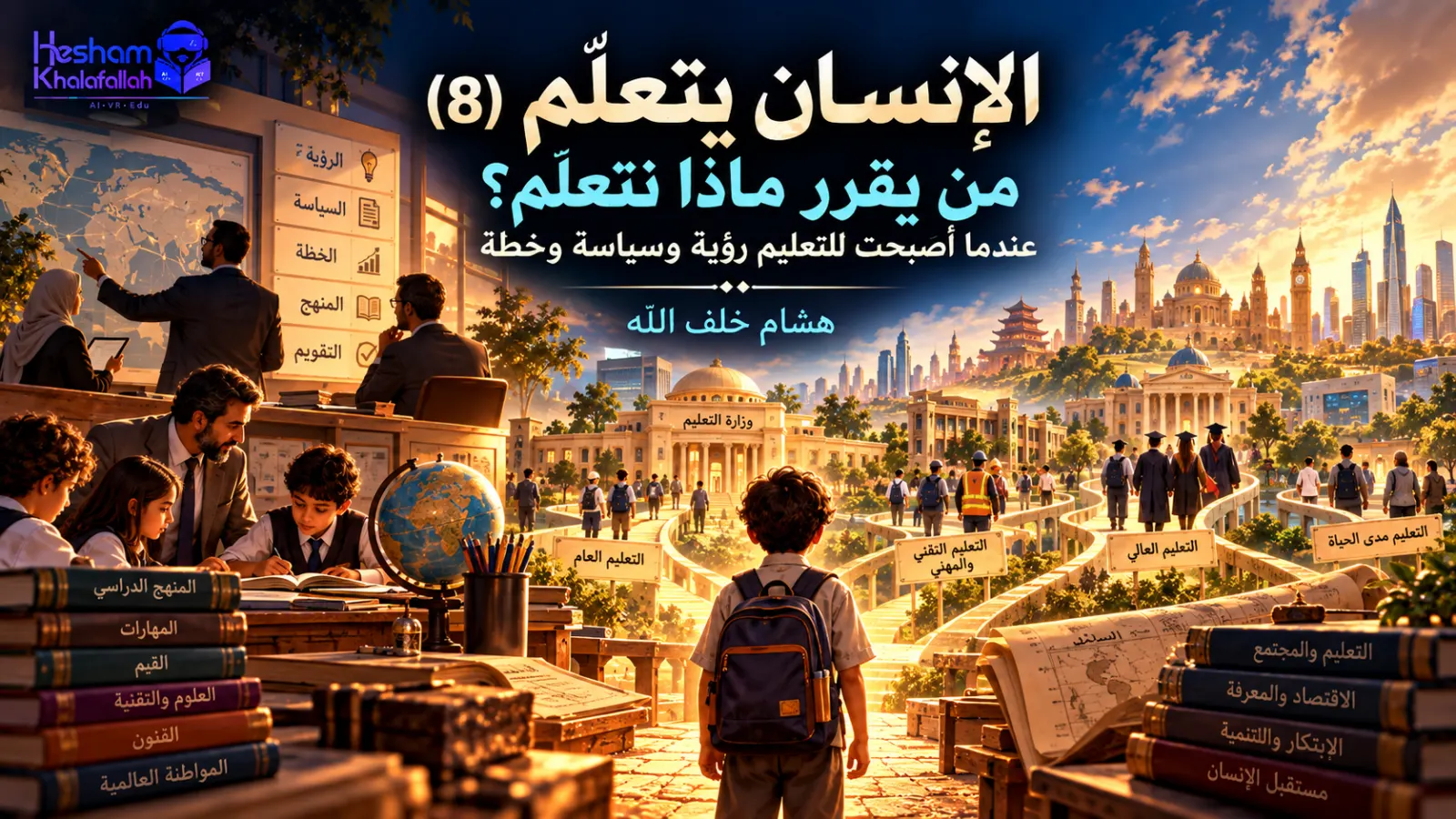
In the previous article, we tried to understand how the education system we know today took shape. We placed the learner at the center, then looked at the family and surrounding environment, the teacher who guides the learner, the knowledge to be acquired, and later the school, curriculum, teaching methods, assessment, and certification.
But when we put all these elements together, a larger question appears:
Who decided that the system should work this way in the first place?
The teacher enters the classroom and leads the educational process, but in most systems does not independently decide everything a student will study throughout their years of education. The school delivers education, but it does not determine by itself the number of school years, the stages of education, or the structure of examinations and qualifications.
Even the curriculum the student sees is not the starting point.
Something comes before it.
A vision that defines where we want to go, a policy that determines the direction, and planning that attempts to transform that vision into a system capable of functioning in reality.
This adds another element to the education system we have been building throughout this series:
educational vision, policy, and planning.
Before Asking What We Teach… Why Do We Teach at All?
Imagine a child entering school today.
They may spend twelve years or more within the education system and graduate into a world very different from the one they entered.
Before asking what they will study in mathematics, how many science lessons they will take, or which books they will read, perhaps we should first ask a more fundamental question:
What do we want this human being to become after all these years?
Do we simply want them to read, write, and calculate? Or do we want them to think, analyze, and solve problems?
Are we preparing them only for university, or also for life and work?
Do we want them to memorize knowledge or use it? Do we want them to discover their talents, learn how to learn, and adapt to a changing world?
These questions should come before the curriculum.
A curriculum is not merely a collection of lessons and textbooks. UNESCO treats curriculum as a central part of education because it influences what learners know, how they think, and the knowledge, skills, and values education systems seek to build.
This is why I like to summarize the idea this way:
The curriculum is what the student sees; the educational vision is what the student does not see, yet it determines much of what they do see.
The vision defines the goal. Policy defines the direction and rules. Planning attempts to translate all of this into schools, teachers, curricula, educational stages, assessment, funding, and implementation.
But successful education does not depend on how impressive the written vision sounds.
The real question is:
Did that vision actually reach the child inside the classroom?
Who Decides What the Child Learns?
In earlier and simpler forms of education, the teacher or experienced person could largely decide what to teach the learner in front of them.
But once education became a system serving millions of people, decision-making could no longer remain in the hands of one person.
Some institutions define broad goals. Others design curricula, determine standards, organize stages of education, and build assessment systems. Then schools and teachers translate all of this into the daily experience of the learner.
This also explains why two countries can teach the same mathematics while students experience education in very different ways.
The equations may be the same.
The way they are taught is not.
One system may rely heavily on direct instruction, while another emphasizes application, projects, and problem-solving. One may place great weight on a final examination, while another uses multiple forms of assessment.
So the question is no longer only:
What do we teach?
It is also: How do we teach it? When? Why? And how do we know that learning has actually happened?
This makes it clear that the teacher, despite being one of the most important elements in education, works within a system larger than themselves. A teacher can innovate, guide, and transform the student's experience, but cannot independently change the number of school years, abolish a national curriculum, or create a new educational pathway.
The teacher leads learning, but does not lead the entire system.
Why Is There No Longer One Educational Path?
As societies developed, another challenge appeared.
If people differ in their abilities and interests, and society itself needs different forms of knowledge and skills, is it reasonable for everyone to follow exactly the same path?
This is why different pathways gradually emerged: basic education, general education, academic education, technical and vocational education, followed by higher education and different specializations.
The principle itself makes sense.
Society does not need only doctors and engineers. It also needs technicians, skilled tradespeople, programmers, specialists, and hundreds of other professions and capabilities.
The problem begins when a difference in pathway becomes a difference in human value.
Academic education may begin to be viewed as socially superior simply because it is academic, while technical or vocational education is seen as the path of those who could not reach anything else—even when the learner has a genuine talent for it or when the economy badly needs such skills.
Here we return to an idea we discussed earlier:
Not every difference in pathway is a difference in value.
A successful system does not push everyone toward the same destination. It helps each learner reach a pathway through which they can build genuine knowledge, competence, and a meaningful future.
If Education Is Widespread… Why Are Its Outcomes So Different?
This brings us to what I consider one of the most important questions in education.
Schools now exist in most countries.
Universities are widespread.
Millions of people spend many years inside educational institutions.
But does the existence of a school automatically mean that learning has happened?
The World Bank has summarized the problem clearly: schooling is not the same as learning. Access to education has expanded dramatically worldwide, yet learning outcomes still vary greatly, and some students can spend years in school without acquiring the expected foundational skills.
The question therefore changes.
If two countries both have schools, teachers, books, curricula, and examinations, why might their educational outcomes still be very different?
There is no single answer.
Teacher preparation may be stronger in one place. The curriculum may be more connected to what the learner actually needs. Assessment may measure understanding rather than memorization.
Management may be better at identifying and addressing problems. Families may provide stronger support. There may be a closer relationship between schools, universities, and the labor market. Or the system may be better at transforming information into skills that people can actually use.
So having all the elements of an education system is not enough.
What matters is whether those elements work together in the same direction.
The real difference between one system and another is therefore not only the number of schools, the number of years of education, or the number of certificates awarded.
It is also:
What does the person know, how do they think, and what are they able to do after all those years?
Is Education the Reason Some Countries Progress?
When we look at the gap between developed and developing countries, it is easy to say that education is the reason.
I think the reality is more complex.
Education is not the only factor behind national progress. Economic institutions, health, infrastructure, investment, scientific research, and many other forces matter as well.
But education remains one of the foundations that builds the human being who operates all of these sectors.
Doctors, engineers, teachers, researchers, technicians, entrepreneurs, and administrators are all, in the end, outcomes of different learning and training journeys.
This is why international institutions consistently connect knowledge and skills with productivity, innovation, and economic growth.
The World Bank describes human capital in terms of the knowledge, skills, and health people accumulate that enable them to realize their potential and participate productively in society, while OECD research highlights how weak skill development or poor use of skills can waste talent and limit growth and innovation.
So for me, the question is not simply:
Does a country have education?
It is:
What does that education do to the human being?
Does it make them capable of thinking?
Can they produce new knowledge?
Can they solve problems?
Can they continue learning after leaving school?
Does what they learned become a real capacity for production and innovation?
A country does not progress merely because its citizens spend more years in school.
The challenge is turning those years into real human capital.
But Is the Solution to Keep Changing the Education System?
Another problem now appears.
When we discover that the system is not producing the results we want, the natural reaction is:
We need to change it.
But how often should it change?
And what exactly should change?
This question becomes very clear when I look at the Egyptian education experience in recent years.
Secondary education has seen repeated attempts to change assessment methods, introduce electronic examinations, digital resources, and tablets, with an announced intention to move from memorization toward understanding.
Some secondary-level subjects were later restructured. In 2024, for example, the Ministry of Education announced a redesign of Grade 10 content and reduced the number of subjects counted toward the final total from ten to six, followed by further changes to study and assessment arrangements in 2025/2026.
These developments make me ask something deeper than whether change itself is good or bad:
When does change become reform?
Introducing tablets is change.
Changing the number of subjects is change.
Changing the examination format is change.
Adding a digital platform is change.
But none of these automatically becomes reform simply because it is new.
Real reform requires a clearly defined problem, a vision of where we want to go, teachers who are prepared, infrastructure capable of implementation, and then measurement that tells us whether learning actually improved.
That is why I believe we must distinguish between the quantity of change and the quality of development.
Education does not improve because of how many things we change, but because we understand why we are changing them and then measure what that change actually did for the learner.
Stability or Renewal?
Sometimes we look at long-established systems such as England's and assume that their strength comes from remaining unchanged for decades.
But the reality is not that simple.
The English system itself has undergone major reforms to GCSEs and A-levels, including changes to subject content, assessment methods, qualification structures, and examination arrangements.
So the issue is not that one system changes while another does not.
The real question is:
How does change happen?
Do tools and methods evolve within a clear vision that remains stable for many years?
Or do the rules of the game themselves change so quickly that students, families, and teachers spend part of their energy simply trying to understand the new system?
A system that refuses to change may become disconnected from the world around it.
But a system that changes constantly without enough time for implementation and evaluation may lose the stability education needs in order to succeed.
So I do not think the answer is choosing between stability and change.
The better equation is:
Education needs a stable vision… and a system capable of evolving.
The vision remains anchored in the big questions: What kind of human being are we trying to help develop? What knowledge, skills, and values do they need?
Then curricula, tools, teaching methods, and assessment can evolve as the world changes and as evidence shows that certain approaches are no longer achieving their purpose.
When Vision Becomes Disconnected from Reality
Any country can write an impressive educational vision:
Creativity.
Critical thinking.
Innovation.
Digital skills.
Readiness for the labor market.
But what happens when the vision says “creativity” while the examination rewards memorization?
What happens when we ask teachers to develop thinking skills but do not give them enough time, training, or flexibility?
What happens when we purchase new devices while teaching methods remain exactly the same?
Or when we establish strong technical education pathways while society continues to treat them as less valuable?
This is where the real problem appears:
the gap between what the system says and what the learner actually experiences.
This may be one of the most important reasons educational outcomes differ.
A vision does not become real simply because it has been written in a document.
It becomes real when the student can experience it in the classroom, the teacher can practice it, assessment can measure it, and society can support it.
Only then do the different elements of education stop existing beside one another and begin functioning as a real system.
What Kind of Human Being Do We Want to Leave School?
This brings me back to the child who entered school at the beginning of this article.
They entered at around six years old and will leave many years later for a very different world.
Entire professions may change during that time.
New fields may emerge.
Some skills may disappear or become less important.
Some knowledge taught at the beginning of their education may even become outdated before they finish school.
So how do we plan their education?
I do not think the answer is simply to place as much information as possible into the curriculum.
Perhaps what matters more is helping the learner develop tools that allow them to continue learning even when the information itself changes.
To know how to search.
How to think.
How to question scientifically.
How to learn a new skill.
How to work with others.
How to use new tools without becoming dependent on them.
This reveals the deeper meaning of educational vision.
Education does not begin with the question: What should we put in the textbook? It begins with the question: What kind of human being do we want to be capable of facing the future after that textbook is closed?
At this point, we can understand something important in our journey.
We have now built an education system that includes the learner, the family, the teacher, knowledge, school, curriculum, teaching methods, and assessment. Then we added vision, policy, and planning to help all these elements move in the same direction.
Only now are we ready to begin talking about technology.
Not as a goal.
And not on the assumption that placing a new device in a classroom automatically means we have improved education.
But as a new tool entering an already existing system.
From this point forward, the question will no longer be:
What is the latest technology we can put in a school?
Instead, it will be:
What educational problem are we trying to solve, and what role can technology play within a system whose first goal is human learning?
Because no matter how advanced the tool becomes, it cannot compensate for the absence of vision.
And this is where the next stage of our “Human Learning” journey begins:
What happened when sound and images entered the classroom, and knowledge was no longer only read and explained—but could also be seen and heard?