
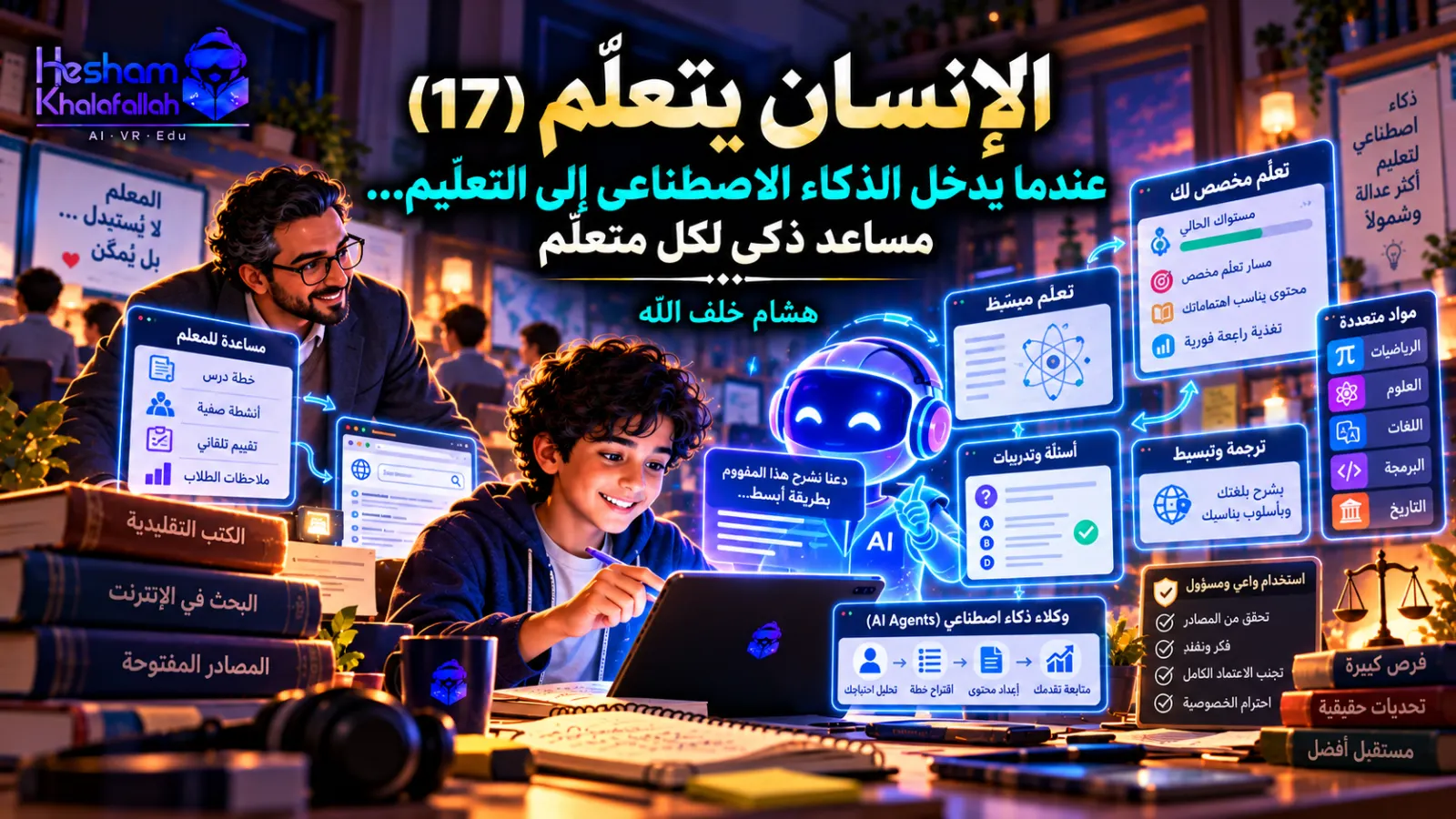
I Feel I Have Seen This Scene Before
Whenever I follow the current debate about artificial intelligence in education, my memory takes me back to the early spread of the Internet.
I clearly remember the concerns. Can students use the Internet as a source? What if the information is wrong? Will they abandon books? Will students simply copy answers? How will teachers know whether students wrote the work themselves? Will easy access to search make students rely less on their memory? And will the teacher become less valuable if students can access information on their own?
These were real questions, not simply resistance to change. Some of them are still with us today.
But the Internet did not disappear. Instead, it became part of education, work, and daily life. Gradually, we learned that the real issue was not the existence of the Internet itself, but how we use it, how we verify what we find, and what role should remain human when a new tool opens new doors.
Today, I feel we are standing in front of the same scene again.
But this time, the tool is different.
The Internet used to say:
These are the places where you may find the answer.
Artificial intelligence says:
Ask me… and I will try to answer you now.
Every new technology that enters education brings back the same question in a different form: should we reject it because it carries risks, or should we learn how to use it in a way that increases human capability rather than reducing it?
From the Encyclopedia… to the Search Engine… to Artificial Intelligence
To understand the scale of this transformation, it may help to remember how we used to reach information.
When I use an encyclopedia, I go to content prepared by authors or editors and search within a knowledge structure that has already been organized. The encyclopedia gives me written and edited information about a subject.
Then came the search engine.
I no longer needed to know where the information was located. I typed a few words, and the search engine scanned a huge number of pages before showing me links, results, and sources.
At that point, more responsibility shifted to me.
Which link should I open? Which source should I trust? Is the information current? Is the source specialized?
Generative AI added another step.
I do not only ask it to show me where the page is.
I can say:
Explain this topic to me. Simplify it. Compare two ideas. Give me an example. I still do not understand—explain it again. Turn this explanation into questions. Test me. Change the difficulty level. Explain it in the language I understand.
And this is the fundamental difference:
An encyclopedia gives me content to search within, a search engine helps me find sources, while generative AI can build a new answer with me inside an ongoing conversation.
But this same ability creates a new risk.
A search engine usually shows me the source in front of me, while an AI model may give me a highly coherent answer without making it immediately clear where every detail came from—and some of those details may be inaccurate.
So search skills do not become less important.
Perhaps verification skills become even more important.
What Does “Generative AI” Actually Mean?
For a long time, artificial intelligence worked in the background of many systems without us speaking directly to it.
Recommendation systems. Data analysis. Automated correction. Predictions. Classification.
Generative AI made the relationship much more visible because it can produce text, images, audio, software, and other forms of content in response to a user’s request.
This wave is different from many earlier waves of educational technology because these tools are easy to use, widely available, and often accessible outside the direct control of the educational institution.
And that matters.
A school may decide whether or not to purchase a platform.
But a student may already be using an AI tool on a phone before the school has even finished discussing its policy toward it.
Once again, technology is moving faster than the institution.
When the Machine Could Ask: “How Should I Explain It to You?”
Perhaps this is where the real educational transformation begins.
In a traditional classroom, one teacher stands in front of a group.
There may be twenty, thirty, or more students.
One understands immediately. Another needs an example. A third needs to return to an earlier concept. A fourth understands better through a visual. A fifth needs a harder challenge to avoid becoming bored.
A good teacher tries to respond to these differences, but time is limited.
Artificial intelligence opens a different possibility.
A student can say:
I did not understand.
And receive another explanation.
Then say:
Give me an example from football.
And the examples change.
Another student can say:
I already understand the basics. Give me something more advanced.
And receive a different level.
Here, an old educational idea comes closer to large-scale application:
Personalized Learning.
Personalized learning has long been an educational ambition; artificial intelligence is beginning to make some forms of it more scalable.
But we should not jump from this sentence to the conclusion that AI knows the learner in the same way a teacher does.
It only knows what we give it, what appears within the interaction, and whatever data the system is allowed to use.
There is a major difference between a system that knows data about a student and a human being who knows the student.
From One Lesson for Everyone… to Different Explanations of the Same Lesson
Here, a very important possibility appears.
In the traditional model, we design one lesson and present it to a group.
With artificial intelligence, the learning goal can remain the same while the route toward it changes.
A simplified version. A more advanced version. Different examples. Additional exercises. Questions based on previous mistakes. Translation. Audio explanation. Review of an earlier concept.
This is somewhat different from Adaptive Learning systems that existed before the current wave of generative AI.
An adaptive system might notice that you answered a question incorrectly and then offer an easier question or an earlier lesson selected from pre-prepared content.
Today, the system may be able to generate a new example, a new explanation, or a new dialogue at that very moment.
Personalization no longer means only selecting the right content from a prepared library; it is beginning to mean generating explanations, activities, and interactions that change with the learner’s needs.
We move from:
the same education for large numbers of students
toward a new possibility:
the same learning objective… but different pathways for different learners.
Does Every Student Now Have a “Private Teacher”?
The idea is tempting.
We might say that the student now carries a teacher who can answer at any time.
Two in the morning?
Ask.
After school?
Ask.
Before an exam?
Ask.
There is no embarrassment in asking the same question ten times.
There is no fear in saying:
I did not understand even the simplest part of the lesson.
This can be extremely valuable.
A student who cannot afford private tutoring may gain access to a form of continuous support. A shy learner can ask questions freely. A learner who wants a greater challenge can request one.
Still, I prefer to describe it more carefully as an intelligent learning assistant or a learning companion, rather than assuming that it is a complete replacement for the teacher.
Education is not just about answers.
A teacher observes. Encourages. Builds relationships. Understands the social environment. Notices when a student has lost confidence. Sometimes understands that the real problem is not the lesson at all.
This is why the emerging relationship in education is increasingly being discussed as one between teacher–AI–learner, rather than a simple replacement of the teacher.
If the Student Has an Intelligent Assistant… So Does the Teacher
This may be one of the areas that most changes the teacher’s everyday work.
Think about how much time teachers spend preparing:
Questions. Exercises. Examples. Summaries. Activities. Different versions of a test. Supporting materials. Explanations for different levels. Lesson plans. Initial feedback.
Artificial intelligence can help with many of these tasks.
A teacher can ask:
Give me five additional examples. Turn this text into an activity. Create questions at three levels. Suggest a visual way to explain this concept. Simplify this material for a student who needs support. Suggest a group activity. Help me build a rubric for assessment.
But one word is important here:
Help.
It should not replace the teacher’s judgment.
AI may generate twenty questions in seconds.
But the teacher still needs to ask:
Are these questions appropriate? Do they measure the right learning objective? Is one of them incorrect? Is the language level suitable? Are there biases? Does this activity actually serve my students?
Artificial intelligence can help teachers produce educational tools quickly, but judging the educational value of those tools remains a human responsibility.
The Teacher May Not Be Losing a Role… but Gaining an Assistant
I prefer to look at this from another angle as well.
For years, we have said that teachers are overloaded with too many tasks.
If there is now a tool that can save time by preparing draft materials, suggesting activities, generating questions, or converting content into different formats…
perhaps the better question is not:
Will AI take the teacher’s role?
But:
Which tasks can AI reduce so that teachers have more time for the things machines cannot do well?
More time for dialogue.
For observation.
For students who need support.
For thinking about learning design.
For projects.
For the human relationship.
The best use of AI in education may not be to make the teacher less important, but to free the teacher from some of the work that prevents them from practicing their most human roles.
Then Another Concept Appeared: AI Agents
The development did not stop with systems that wait for us to ask a question and then answer.
There is now growing attention around AI Agents.
The difference matters.
When I use a generative model in a simple way, I say:
Write. Explain. Summarize. Answer.
An intelligent agent, however, can be designed to work toward a goal, plan a sequence of steps, use permitted tools and information, and then continue following the task.
Imagine a student saying:
I want to learn the basics of programming within one month.
An educational assistant built in this way could begin by assessing the learner’s level, propose a plan, divide it across days, provide activities, follow progress, adjust the difficulty according to performance, and review areas of weakness.
We move from:
a machine that answers me
to:
a system that can help me manage a learning journey.
Generative AI can converse with the learner; an intelligent agent opens the possibility of helping plan and follow parts of the learning journey itself.
This is exciting.
But it also makes questions of privacy, oversight, accuracy, and responsibility much more important.
When the Answer Becomes Too Easy… What Happens to the Attempt?
This is the educational issue that concerns me most.
Years ago, when students wanted an answer, they sometimes had to search.
Open more than one source.
Read.
Compare.
Try.
Today, they can type a question and receive a well-organized answer within seconds.
This is excellent when the answer becomes a pathway to understanding.
It becomes a problem when the answer becomes a substitute for thinking.
If a student faces a problem and immediately asks AI to solve it completely…
who practiced the thinking?
If the system writes the entire essay…
who learned how to write?
If it completes the project…
what did the student actually learn from the project?
When the answer becomes extremely easy to obtain, the new educational challenge may be how to preserve the value of trying.
So we should not ask only:
Did the student use AI?
We should ask:
How did the student use it?
Did they ask for the answer, or a hint?
Did they copy, or discuss?
Did it make them think less?
Or did it help them understand something they could not understand before?
Artificial Intelligence Can Help You Think… or Think Instead of You
The difference between the two may lie in a very simple request.
One student says:
Solve the question.
Another says:
Do not give me the answer. Ask me questions that help me reach it.
The same tool.
Two completely different learning experiences.
The first learner may get a faster result.
The second may get more learning.
A new skill appears here.
Not only Prompt Engineering in its technical sense.
But the ability to ask AI for help in a way that preserves your own role in thinking.
The educational value of AI does not appear when it performs the task instead of the learner, but when it helps the learner become more capable of performing the task independently.
For me, this is one of the most important principles for using AI in education.
But AI Can Sound Confident… Even When It Is Wrong
There is another risk that should not be underestimated.
Generative AI systems can produce answers that sound natural, organized, and highly convincing.
But they can still be wrong.
They can mix things up.
They can generate inaccurate information.
They can present a source or detail in a way that sounds more confident than the evidence justifies.
This is different from a poorly designed web page that immediately makes me suspicious.
Artificial intelligence can present an error beautifully.
That brings back one of the central skills from earlier articles:
verification.
In the age of AI, it is not enough for learners to know how to ask a question; they must also know when to doubt the answer and how to verify it.
Critical thinking and the responsible evaluation of AI outputs are becoming essential learner skills.
Is the Same Thing Happening Again as with the Internet?
To a large extent, yes.
When the Internet arrived, some people feared that students would stop reading books.
Then we learned that the Internet can lead to a book.
To research.
To a university.
To a library.
And also to bad content.
The Internet was neither completely good nor completely bad.
The result depended on how it was used.
AI is bringing back the same scene in a more powerful form.
It can help a student who cannot afford private tutoring.
It can help another student cheat.
It can open knowledge to someone in their own language.
It can give inaccurate information.
It can save the teacher time.
It can make the teacher overly dependent on it.
It can encourage a student to think.
It can offer the shortest path that allows the student to avoid thinking.
The problem with educational technology is rarely only what the tool can do; it is also what we decide to let it do inside the learning process.
So Should We Ban It from School?
This question also reminds me of what happened with the smartphone.
When the phone entered the classroom, the easiest answer was:
Ban the device.
Today, we see a similar debate around artificial intelligence.
But if students will live and work in a world that uses AI, is the role of education to pretend that the tool does not exist?
Perhaps it is better to teach them:
When to use it.
When not to use it.
How to disclose its use.
How to verify its output.
What they should do themselves.
What information they should not enter into it.
And what the limits of dependence on it should be.
The important point is that AI literacy in education must include technical understanding, responsible use, ethics, human judgment, and appropriate educational design.
Therefore:
Learners do not only need to learn with artificial intelligence; they also need to learn how to use artificial intelligence without stopping their own learning.
And Homework? Perhaps the Old Question Is No Longer Enough
This is one of the most difficult issues.
If the assignment is:
Write a one-thousand-word essay about a topic.
And AI can produce the essay in seconds…
what exactly are we measuring?
Should we ban the tool?
Perhaps in some activities, yes.
But perhaps we also need to rethink the activity itself.
We can ask the student to discuss what was written.
Explain why they chose an idea.
Review an AI answer and identify its mistakes.
Compare sources.
Produce a project.
Defend an argument.
Document their process.
Explain where AI was used and what they changed themselves.
Here, artificial intelligence forces us to return to an old question:
How do we know that learning actually happened?
Artificial intelligence is not only changing how education is delivered; it is forcing us to rethink how we know whether the learner has actually learned.
And perhaps this is not only a problem.
It may also be an opportunity.
We may discover that some old assignments measured the student’s ability to produce a piece of paper more than their ability to understand.
What About Privacy and Fairness?
If a system is going to personalize learning, it may need data.
The student’s level.
Mistakes.
History.
What they have read.
What they did not understand.
Sometimes, more sensitive information.
This creates another question:
How much should the tool know about a child in order to help them?
Who owns the data?
How long is it stored?
Can the student delete it?
Can it be used for other purposes?
Then there is fairness.
One student may use a powerful paid model.
Another may not have a suitable device.
Or good connectivity.
Or content in their language.
And so we return to a principle that has followed us throughout this series:
Every technology that closes one gap may create another if we do not think carefully about who can access it and how it is used.
So the idea of “personalized education for everyone” should not become a technological promise alone.
Will the Teacher Disappear?
I think we are now able to answer this question more thoughtfully than we could at the beginning of the series.
When books appeared, teachers did not disappear.
When video appeared, they did not disappear.
When the Internet appeared, they did not disappear.
But their role changed each time.
Artificial intelligence may push this transformation even further.
If a machine can provide a definition more quickly and perhaps more clearly…
the teacher’s value is not in memorizing the definition.
If a machine can generate twenty questions…
the teacher’s value is not in writing questions faster.
If a machine can explain the same concept in five different ways…
the competition between teacher and machine should not be about who talks more.
The teacher’s value may increasingly lie in:
Choosing the objective.
Designing the experience.
Understanding the learner.
Observing progress.
Building motivation.
Managing dialogue.
Setting ethical boundaries.
Connecting knowledge to life.
Deciding when AI should be used…
and when the student should be required to think alone.
When the machine became capable of explaining and answering, the teacher’s value became even greater in identifying the right question, the right context, and what the learner must still do independently.
The educational relationship is therefore becoming less like a simple line between teacher and learner and more like a triangle involving teacher, AI, and learner.
From “One Teacher for a Group”… to the Possibility of a Different Experience for Every Learner
Perhaps this is the greatest transformation.
Printing allowed the same content to reach large numbers of people.
School allowed one teacher to teach a group.
Radio and television expanded the audience.
The Internet made knowledge global.
Artificial intelligence offers a different possibility.
One million learners may study the same topic…
but not necessarily in the same way.
One may need a story.
Another a diagram.
A third a practical example.
A fourth a harder challenge.
A fifth may need to go one step backward.
For the first time at this scale, the challenge may no longer be how to deliver one good lesson to millions of students, but how to help millions of students reach the same objective through learning experiences that respond to their differences.
Personalized learning then becomes larger than a platform.
It becomes a new way of asking a very old question:
If every human being learns at a different pace, in a different context, and sometimes in a different way, why do we always assume that one method should work equally well for everyone?
But Do Not Let Artificial Intelligence Learn Instead of You
This is what I most want to remain from this article.
I do not believe we should treat artificial intelligence as an enemy of education.
And I do not believe we should become so fascinated by it that we hand over the entire learning process.
The tool is powerful.
The opportunities are real.
The risks are real too.
Perhaps the new skill we need to teach our children and students is:
How to work with artificial intelligence while keeping the human role in thinking, choosing, and taking responsibility.
AI can be:
A teaching assistant.
A coach.
A brainstorming partner.
A translator.
An editor.
A teacher’s assistant.
A practice tool.
A way to personalize learning.
But every time, one question should remain:
Does this tool make the learner more capable after using it… or more dependent on it?
The best educational AI is not the one that gives students the greatest number of answers, but the one that helps them become more capable of reaching answers, understanding them, and critically evaluating them on their own.
Perhaps the lesson of the Internet is repeating itself once again.
The real value was never simply having access to the Internet.
It was learning how to use it.
And the value of artificial intelligence will not lie in its ability to answer everything…
but in what human beings become capable of doing and learning when they know how to work with it.
In the next stage, we will no longer remain in front of knowledge on a screen—even if that screen is intelligent and capable of conversation.
We will begin to enter knowledge itself.
What happens when the learner can stand inside a historical site, manipulate a three-dimensional model, or conduct an experiment inside a world that does not physically exist?
And this begins the next stage of our Human Learning journey:
Human Learning (18): When the Learner Entered Knowledge… How Did Virtual and Augmented Reality Change the Learning Experience?