
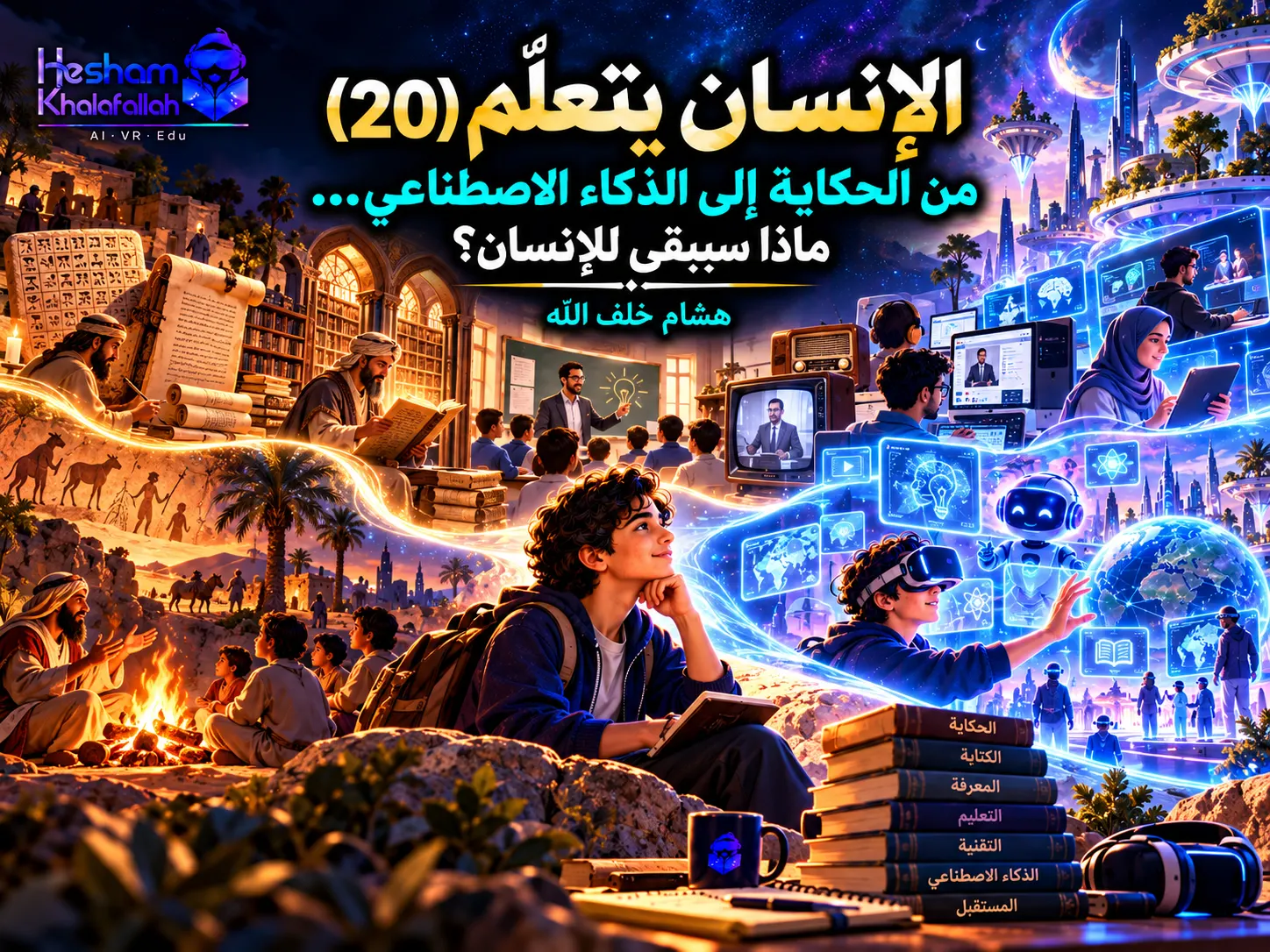
The Journey Began Before We Called It “Education”
Before schools, human beings learned from other human beings.
They watched.
Imitated.
Asked questions.
Listened to stories.
Experimented.
Made mistakes.
And tried again.
There was no written curriculum in the modern sense, no platform, no online exam, and no certificate.
But one essential thing already existed—and it has not changed:
A human being wanted to understand the world.
Then tools began to appear, one after another.
Each tool expanded what humans could know.
And each tool also changed how humans learned.
When Knowledge Gained a Memory
Writing transformed our relationship with knowledge.
Experience no longer had to disappear when its owner died.
An idea written today could be read hundreds of years later.
Then came the book, gathering knowledge into a form that could be revisited.
The library gave knowledge a home.
Printing allowed the same text to reach far more people.
With every step, knowledge became more capable of traveling through time and space.
But something else was happening at the same time:
Human beings no longer had to carry everything in memory alone.
Part of memory moved into the medium.
Onto tablets.
Onto paper.
Then into computers.
Then onto the Internet.
And today, into systems that can retrieve, summarize, and reproduce knowledge within moments.
The more capable our tools become at storing and retrieving knowledge, the more important it becomes to know what to do with that knowledge when it reaches us.
Then Knowledge Became an Institution
With school, education was no longer only an informal relationship between one person and another.
There was a place.
A schedule.
A teacher.
A curriculum.
Stages.
Exams.
Certificates.
And a system designed to transfer knowledge to large numbers of people in an organized way.
That was an enormous achievement.
But every system brings a paradox.
The more we try to educate large numbers of people, the harder it becomes to treat every learner as completely unique.
The classroom needs a shared schedule.
The curriculum needs an order.
Assessment needs standards.
And so dozens of students may learn in nearly the same way, even though they are not the same.
It took technology many years to reopen an old question:
Should everyone learn in the same way?
When Technology Entered… Education Did Not Change at the Same Speed
Audio and visual media entered education.
Then computers.
Then the Internet.
Then platforms.
Then the smartphone entered the learner’s hand.
The tools changed quickly.
Education did not always change at the same speed.
This is why one important question emerged throughout this series:
Are we using technology to transform learning, or are we merely using digital tools to deliver traditional education?
We can have a digital textbook.
An online classroom.
An electronic exam.
A modern platform.
And still preserve the same philosophy of learning.
This led me to one of the most important ideas in this journey:
Education does not change simply because technology enters the classroom; it changes when the relationship between learner, teacher, and knowledge changes because of it.
Then the Classroom Moved Beyond Its Walls
The Internet changed something deeper than access to information.
It changed the idea of place.
Learners no longer had to be physically located with the teacher.
Then came global platforms, open courses, professional certificates, and specialized content. A person could learn from a university, a company, or an expert on another continent.
Then social networks appeared, and almost everyone gained the ability to become a publisher.
Then smartphones and tablets became part of daily life, placing a learning tool in our pockets.
The question was no longer:
Is there somewhere I can learn?
It became:
Can I turn all this access into real learning?
Access to knowledge does not necessarily equal the ability to learn from it.
A new role for the learner appeared.
The learner no longer waited for an institution to choose everything.
They increasingly had to choose.
Verify.
Organize.
Decide what to learn.
When.
And from which source.
Then the Machine Began to Explain
Artificial intelligence entered education differently.
The tool was no longer simply a library or a search engine.
It began to converse.
Explain.
Explain again.
Summarize.
Generate examples.
Ask questions.
Test.
And provide different content to different learners.
An old educational ambition came closer:
Can every learner receive some form of support tailored to their needs?
But this possibility created a challenge we had not faced at this scale before.
What happens when the machine can perform the same task the student is supposed to perform?
If it writes the essay.
Solves the problem.
Summarizes the book.
Builds the presentation.
Are we helping the student learn?
Or helping them avoid learning?
This is why one principle has become essential to me:
The educational value of artificial intelligence does not appear when it performs the task instead of the learner, but when it helps the learner become more capable of performing the task independently.
When the Learner Entered Knowledge
Then came extended reality.
The learner was no longer limited to looking at a screen.
We began to imagine entering a laboratory.
A historical site.
A factory.
A simulation environment.
And learning from inside the experience itself.
We realized that distance education did not only need to move the lecture.
Sometimes it needed to recreate place, practice, and experience.
But experience also taught us that a beautiful virtual world is not education by itself.
We may build an extraordinary three-dimensional environment and then place a traditional lecture inside it.
We may change the appearance of the classroom without changing learning.
So the same question remains:
What does the learner actually do inside the environment?
Do not begin by designing the virtual world; begin by designing what you want the learner to do inside it.
Then the System Began to See the Learner Through Data
As digital environments expanded, learning began to leave a trace.
We could increasingly know:
Where the learner stopped.
What they repeated.
Where they made mistakes.
What they mastered.
How much time they needed.
And which path they followed.
This created a new possibility:
Instead of waiting until the exam to understand the student, we could try to understand the learning journey while it was happening.
But once systems began to see the learner more clearly, another question appeared:
Does understanding the data mean we understand the human being?
Not always.
The data may tell us that the student was late.
It may not tell us why.
It may tell us they stopped.
It may not tell us what happened in their life that day.
It may know their grades.
It does not know their dream.
The more a system knows about the learner, the greater our responsibility becomes not to forget that behind the data is a human being who cannot be reduced to data.
So… What Remains Human?
If a machine can remember more than we can.
Search faster than we can.
Generate text, images, and software.
Explain.
Translate.
Analyze data.
And perhaps in the future organize parts of the learning journey itself…
what remains for us?
In my view, that is slightly the wrong question.
Human value was never based on competing with our tools at the tasks those tools were designed to perform better.
We did not lose our value when calculators became faster at arithmetic.
We did not lose it when search engines became faster at finding information.
The value moves to another level.
Why are we calculating?
What are we searching for?
Which information should we trust?
What is worth creating?
What should we refuse to create even if we can?
These are not questions of speed.
They are questions of judgment, meaning, and responsibility.
Curiosity… Perhaps More Important Than Knowledge Itself
Knowledge will become easier to access.
But no tool can force a human being to be curious.
We may stand before the largest library in history and fail to ask a single question worth exploring.
We may possess the most powerful artificial intelligence and use it only to obtain the fastest answer possible.
Learning begins before the answer.
It begins when we ask:
Why?
What if?
Is this true?
Is there another way?
Education in the future should perhaps not measure only how much a student knows.
It should also ask:
Do they still want to know?
One of the greatest dangers technology can create for learning is not only giving us wrong answers, but making us lose the desire to ask questions.
Critical Thinking… When the Answer Looks Beautiful and Convincing
In the past, an error sometimes looked like an error.
Today, an answer can be beautifully written.
Organized.
Confident.
Persuasive.
And still be inaccurate.
This is why it is not enough to teach our children how to search.
Or how to use AI.
We must also teach them how to doubt constructively.
How to review.
How to compare sources.
How to ask for evidence.
How to say:
I do not know yet.
Perhaps the ability to admit that we do not know will become one of the most important skills in a world where machines can produce an answer to almost anything.
A strong learner in the age of artificial intelligence is not the one who gets the fastest answer, but the one who knows when the answer is not enough.
Creativity… Is Not Simply Producing More
Artificial intelligence can produce.
Texts.
Images.
Ideas.
Designs.
Suggestions.
But human creativity is not merely the production of something new.
Creativity also asks:
Why am I making this?
What problem am I trying to solve?
For whom?
In what context?
What gives the idea meaning?
A machine may generate one hundred ideas.
The human being decides which one deserves to become real.
The meaning of creativity may therefore shift.
From producing the greatest number of ideas…
to choosing the idea with value, developing it, and connecting it to human life.
Ethical Judgment… What Should We Do, Not Only What Can We Do?
The more powerful technology becomes, the more important this question becomes.
We may be able to collect more data about a child.
But should we?
We may be able to monitor every step a student takes.
But is that good education?
Artificial intelligence may be able to make a decision.
But should we allow it to make the final decision?
We may be able to simulate almost anything.
But does everything deserve to be simulated?
Technology often answers the question:
Can we?
Ethics asks:
Should we?
The future of education will not only need people who know how to use technology, but people who know when to place limits on it.
The Ability to Learn… Perhaps the Most Important Skill of the Future
In a rapidly changing world, the most important human advantage may not be knowing the greatest number of facts.
It may be the ability to learn something new when needed.
To abandon an old method when it no longer works.
To rebuild skills.
To begin again.
This is the idea of lifelong learning that has appeared throughout this series.
It is no longer simply an attractive slogan.
It has become a real necessity.
Tools may change.
Professions may change.
Platforms may change.
Required skills may change.
But a human being who knows how to learn can continue moving with change.
In a world where knowledge changes continuously, the ability to learn becomes more important than relying only on what we learned in the past.
Will the Teacher Remain?
After twenty articles, I think the question is no longer:
Will the teacher disappear?
A better question is:
What kind of teacher will we need?
If information is available everywhere, the teacher’s value will not lie only in possessing it.
If a machine can explain, the teacher’s value will not lie in speaking more than the machine.
If a platform can mark an exercise, the teacher’s value will not lie only in assigning the grade.
The teacher’s value will increasingly lie in what cannot easily be reduced to an algorithm:
Knowing the human being in front of them.
Discovering potential.
Encouraging.
Asking the question that changes the learner’s way of thinking.
Saying, at the right moment:
You can do this.
And eventually helping the learner become less dependent on the teacher.
The best teacher is not the one who makes the learner permanently dependent on them, but the one who gradually helps the learner become capable of learning independently.
And What About School?
It may change.
It may become more flexible.
Less tied to a single place.
More connected to projects and experiences.
A student may sometimes join from home.
Sometimes from a virtual environment.
Sometimes from a physical laboratory.
They may have a human teacher and an AI assistant at the same time.
But I do not believe the deeper value of school should disappear.
Because school is not only a place where information is transferred.
It is also where human beings learn how to live with other human beings.
How to wait their turn.
How to disagree.
How to cooperate.
How to lose.
How to succeed.
How to build relationships.
Even in the most advanced digital environments, there will still be a need to learn how to be human with other humans.
The Future Is Not Human Versus Machine
I do not believe this is the right battle.
History tells a different story.
Humans create tools.
Tools change humans.
Then humans learn to redefine their role.
The question was never really:
The book versus the teacher.
The computer versus the school.
The Internet versus the book.
And I do not believe the future should be:
The human versus artificial intelligence.
The better question is:
How can humans work with machines without losing the qualities that make human capability meaningful?
A machine may be faster.
But speed is not always the objective.
It may produce more.
But production is not valuable by itself.
It may know more.
But knowledge without judgment is not enough.
The strongest future is neither a human without technology nor technology without humans; it is a more capable human who knows how to use technology without allowing it to reduce their humanity.
The Curriculum of the Future… What Should We Teach?
Perhaps we need to rethink the question itself.
Instead of asking only:
What should the student memorize?
We should also ask:
How do they learn?
How do they verify?
How do they think?
How do they deal with what they do not know?
How do they use artificial intelligence?
How do they protect their data?
How do they work with others?
How do they create something?
How do they explain an idea?
How do they change their mind when stronger evidence appears?
How do they make an ethical decision when there is no ready-made answer?
This does not mean basic knowledge is no longer important.
Quite the opposite.
We cannot think critically about something we know nothing about.
But knowledge becomes the beginning of thinking, not its end.
Perhaps the Meaning of Success Must Change Too
Is the successful student the one who received the highest grade?
Perhaps.
But what about another student who became more curious?
More capable of working with others?
More independent?
Better at asking questions?
More willing to learn something new?
More responsible in their use of technology?
Can one grade see all of this?
Perhaps the future of education needs a broader definition of success.
Not only:
What does the student know?
But also:
What can they do?
How do they think?
How do they learn?
And how responsibly do they use what they know?
The Human at the Center… Not the Technology
Throughout this series, we have discussed many tools.
Books.
Printing.
Schools.
Computers.
The Internet.
Platforms.
Smartphones.
Artificial intelligence.
Extended reality.
Data.
But I do not want the end of this series to be about any one of them.
Because the tools will change.
In the years ahead, technologies may appear that we have not discussed here—and perhaps have not yet been invented.
If we begin with the technology every time, we will spend our lives running after it.
It is better to begin with the human being.
What does the learner need in order to understand?
To grow?
To find opportunity?
To become capable of learning independently?
Then we ask:
Which technology can help us do that?
The learner is not simply one element within the educational system; the learner is the reason the entire system should be built.
After Twenty Articles… What Actually Changed?
The tools changed.
Speed changed.
Access changed.
Place changed.
The teacher’s role changed.
Sources of knowledge changed.
The meaning of certification changed.
The classroom changed.
We can now converse with machines, enter virtual worlds, and see traces of the learning journey through data.
But one thing has remained present from the beginning:
The human being wants to learn.
A person may learn from a mother.
A father.
A teacher.
A book.
A screen.
A community.
An experience.
Or an artificial intelligence system.
But real learning does not happen inside the tool.
It happens inside the human being.
Perhaps this is also the most important thing I have learned from this journey.
Technology can change the way knowledge reaches us, but it cannot remove our responsibility for what we do with that knowledge once it arrives.
Perhaps This Was Never Only a Series About Education
When I began writing about how human beings learn, it first appeared to be a journey through the history of education.
Gradually, I realized the question was larger.
Every change in the way we learn changed something in the way we live.
Writing changed memory.
Books changed access.
School changed society.
The Internet changed place.
The smartphone changed behavior.
Artificial intelligence is beginning to change the relationship between humans and knowledge itself.
So perhaps this series was never asking only:
How did education evolve?
Perhaps it was always asking:
How does the human being change when the way they learn changes?
Human Learning… and Humans Will Continue to Learn
I do not know what school will look like fifty years from now.
I do not know what devices will look like.
I do not know which artificial intelligence models we will use.
I do not know whether we will still use the word “metaverse” for digital environments.
But I believe something will remain.
There will still be a child who sees something for the first time and asks:
Why?
There will still be a human being who tries something, fails, and tries again.
There will still be a teacher, a parent, a friend, or someone who says to another person:
Let me explain it in a different way.
Knowledge will continue to move.
To grow.
To change form.
And every generation will add something new.
This is the essence of the whole story.
Whenever the way humans produce, preserve, and transmit knowledge changes, the way they learn changes. And whenever the way humans learn changes, the human being changes too.
And so, after all the tools, technologies, and questions we have explored, I return to the simplest sentence with which this journey can end:
Human beings learn.
And they will continue to learn…
as long as they continue to ask.