
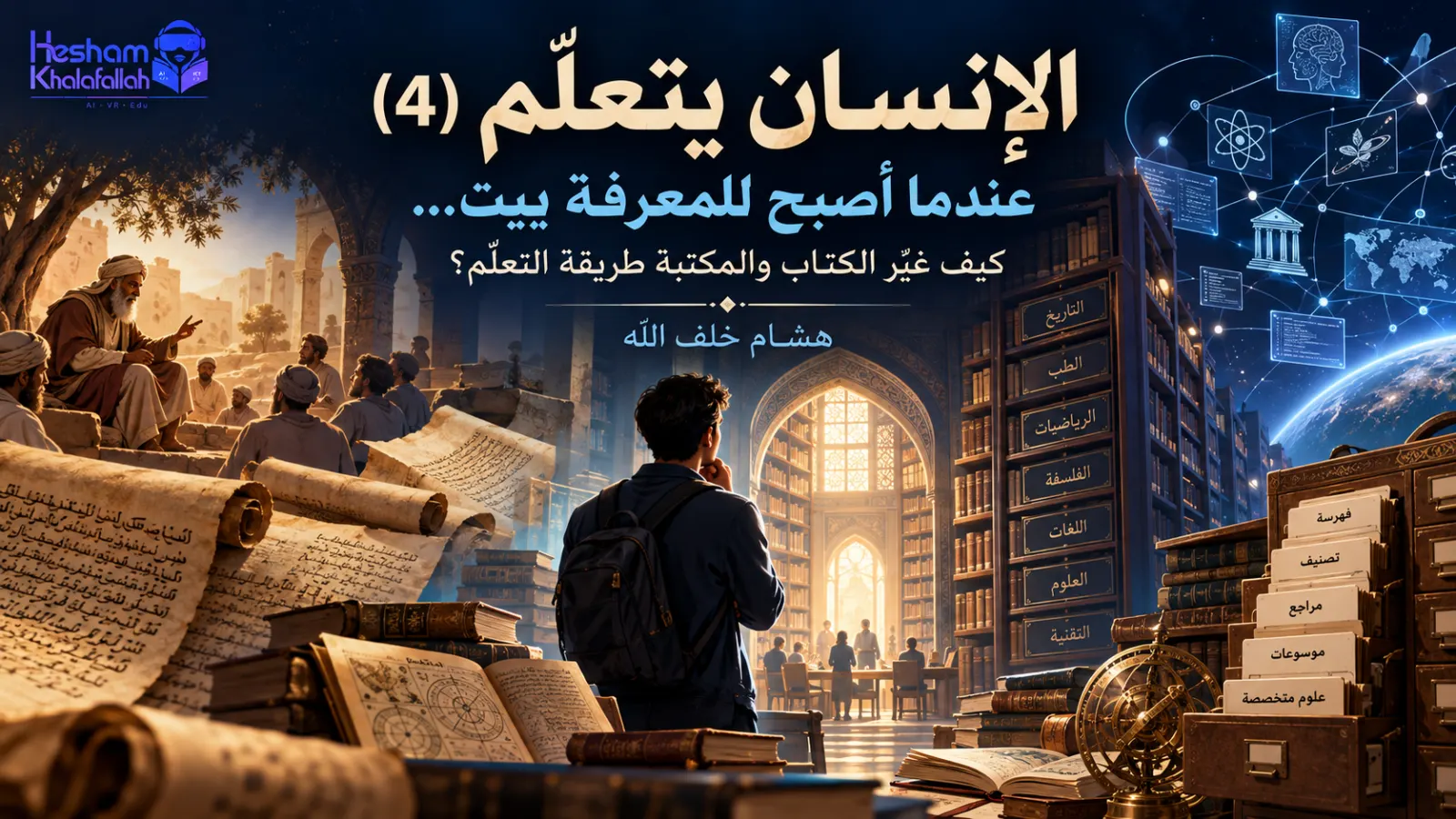
In the previous article, we reached a turning point in humanity’s relationship with knowledge. Human beings had learned how to move part of what they knew outside their own memory and place it into symbols and texts that could survive after them.
But solving the problem of forgetting created a new problem.
The more people wrote, the more texts accumulated: laws, calculations, stories, observations, experiments, remedies, ideas, and knowledge passed from one generation to another.
The question began to change. It was no longer only: How do we preserve knowledge?
It became: Where do we put all this knowledge? How do we reach what we need? And how do we know whether what has reached us is actually true?
This marked a new stage in the story of learning. Human beings were no longer the only source of knowledge. There were now books, manuscripts, libraries, catalogs, and sources that could be consulted again and again.
When the Source of Learning Changed
In the earliest stages, people learned mainly from those around them: family, experienced individuals, teachers, elders, and those who had lived through something before them. The main source of knowledge was another human being.
Then writing appeared, making it possible to learn from someone who was not physically present. Books and manuscripts made that knowledge easier to preserve, carry, and transmit.
This created an important shift in the history of education: a source of learning appeared that could be revisited repeatedly.
A person could read an idea, return to it, review it, compare it with another idea, and pause over what they did not understand. If people once learned mainly from the memory of others, they could now also learn from written memory.
But the existence of a text did not necessarily make learning easy. A book might be far away, only a few copies might exist, or the learner might not even know where to look for it.
Access to knowledge itself became part of the learning process.
As written material increased, people needed places to collect and preserve it. The library gradually became more than a place where books were stored. It could be seen as an attempt to build an organized collective memory for society.
Books made knowledge portable. Libraries made it collectible. But once hundreds or thousands of texts were gathered together, another question emerged: how do we find what we are looking for?
This created the need for organization, classification, and indexing. One text belonged to medicine, another to mathematics, another to language, astronomy, history, or philosophy.
It was no longer enough to preserve knowledge. We also had to know where it was and how to reach it.
I do not think this principle has changed very much today.
From my own experience with libraries, part of learning was not simply reading a book. It was finding the book in the first place: looking through shelves, identifying the right section, and sometimes asking someone who knew the library better than I did.
Searching itself was part of learning.
Today, the tool has changed. The shelf became a database. The catalog became a search engine. A question once asked to a librarian may now be asked to a search engine or an AI system.
But the underlying problem remains:
Knowledge exists… so how do I reach the right knowledge?
When the Question Became: Can We Trust What We Read?
As texts and books increased, another problem emerged—one no less important.
Not everything that is written is correct.
Errors can occur while copying a manuscript. A text may be attributed to someone who did not write it. Scholars may disagree in their interpretation of the same phenomenon. An idea may spread for years before later evidence shows that it was inaccurate.
So the question was no longer only: Where can I find knowledge?
A new question appeared:
Can I trust it?
Over time, different civilizations developed forms of comparison, review, criticism, and verification of texts and sources. Human beings began to understand something important:
The existence of information does not automatically make it true.
Here, it is important to distinguish between two things.
Verification asks: Is this information correct? What is its source? What evidence supports it?
Censorship asks a different question: Should this idea or text be allowed to circulate at all?
Throughout history, societies and authorities have practiced forms of censorship for political, religious, or social reasons, while scholars and researchers were also developing better ways to criticize, compare, and verify knowledge.
That challenge has not disappeared. Its tools have simply changed.
In the past, the problem might have been whether a manuscript had been copied accurately. Today, false information can reach millions of people within minutes. We may also need to ask whether what we are seeing is an original source, whether it is authentic, or whether it has been manipulated, reproduced, or generated by artificial intelligence.
This reveals a principle that will return repeatedly throughout this journey:
The easier knowledge becomes to publish, the greater the responsibility to evaluate it.
When Knowledge Became Too Large for a Single Field
At the same time, knowledge itself was expanding.
Human beings did not simply preserve what earlier generations had discovered. They read it, added to it, and passed it forward for others to add more.
As observations, experiments, and texts accumulated, different fields of knowledge became clearer: medicine and healing, mathematics, astronomy, language, nature, architecture, philosophy, and others.
The sciences did not suddenly appear at one moment, nor were their boundaries always as rigid as they are today. But as knowledge accumulated, people increasingly needed to organize it into fields that could be studied and understood more effectively.
This directly influenced education.
In many historical periods, a scholar could move between more than one field. In the Islamic civilization, for example, figures such as Ibn Sina, Al-Razi, and Ibn al-Haytham are well known for contributions that extended across several branches of knowledge.
This does not mean that specialization did not exist. But its boundaries were often less rigid than they are today, and knowledge could be viewed more as an interconnected network than as a collection of separate islands.
Knowledge, however, continued to grow.
The deeper one field became, the more difficult it was for a single person to grasp everything humanity had learned.
Specialization therefore became increasingly necessary.
It allowed people to reach levels of precision and depth that might otherwise have been impossible.
But like every solution in this journey, it created a new challenge.
Today, we may know an enormous amount about a very small part of the world while becoming less able to see how that part relates to the larger picture.
That raises an important question for modern education:
Do we want to produce specialists only, or educated human beings who can connect their specialization to the world around them?
I do not believe the answer is to return to the past and expect every person to become a physician, philosopher, engineer, and astronomer at the same time. The scale of knowledge today makes that almost impossible.
But I also do not believe that good education should trap a person inside a narrow specialization.
Perhaps the better model is to have real depth in one field, together with enough breadth to understand and communicate with other fields.
Many new ideas emerge precisely where disciplines meet: when medicine meets technology, education meets psychology, engineering meets artificial intelligence, or art meets virtual reality.
We may not be able to know everything.
But we should not lose the ability to see that knowledge is interconnected.
When the Means Becomes More Important Than the Goal
This brings me to one of the ideas I consider most important in this series.
All of these tools and systems originally appeared to make learning easier: writing to preserve knowledge, books to gather it, libraries to protect it, indexing to help us find it, classification to understand its fields, and specialization to allow us to go deeper.
But sometimes the means becomes the goal.
We may become more concerned with the curriculum than with learning, with the certificate rather than knowledge, with the exam rather than understanding, and with specialization rather than the ability to think and connect ideas.
This is why I believe we must always distinguish between education and learning.
Education is what we build through schools, curricula, institutions, policies, and tools designed to transfer knowledge and develop skills.
Learning is what actually happens inside the human being—in their understanding, their way of thinking, and their ability to use what they know.
We can have a highly organized education system while genuine learning remains limited.
At the same time, a person may continue learning through reading, work, experience, and conversation even outside formal educational institutions.
This does not mean that curricula, policies, or institutions are unnecessary. On the contrary, they are essential when education must serve millions of people.
But the question must always remain:
Were these systems designed to serve learning, or has the learner become the one expected to serve the system?
In my view, the societies most capable of progress are not only those that build more educational institutions, but those that make learning a natural part of their culture and daily life.
A person should be able to ask without fear, read without waiting for an exam, learn outside their specialization, change their mind when better evidence appears, and understand that education does not end with a certificate.
The Same Problem… in New Forms
If we look at the journey so far, we can see a recurring pattern.
Storytelling transmitted knowledge, but memory was limited. Writing preserved knowledge, but required literacy. Books gathered knowledge, and libraries expanded the ability to preserve it, but organization and indexing became necessary. The accumulation of knowledge created clearer disciplines and deeper specialization, but made it harder to see the bigger picture. And the growth of written information made evaluating its reliability increasingly important.
Every stage solved a problem… and then created a new challenge.
Perhaps this is why I do not believe that today’s educational problems are entirely new.
The tools have changed. The speed has changed. The volume of information has changed.
But many of the fundamental questions remain:
Where is knowledge?
How do I reach it?
How do I know whether it is correct?
What do I need to learn from it?
And how do I use what I have learned?
This is why I believe understanding the history of learning is not about returning to the past, nor about proving that everything new is better.
It is about understanding why each tool appeared, what problem it tried to solve, and what new challenge it created.
Because once we understand that journey, we can ask a better question about education today:
What do we actually want human beings to learn, and what is the best way to help them learn it?
Yet books and libraries, for all they achieved, still faced one major limitation.
Books were copied by hand. A single copy could require enormous time and effort, and important knowledge might exist while remaining accessible to only a limited number of people.
A new question therefore emerged:
What if we could produce hundreds or thousands of copies of the same knowledge?
Then the book itself would not be the only thing to change.
The number of people able to learn from it would change as well.
And this is where the next stage of our “Human Learning” journey begins:
The story of printing.