 Hesham Khalafallah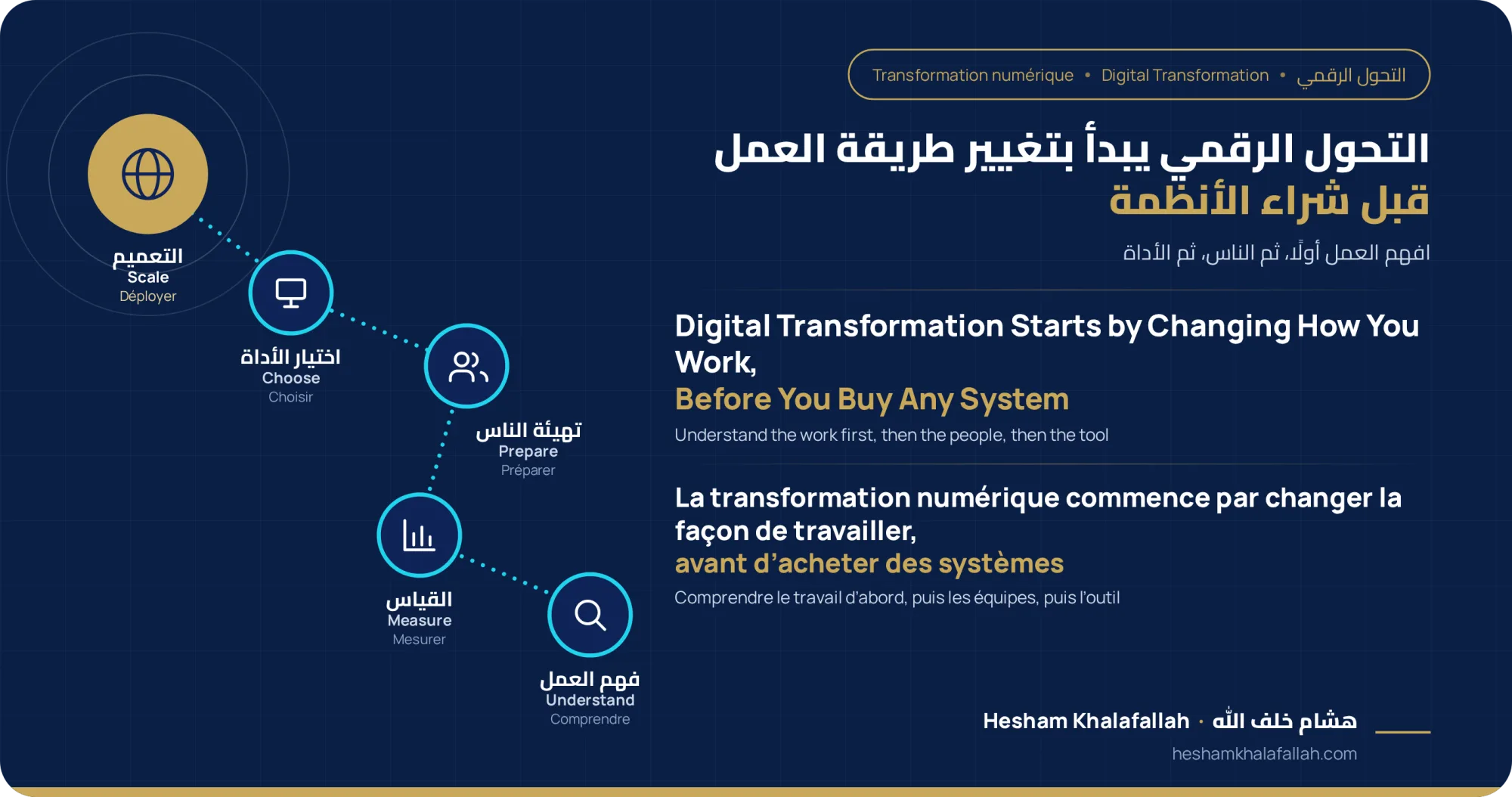
Summary: Why do most digital transformations fail even when the system is ready? Because the work itself did not change. Practical steps that start with understanding and measuring the process, then preparing people, and only then choosing the tool, with a real case from Ford.
When an organization decides to go digital, the first step is very often to look for a system. Meetings are held with vendors, offers are compared, and the most impressive solution is chosen. Months into implementation the same scene repeats: the system is ready, but the work has not changed. Paper files still circulate, approvals still arrive late, and employees drift back to their old spreadsheets.
This scene is not an exception. In a global McKinsey survey run in January 2018 with 1,793 participants, only 16% said their organizations’ digital transformations had improved performance and sustained that improvement over the long term[1]. Another 7% said performance improved but the gains were not sustained. In traditional sectors such as oil and gas, automotive and pharmaceuticals, success rates fell between 4% and 11%.
The figure has limits. It rests on the participants’ own assessment, and a transformation counted as successful only if they rated it “very” or “completely” successful at both improving performance and sustaining it, which is a demanding standard. So the number does not mean that 84% of projects failed; it means that only a minority achieved an improvement that lasted and that its own leaders were convinced by. Its value is that it shows the size of the gap between launching a system and actually changing the work.
The reason is simple: digital transformation is not about buying tools, it is a change in the way we work[4]. A tool, however good, does not fix a broken process; it speeds up the fault and makes it more expensive.
Automation does not fix chaos
If a process goes through five unnecessary steps, automating it means performing the same five steps faster. If responsibilities are unclear, the new system will not decide who is accountable; it will display the confusion on an elegant screen. Michael Hammer argued as early as 1990 that we should rethink the process itself instead of automating it as it is[2]. So the real work starts before choosing any platform: draw how work is actually done today, where time is lost, and what can be removed altogether.
A real case: Ford. The problem: Ford’s accounts payable department in North America (paying supplier invoices) employed more than 500 people, while Mazda’s equivalent department had just five. Most of the effort went into matching the purchase order, the receiving document and the invoice across 14 data items, and then chasing every discrepancy.
The change: Ford did not simply automate this matching; it removed the reason for it. Purchasing entered each order into an online database, receiving checked the same database when goods arrived, and payment was released without waiting for a supplier invoice, with matching reduced to three items instead of 14. The result: a 75% reduction in headcount in the department, where conventional improvement methods would have delivered about 20%[2]. Technology was the means of carrying out the new process, not a substitute for designing it.
Start with questions, not demos
Before you ask any vendor for a proposal, try to answer these questions honestly:
• What exactly is the problem we want to solve, and how will we know we have solved it?
• Who will use this solution every day, and did they take part in designing it?
• Which steps do we perform today that add no value?
• Is the data we will rely on accurate and well organized?
• Who will own the change after the project ends?
These questions often reveal that a large part of the solution is organizational, not technical.
Let the data reveal the problem and judge the solution
Do not rely on impressions to decide what needs to change. Request logs (start date and completion date) show where waiting piles up, the number of returns and corrections shows where errors occur, and the volume of requests on each path shows where effort is worth spending first. The numbers often reveal that the problem is not where everyone thinks it is.
After the pilot, compare the results with the same figures recorded before the change, not with a general feeling, and you will know whether the solution really worked. If the data is incomplete or scattered across many files, cleaning it is the first step of the project, and may be one of its most valuable outcomes.
People before systems
The hardest part of any digital transformation is habit. An employee who has mastered the old way will not give it up just because senior management decided so. Change succeeds when people understand why the work is changing, when they take part in shaping the new way, and when they see tangible results in the first weeks[3]. That is why the training and follow-up budget is no less important than the license budget.
Start small and measure
There is no need to transform the whole organization at once. Pick one clear process, such as receiving requests, tracking attendance or internal approvals, and follow these steps:
1. Analyze the process. Map the steps as they are actually performed, not as the manual says, and record for each step who does it, how long it takes, and how often it is redone because of an error. Mark the steps that add no value for the user or the organization.
2. Choose performance indicators. Three or four indicators tied directly to the problem are enough, such as time from request to completion, error and rework rate, cost per transaction, and user satisfaction. Record their current values before any change so they become your baseline.
3. Redesign and test. Remove what has no value and simplify what remains on paper, then test it with a small team for a fixed period, six to eight weeks for example.
4. Define the right system. Turn what you learned into a list of requirements (what the tool must do to serve the new process), compare vendor offers against that list, and ask to trial the system on your own process before signing.
5. Measure and scale. Compare the indicators with the baseline. If they improved, roll out to other departments; if not, review the design before you review the tool.
This way you buy what you actually need, not what impressed you in the presentation.
Does this mean we should not buy technology?
Of course not. Technology is a powerful enabler when it is in the right place[5]. The point is that it should come third, not first: understand the work first, then prepare the people, then choose the right tool. When the foundation is sound, any reasonable platform can deliver good results; when it is weak, the most expensive system on the market will not save it.
Conclusion
Digital transformation is a journey that starts with the question “How do we work?”, not “What do we buy?”. Those who begin by understanding their process and preparing their team save time and money, and reach a result that lasts longer than any license.