
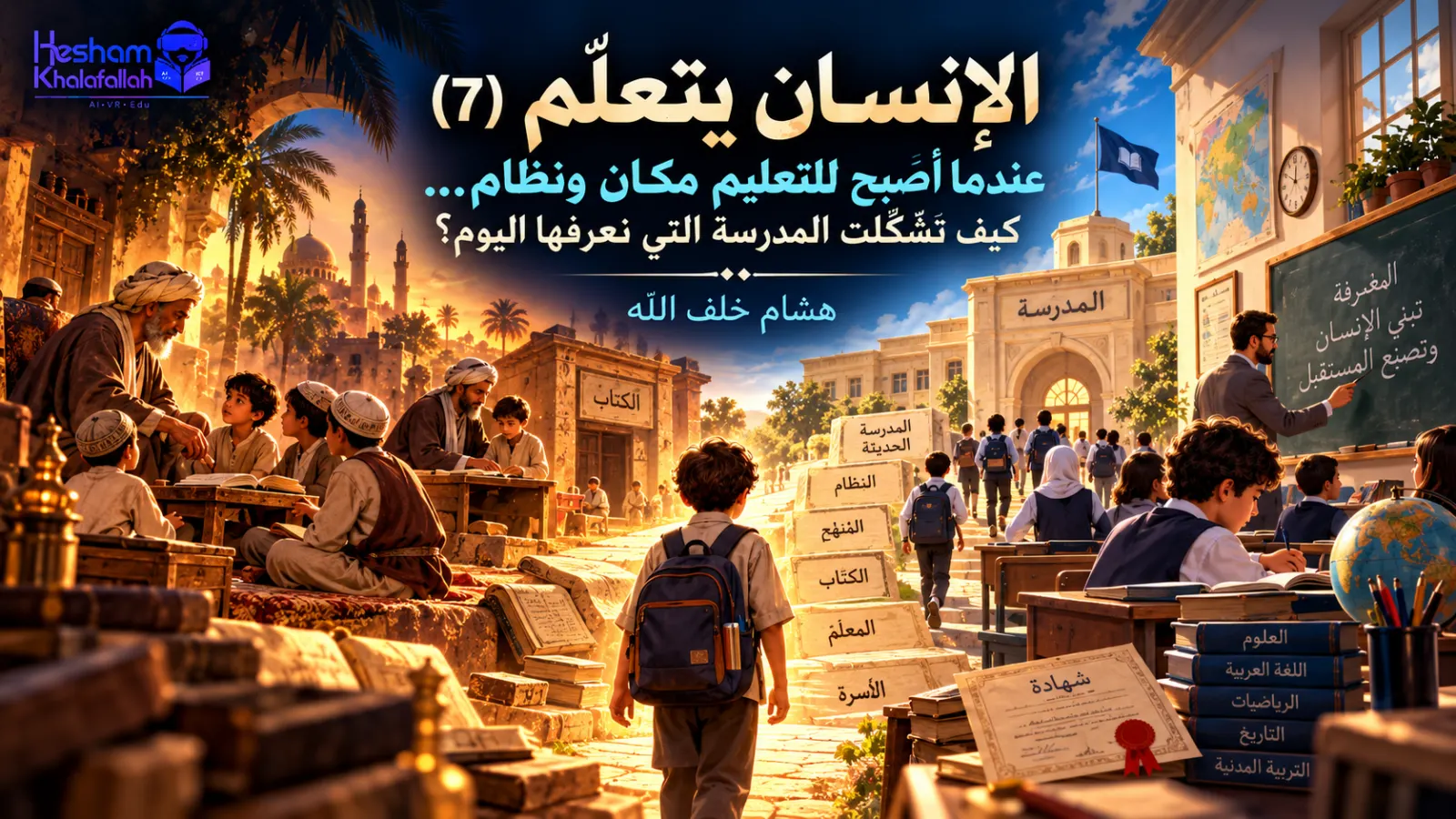
In the previous article, we distinguished between education and learning. We saw that people can learn through life, work, craft, and experience, and that a certificate or years of schooling alone cannot fully represent everything a person knows or is capable of doing.
But when societies decided that education should reach larger numbers of people, a different challenge appeared:
How do we organize the learning process itself?
How do we bring learners together? Who teaches them? What should they learn? At what age? Who determines the content? And how do we know whether they have actually learned?
From this point, the school began to evolve, and with it the education and learning system we know today gradually began to take shape.
Before There Was a School… There Was a Simpler System
If we return to the beginning of our journey, we find that learning, in its simplest form, revolved around only a few elements.
At the center was the learner: the child or individual who wanted or needed to acquire knowledge or a skill.
Around the learner were the family and the social environment. From them, the child learns language, behavior, values, and often develops curiosity—or sometimes loses it. They shape a large part of the learner’s first relationship with knowledge.
Then comes the teacher, guide, or person with experience. This did not necessarily mean a professional teacher in the modern sense. It could have been a father, mother, craftsman, scholar, religious teacher, or simply someone who had already gone through the experience the learner was trying to understand.
Finally, there was what the person needed to learn: hunting, agriculture, language, arithmetic, religion, a craft, or another form of knowledge.
We can summarize this original core as:
Learner + Family and Environment + Guide + Knowledge.
These elements have never disappeared.
What changed was that society gradually began to add new layers of organization around them.
When Education Gained a Place
Across civilizations, people learned at home, at work, in workshops, in places of worship, in learning circles, and in different institutions created by societies to educate their children.
In Arab and Islamic societies, there were kuttab schools, learning circles, mosques, and madrasas. Other civilizations developed models connected to temples, monasteries, the state, or professions.
The form was not the same everywhere, but the need was similar:
a place, a time, and an organized relationship that helped the learner acquire knowledge.
As the number of learners increased, organization became increasingly necessary.
If you are teaching one or two children, you can respond to each of them directly. But when you want to educate hundreds of thousands, and later millions, you need schools, teachers, books, schedules, stages, and a system that can be repeated.
At this point, the school was no longer simply a place where learning happened.
It began to become an institution that managed the process of education.
When the “System” Entered Education
This was a major transformation.
In a simpler model, the teacher might personally decide what the learner needed to know, in what order, and when to move on to another topic.
But when education became the responsibility of an entire society or state, it was no longer practical for each teacher to decide independently what every child should learn.
A new element appeared:
the education system.
A curriculum or general framework began to define what students should study. Stages organized the sequence of knowledge. Timetables organized time. Teaching methods emerged. Assessment systems were introduced. Certificates began to confirm the completion of particular levels.
The education system expanded.
We no longer had only the learner, family, teacher, and knowledge. We now also had:
school, curriculum, teaching method, assessment, certification, and an organizational framework connecting all of these elements.
And this leads to an important idea:
The education system did not appear fully formed at once. Every stage added a new element to solve a problem created by the expansion of education.
Why Do Education Systems Differ If the Sciences Are the Same?
This raises an interesting question.
Mathematics does not become a different science because it is taught in a British, American, or French system.
The fundamental laws of physics and chemistry do not change because of the country in which the student lives.
So why do education systems differ?
Because the difference is not always in the knowledge itself, but in how a society organizes the learner’s journey through that knowledge.
Systems may differ in when a topic is introduced, how content is sequenced, how much emphasis is placed on projects or examinations, how students are assessed, how long educational stages last, what role teachers play, and what kind of certificate students receive.
This helps us distinguish between several important questions:
What do we learn? is a question about knowledge and curriculum.
How do we learn? is a question about teaching methods and the learning experience.
How do we know that we have learned? is a question about assessment.
How does society recognize what we have learned? is a question about certification and accreditation.
So it is not enough to say that a country teaches mathematics or science.
What also matters is how the learning experience around those subjects has been designed.
When Age and Stages Became Ways of Organizing Learners
Today, we consider it perfectly normal to say that one child is in Grade 3 and another is in Grade 6.
But dividing learners by age and educational stage is also an organizational tool.
It helps systems plan curricula, books, teachers, and the distribution of students.
Yet children of the same age are not identical.
One child may be advanced in mathematics but need support in language. Another may learn to read very quickly while a classmate requires more time.
A third child may perform at an average academic level but have remarkable abilities in art, movement, problem-solving, or working with their hands.
The problem begins when an organizational solution becomes an assumption about human nature.
Similar age does not mean similar ability, and being in the same classroom does not mean learning in the same way.
A system needs rules to serve large numbers of people, but every learner remains an individual with a unique pace, readiness, and experience.
The Curriculum… Who Decides What Everyone Should Know?
As education expanded, societies needed a common body of knowledge.
Language, arithmetic, science, history, geography, and other areas came to be considered essential.
This achieved something very important: a child’s education no longer depended entirely on what the family or local environment could provide.
But the curriculum itself is always the result of choices.
Human knowledge is far greater than the amount of time a student can spend in school.
So someone must decide: What should we teach? In what order? At what age? What should be considered essential?
The curriculum therefore reflects not only knowledge, but also the culture, priorities, needs, and future vision of a society.
This is why curricula change when societies change.
And this raises a question that will become increasingly important as we continue this series:
What happens when the world changes faster than the curriculum?
Teaching Methods… The Same Content Can Create Two Different Experiences
Having one curriculum does not necessarily mean having one learning experience.
One teacher may present a subject as a lecture, another as a discussion, and a third through an experiment, project, or problem that students try to solve.
This shows us that education is no longer only a question of content, but also of designing the learning experience.
The content may be the same, but the way it reaches the learner can change the level of understanding, interest, and participation.
This will become increasingly important in later articles as new tools and approaches enter the education system, because every new development can change not only the source of knowledge, but also the way the learner experiences learning itself.
Assessment… How Do We Know Learning Has Happened?
When large numbers of students are being educated, it becomes necessary to know whether they have reached the required level.
This is why assessment and examinations became central parts of the system.
Tests help answer practical questions: Has the student understood? Can the student move to the next stage? Have the required standards been achieved?
But the risk begins when measuring learning becomes the goal of learning.
Students begin to study what will appear on the exam. Teachers focus on what will be measured. A single grade may come to summarize a long journey of knowledge and experience.
We must therefore remember:
An examination is a tool for measuring part of learning; it is not learning itself.
The way we choose to assess students can also influence teaching methods and learner behavior.
This is why differences in assessment systems can create very different educational experiences even when much of the academic content is similar.
And What Happened to the Family?
As schools expanded, it can sometimes appear as though education moved from the family to the institution.
But I do not believe the role of the family disappeared.
A child may spend several hours a day at school, yet the family environment continues to influence the child’s relationship with learning, reading, discipline, confidence, ambition, and the way the child views school, teachers, and knowledge.
This leads to an important point about the education system:
We cannot expect the school alone to solve everything that happens around the learner.
The family is not outside education.
The teacher is not the system alone.
The curriculum alone does not create learning.
And no new tool we add to education will be able to do this by itself.
The quality of education is the result of the relationship among all the elements of the system surrounding the learner.
Is the Learner at the Center… or at the End of a Chain of Procedures?
This brings us to the most important question.
We created schools, curricula, educational stages, schedules, examinations, and certificates in order to serve learning.
But as systems grow, something strange can happen:
maintaining the system can become more important than the human being for whom the system was created.
We become preoccupied with completing the curriculum, attendance, grades, reports, and moving students from one year to the next, and we forget the simplest question:
Is this student actually learning?
This is why I believe we must place the learner in the correct position within the system.
The learner is not simply one element within the education system; the learner is the reason the entire system should exist.
The family supports the learner.
The teacher guides the learner.
The curriculum provides knowledge.
The school provides the environment.
Teaching methods shape the experience.
Assessment tries to understand what has been achieved.
And the entire system should ultimately serve the process of learning that happens inside the learner.
But Who Leads This System?
At this point, the picture may seem complete.
We have a learner, family, teacher, curriculum, school, teaching method, assessment, and certification.
But one larger question remains.
Who decided how all of these elements should work together in the first place?
The teacher leads the process inside the classroom, but in most systems the teacher does not independently decide everything the student studies, the number of years of schooling, the structure of educational stages, the examination system, or the type of certificate the learner receives.
Even the school itself works inside a larger framework.
Someone decides what a child should learn at each stage, what counts as basic education, what becomes general, technical, or vocational education, how teachers are prepared, how school quality is measured, and how students move from one pathway to another.
This reveals another element within the education system—one the student may never see directly, yet one that influences almost everything around them:
educational vision, policy, and planning.
Behind every curriculum there are decisions.
Behind every educational stage there is a philosophy of education.
Behind every assessment method there is an idea of what we consider success.
And behind the division of education into different pathways there is a vision of what society, the economy, and the future will require.
This leads us to an even more interesting question.
If many countries teach roughly the same sciences, mathematics, and languages, and all have schools, teachers, curricula, and examinations, why do educational outcomes differ so dramatically between them?
Why have some societies managed to make education a central part of their scientific, economic, and social progress, while others have built enormous education systems without achieving the same results?
Is it about funding?
The teacher?
The curriculum?
Assessment?
The relationship between education and the labor market?
Or does the real difference begin even earlier—with the vision that defines why we educate and what kind of person we want the learner to become after years of schooling?
Perhaps the curriculum is what we place before the student to learn.
But behind the curriculum is a larger question:
What kind of human being do we want education to help shape?
And this is where the next stage of our “Human Learning” journey begins.
Now that we understand how the education system took shape, we need to move one level higher and ask:
Who designs the curriculum? Who shapes the direction of education? And why are some education systems more successful than others at building generations capable of creativity and progress?
This will be the subject of the next article:
Human Learning (8): Who Decides What We Learn?… When Education Gained a Vision, a Policy, and a Plan