
24 September 2026
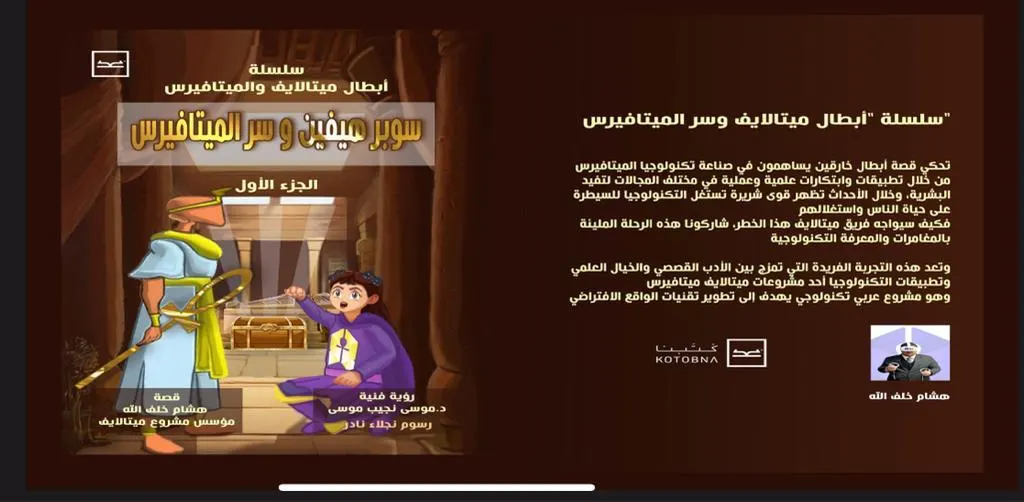
What if the secret the world is searching for today — a way to connect across virtual worlds — isn't entirely new? What if it's a distant echo of wisdom the ancient Egyptians carried thousands of years ago? From that single question, the idea for "MetaLife Heroes" was born.
In traditional children's stories, superheroes are given powers detached from a child's everyday reality: invisibility, superhuman strength, or other abilities with no real bearing on daily life. I wanted to break that familiar formula entirely. What if a hero's true power was knowledge itself? That's why I decided my heroes' weapon would be science and technology — for two reasons that, to me, are inseparable: to inspire children, indirectly, to love achievement and effort, and to root in them, from an early age, the idea that knowledge is worthless unless it serves and helps others.
Nothing in the story happens by accident. When the family gathers around the table each evening, it isn't just an opening scene — it's a deliberate message about the value of family closeness, and about how the greatest gift a parent can give their children is daily presence in their lives, not busy absence from them. When "Mr. Magdy" appears, a teacher who didn't stop at his first degree but went on to earn a doctorate, he becomes a quiet model that tells the child: learning is a journey that never ends. Even the students' discipline inside the archaeological site is deliberate — teaching respect for history before anything else.
### Why the Metaverse, and Why Now?
Every major technology in human history began as a simple idea, often obscure in its early days, before growing gradually into something inseparable from everyday life. Ironically, the generation that plants the seed of an idea is rarely the one that harvests its full fruit. The metaverse today is still taking shape, but within just a few years, it will become a lived reality, not a choice. So who better to prepare for that future than the children who will actually live in it? Not through imagination alone, but through accurate scientific information — simple enough for them to understand and use safely, and aware enough to protect them from any risk this technology might carry.
### The Key of Life: Where the Ankh Meets the Metaverse
Here lies the deepest point in the entire story — the personal conviction it grew from: that the ancient Egyptians reached a level of knowledge we still cannot fully grasp today. A civilization that built the pyramids with an engineering precision that astonishes today's engineers, tracked the stars and astronomy with an accuracy reflected in their temple designs, and developed medicine and mummification techniques far beyond what we imagine for their time — is it really so far-fetched to imagine that such a civilization touched, in some different form, the very idea of "connecting across worlds" that lies at the heart of the metaverse today? I make no historical claim of certainty, but I don't rule it out — and it's precisely that space between certainty and possibility that feeds a child's imagination in the story.
From that conviction, I chose the symbol of the "Key of Life" to be the key to the secret in the story. This symbol is known in Egyptology as the Ankh, sometimes called the "Key of the Nile." Shaped like a cross with a loop at its top, it is one of the most famous and ancient symbols of Egyptian civilization. In temple carvings and wall paintings, gods are depicted offering this key to pharaohs, in a symbolic scene granting them "eternal life." Ancient Egyptians carried it as an amulet and placed it within mummy wrappings, believing it guaranteed eternal life after death. Even today, this symbol remains present in Egyptian collective consciousness — as seen recently when it appeared during the famous Pharaohs' Golden Parade of royal mummies.
A symbol carrying this much weight — life, secrecy, eternity — felt to me like the ideal gateway into the world of the metaverse within the story. And this connection wasn't limited to the story alone: the name of the "MetaLife" project itself, and its logo, are directly inspired by the Key of Life — a deliberate attempt to build a symbolic bridge between the wisdom of our ancestors and the technology of the future; between the Ankh, which granted eternal life in the past, and MetaLife, which seeks to give life new meaning in the future.
### When the Story Stepped Off the Page and Into Reality
The ambition didn't stop at the written word. Stories are fundamentally built on a child's capacity to imagine, so I decided to extend that imagination with a real bridge into experience: the child imagines the events while reading, then puts on a virtual reality headset to live those same events as if they were real, not just words on paper. This was the first step in a larger project I intend to continue, God willing: a series of stories that can be read on the page, and lived, at the same time, as immersive virtual reality experiences.
That dream has already become tangible reality, with an official launch held as part of the Cairo International Book Fair. What mattered most to me that day wasn't only that children read the story, but that they tried the headset themselves and lived the virtual experience with their own hands — because that is exactly the heart of the idea I had dreamed of. The response exceeded all my expectations, and the story was covered by several Egyptian newspapers and media outlets, including Egyptian state television and a number of satellite channels. I made sure to document every moment of that experience, because I believe it wasn't just a passing event, but the genuine beginning of a bigger idea: connecting literature with technology, and turning a story from a static reading experience into a life that can be lived and touched.
### The Real Secret Behind the Name: "Super Haven"
In the end, behind all this depth of thought lies a simple, honest, personal reason: I chose the name "Haven" for the story's heroine after my own daughter. I wanted her, from the earliest days of her childhood, to carry a genuine motivation toward science, and an unshakable belief that the future is built through knowledge, not waiting.
The story doesn't end with this first part. Many adventures still await "Super Haven" and the MetaLife team, which I intend to tell, God willing, one after another.