
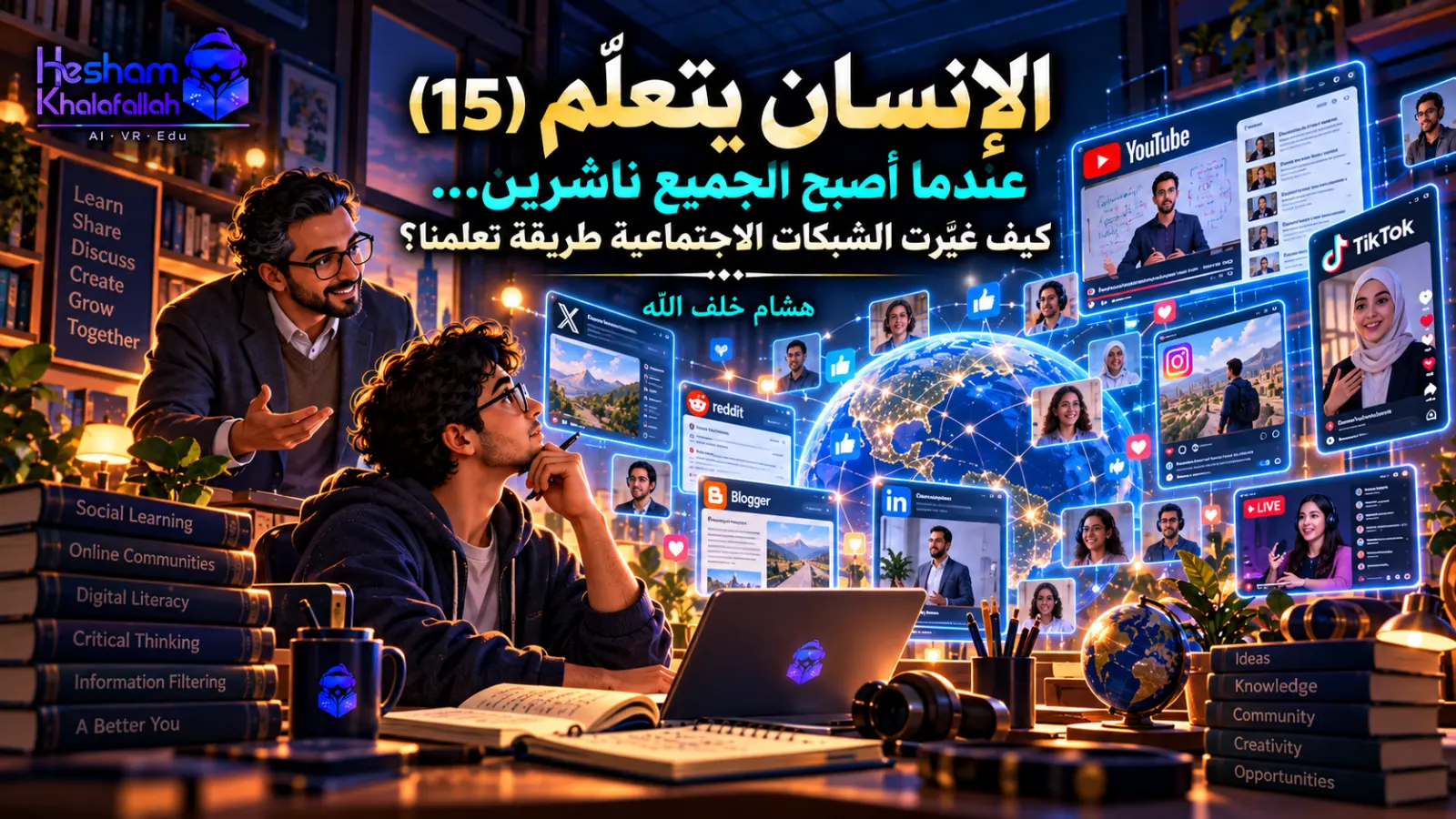
From the Learning We Choose… to the Learning That Finds Us
In the previous article, we discussed an important transformation. People became able to enter an educational platform because they had decided to learn. They could choose a specialization, enroll in a course, follow a structured pathway, and perhaps earn a certificate at the end.
That was intentional learning.
I knew why I entered the platform, what I wanted to learn, and which institution was providing the program. But at the same time, the Internet was changing in another direction.
Users no longer entered only to read what others had published. They began writing, commenting, discussing, filming, explaining, reviewing, and sharing their own experiences.
Forums appeared. Then blogs. Then user-generated video. Then social networks.
Suddenly, people no longer needed to enter an educational platform in order to learn something. They might open the Internet for entertainment and find someone explaining an idea, read a professional experience, watch a short video about a scientific concept, or encounter a discussion between specialists.
They might learn something they had never consciously decided to learn.
A new transformation had begun:
We no longer always go to knowledge; knowledge, information, and experience have begun to reach us as part of our everyday digital lives.
When the Internet Changed from Pages We Read into a Community We Participate In
In the early stages of the Internet, users generally entered a website created by a person or organization. They read, searched, downloaded a file, and left.
But something important changed when users themselves could participate more easily.
Someone asked a question in a forum. Another person answered.
Someone wrote a blog post. Others responded.
Someone published a video. Another added a different experience.
The Internet was no longer simply a vast digital library. It also became a community continuously producing knowledge and content.
The difference is fundamental.
A library stores what has already been produced.
A digital community produces new content in front of you all the time.
The Internet was no longer only a place from which we received knowledge; it became a place where we also participate in producing what others may regard as knowledge.
This gave ordinary people a capability that had never before been available with such ease: the ability to speak to an audience in another city, another country, or even on the other side of the world.
When Not Everyone Who Teaches Carries the Title “Teacher”
Something else changed as well.
Who is the teacher?
In the traditional model, the answer is relatively clear: a qualified person working in a school, university, or institution with an official role in the educational process.
But the Internet began separating the act of teaching from the formal title of teacher.
I may learn programming from a developer sharing professional experience.
Photography from a professional photographer.
A practical skill from someone who performs it every day.
A language from a specialist content creator.
That person may be followed by hundreds of thousands or millions of people without ever being employed by a school.
A person can now influence the learning of millions without ever entering a classroom in the formal role of a teacher.
This created enormous opportunities.
Knowledge and experience once confined to a particular person or place could now be shared widely.
At the same time, however, some of the barriers separating specialists from non-specialists began to disappear.
Anyone can turn on a camera.
But not everyone who can explain something confidently on camera actually possesses the knowledge they are explaining.
And that created a new problem.
Have We Returned to the Time Before School… but Digitally?
When I think about this transformation, I am reminded of the beginning of the journey we explored in the first articles of this series.
Before schools existed in the form we know today, people did not depend on a single institution for learning.
They learned from family.
From elders.
From craftspeople.
From the community.
From observation.
From stories.
From experience.
Learning sources were distributed around the individual.
Then schools developed, and a large part of education moved into an organized institution that brought together the learner, teacher, curriculum, place, and assessment.
Centuries later, the picture seems to be moving in another direction again.
A student goes to school, but on the same day may also learn from a teacher, a YouTube video, a specialist in another country, an online community, a social-media post, or the experience of someone they have never met.
But we have not returned to the past.
School still exists.
What has happened is that a much larger learning world has grown around it.
Human beings began by learning from the communities around them, then education was gathered inside the school; today technology has reopened the doors of the school onto a global community of knowledge.
School may no longer monopolize learning.
That does not mean its mission has ended.
It may mean its mission has become more complex.
If the Teacher Is No Longer the Only Source… What Is the Teacher’s Role?
At first glance, the abundance of sources may seem to reduce the need for teachers.
Students can search.
Watch.
Ask.
And access dozens of explanations of the same topic.
So why do they still need someone to explain it?
Perhaps because that question is based on an outdated understanding of the teacher’s role.
If the teacher’s only function is to carry information that the learner cannot access elsewhere, then it is understandable that the teacher may feel threatened when information becomes available everywhere.
But when knowledge becomes abundant, other roles become more important.
Who helps the learner decide what to learn first?
Who connects what they watched today with what they learned yesterday?
Who notices that a concept has been misunderstood?
Who helps compare two sources?
Who knows the learner’s level and recognizes what they need?
Who turns scattered pieces of information into a coherent pathway?
This is where the teacher’s role changes.
When knowledge was scarce, the teacher helped the learner reach it; when knowledge became abundant, the teacher’s most important role became helping the learner understand, organize, verify, and use it.
Teachers do not need to compete with the Internet in the quantity of information.
The Internet will always win that competition.
But teachers can do something different.
They can transform distraction into direction, information into understanding, content into knowledge, and knowledge into capability.
The digital-age teacher does not lose value because sources of knowledge have multiplied; the value of the teacher shifts from possessing knowledge to guiding the learner through its abundance.
The Algorithm… a New Participant in the Learning Journey
Social networks introduced another element that had never been present with such power before.
At school, someone determines much of what the student encounters.
The curriculum.
The teacher.
The timetable.
On social networks, however, people do not choose everything they see.
There is also the algorithm.
It notices what you click.
What you watch until the end.
What you skip quickly.
What you like.
What you return to.
It then uses these signals to determine part of what appears next.
This creates a profound shift.
In a search engine, I type what I am looking for.
On many social platforms, content may appear in front of me before I ask for it.
Human beings are no longer the only ones searching for knowledge; platforms also choose part of what they place in front of us.
This makes the question more complicated.
If a child watches a sequence of videos about a particular subject, who designed that sequence?
The child?
The family?
The teacher?
Or the recommendation system?
And this raises a question that did not exist in quite the same form before:
Who designs the knowledge environment in which a child lives today: the school, the family, or the algorithm?
The Algorithm Knows What Attracts You… but Does It Know What You Need to Learn?
Here we find an important difference between an educational platform and a social network.
In education, we are supposed to ask:
What does the learner need to know?
Which step should come after the previous one?
What is appropriate for their age and level?
A social platform has other goals as well.
One of them is keeping people using the platform.
Therefore, the content shown to a person may be highly effective at maintaining attention, but not necessarily the most important content educationally.
This creates a role for the teacher that an algorithm does not perform in the same way.
An algorithm may know what attracts a learner’s attention, but a teacher must know what the learner needs to learn—even when it is not immediately attractive.
Mathematics does not always become easy simply because it is entertaining.
Deep reading sometimes requires patience.
Learning a complex skill may require passing through difficult stages before the result becomes visible.
Education cannot be built entirely around one question:
Did the learner enjoy this minute?
Some valuable learning requires effort and persistence.
When Attention Became a Currency
With social networks, another kind of competition emerged.
Millions of people, platforms, advertisers, and content creators compete for a share of human attention.
This is often described as the attention economy.
The headline must attract you.
The first few seconds of a video must stop you from leaving.
Content becomes shorter.
Movement from one subject to another becomes faster.
The page does not seem to end.
Another scroll.
Another video.
Another post.
The way knowledge is presented begins to change as well.
Can an idea be explained in one minute?
Can a subject be reduced to five points?
Can a book be summarized in a short video?
Sometimes, yes.
And that is not necessarily bad.
Simplification is a valuable skill.
Short content may open a door to a subject someone knew nothing about.
But there is an important difference between simplifying an idea and flattening it.
Shortening information may make it easier to access, but it should not shorten the thinking required to understand it.
Is What You Watched Knowledge… or Merely Content?
Here we reach a major challenge.
In the past, publishing a widely distributed book usually required a publisher.
Broadcasting a television program required a channel.
Publishing a newspaper article required an institution.
These institutions did not guarantee that everything was correct, but they acted as gateways through which publication generally passed.
Today, anyone can publish information within seconds.
That is an extraordinary democratization of knowledge.
People who once had no voice can now share experience.
But the same door is open to error.
Misinformation.
Exaggeration.
And material that looks scientific without being so.
An opinion can begin to look like a “fact” simply because it is presented attractively.
The more democratic the publication of knowledge becomes, the greater the responsibility to verify it.
Views do not prove accuracy.
Follower counts do not equal expertise.
Confidence while speaking is not a scientific qualification.
This is why media and information literacy has become a core skill in the digital age.
When the “Influencer” Can Also Teach
Another new model has appeared.
The content creator.
They may be a genuine expert who offers excellent knowledge.
They may simply be very talented at explanation.
They may be both.
Or they may possess neither, but know how to attract attention.
The roles begin to overlap.
Education.
Entertainment.
Marketing.
Personal opinion.
A video may begin as information and end as advertising.
A personal experience may be presented as though it were a universal rule.
So the question is no longer only:
Did I understand the content?
It is also:
Who produced it? Why? And what is the source?
This should no longer be treated as an optional additional skill in education.
It has become part of how learning itself works.
From the Local Community… to a Global Knowledge Community
Yet amid all these challenges, there is an enormous positive side.
Social networks and digital communities have restored one of humanity’s oldest learning methods:
learning from other people.
One person asks.
Another answers.
A third adds experience.
A fourth corrects something.
A fifth provides a source.
A programmer may find an entire community ready to help solve a problem.
A language learner may communicate with native speakers in different countries.
A small-business owner may learn from people working in similar fields on other continents.
And in a strange way, we return to the beginning.
But this time, the community is no longer only the tribe, village, or neighborhood.
It can extend around the entire world.
Human learning began within the community, and thousands of years later we have returned to learning from communities again—but this time the community is global and digital.
Distributed Knowledge Still Needs Someone to Bring It Together
This is where the teacher becomes more important in a different way.
Suppose a student watches five videos about a scientific subject.
One is excellent.
Two are correct but overly simplified.
One contains an error.
Another presents personal opinion.
The student may arrive in class carrying more information than a student twenty years ago.
But do they carry better understanding?
Not necessarily.
This is where the role of school and teacher becomes visible in an age of abundant sources.
The goal should not be to stop students learning outside school.
Perhaps the opposite.
The teacher can ask:
What did you find?
Who said it?
Can we verify it?
Is there another perspective?
How does it connect with what we are studying?
The more people become able to explain, the greater the need for someone who helps learners distinguish between good explanation and merely persuasive explanation.
The teacher does not close the door to the world.
The teacher helps the learner enter it more intelligently.
Families No Longer See the Same World Their Children See
In the age of television, family members largely watched a limited set of channels.
Programs might differ, but the media environment was more visible.
Today, two people living in the same home may inhabit completely different digital worlds.
Each has an account.
A viewing history.
Different interests.
And an algorithm learning from them.
As a result, a child may encounter content that a parent does not even know exists.
It therefore becomes difficult for the family’s role to be simply:
I monitor everything my child watches.
The volume is too large to monitor completely.
Perhaps the more important role becomes:
I teach my child how to deal with what they will see when I am not beside them.
To ask.
Pause.
Verify.
Understand that views do not equal truth.
Know that influencers are not always experts.
Recognize that some content may be advertising even when it does not immediately appear to be.
School No Longer Owns the Entire Learning Environment
This may be one of the most important conclusions of this stage.
For many years, school could largely say:
This is the book.
This is the curriculum.
This is the teacher.
This is what the student will study today.
Now the student leaves school carrying access to a knowledge world that the institution cannot fully control.
That does not mean school has lost its importance.
It means school can no longer behave as though everything a learner learns begins and ends within its walls.
The learner now lives inside two systems at the same time: an organized educational system led by the school, and an open learning system created by digital communities, algorithms, and millions of publishers.
The real challenge is not to force one system to eliminate the other.
It is to help learners move between them without losing direction.
From “Teacher” to “Guide of the Learning Journey”
Perhaps we need to redefine the word teacher once again.
Not simply as the person standing in front of a classroom telling students what they know.
But as the person who helps them:
Reach the right question.
Build a coherent foundation of knowledge.
Choose sources.
Verify.
Discuss.
Experiment.
See what does not fit into a short video.
And continue when knowledge becomes too complex to explain in sixty seconds.
Perhaps the teacher’s most important skill is no longer being the fastest person to provide an answer, but helping learners develop the ability to search, think, verify, and learn independently.
This role will become even more important in the next stages of our journey, not less.
Because soon the party providing answers to learners will no longer always be human.
But we have not reached that stage yet.
And When the Internet Left the Computer… and Entered the Human Pocket
Until this point, much of what we have discussed required people to “enter” the Internet.
Sit at a computer.
Open a browser.
Visit a website.
Then came a transition that made everything we have discussed even more powerful.
The Internet was no longer a place we went to.
It became something we carried with us all the time.
On the road.
At work.
At school.
At home.
Before sleep.
After waking.
And in the small moments that once contained nothing.
The smartphone.
With it, the question was no longer:
When do we enter the Internet to learn?
It became:
What happens to the way humans learn when knowledge, algorithms, content, and digital communities are all carried in their pocket throughout the day?
And this begins the next stage in our Human Learning journey:
Human Learning (16): When Knowledge Entered Our Pocket… How Did the Smartphone Change the Way We Learn?