
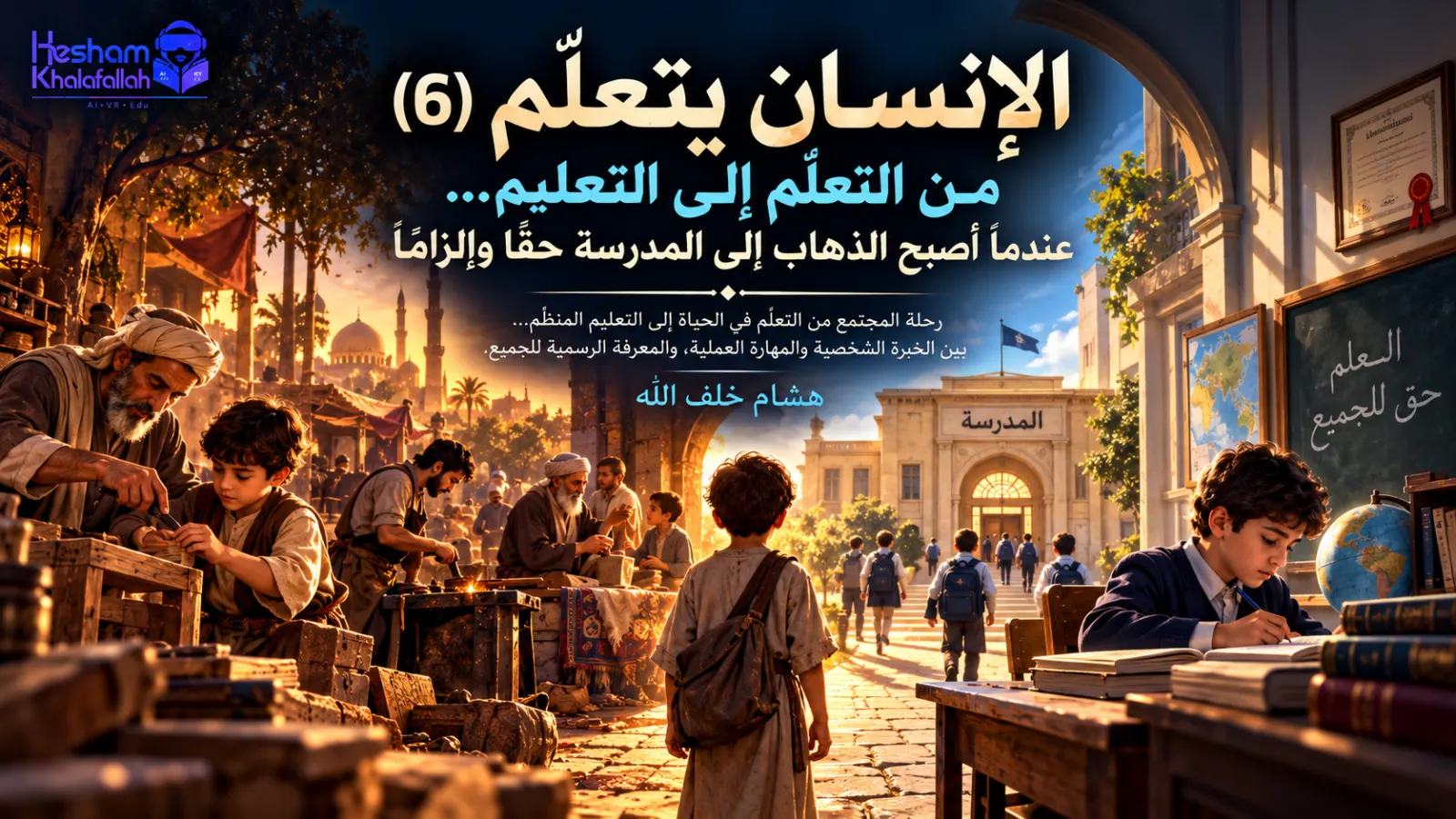
Up to this point in our journey, we have been following humanity’s search for knowledge and the tools developed to preserve it, access it, and spread it.
People learned through observation and storytelling, then through writing, books, libraries, and finally printing, which made it possible for knowledge to reach larger numbers of people.
But here, something different began to happen.
The question was no longer only: How does a human being learn?
Society also began to ask:
How do we make sure that everyone learns?
Education gradually shifted from an opportunity available to some into a broader social concern, then into a right, and in many countries into compulsory schooling organized by the state through defined stages and years of study.
Historically, widespread access to basic education is relatively recent. In the early nineteenth century, most of the world’s population had not received basic schooling, while public education systems expanded dramatically over the following two centuries.
That was a major civilizational achievement.
But as education became more organized and widespread, new questions began to emerge about what education itself actually means.
When Education Was No Longer Only a Family Choice
My mother, may God grant her a long life, used to tell me that some families in her time were afraid to send their children to school, and that some would even try to keep them hidden or away from formal education.
I used to hear these stories and wonder: why would anyone fear something that we now consider normal and essential?
But when we look at the issue from another perspective, we begin to understand that school was not always a natural part of every family’s life.
A family might need a child to work.
They might fear sending the child into an unfamiliar environment.
They might believe that what the child learns at home, through a trade, or within a religious setting is closer to their culture and way of life.
They may simply not trust the model of education being introduced by the state or an institution.
This reminds us that turning education into law does not mean culture changes at the same speed.
School attendance may become compulsory, but accepting the idea of school itself requires time, trust, and a degree of compatibility with the surrounding community.
This tension between formal education and local culture has not completely disappeared even today.
When a Person Became “Illiterate” Because They Could Not Read or Write
As formal education expanded, reading and writing became central measures of a minimum level of education.
The term illiteracy became closely associated with the inability to read and write, and literacy programs became an important part of educational and development policies.
Yet the idea of literacy itself has evolved.
Today, literacy is not understood simply as the ability to recognize letters or write words, but more broadly as the ability to understand, interpret, communicate, and use information.
This leads to an important distinction.
Being unable to read or write does not mean a person has no knowledge.
Someone may never read a book, yet understand the land and its seasons in remarkable depth.
Another person may have no formal qualification, yet understand trade, maintenance, construction, or animal care better than many people who studied such subjects theoretically.
We are therefore looking at different forms of knowledge.
There is knowledge gained through formal education.
And there is knowledge gained through life, practice, and experience.
The problem begins when we treat the first kind as the only knowledge worthy of recognition.
If Someone Fails at School, Have They Failed at Learning?
Imagine a child who attends school for several years.
They learn to read and write at an acceptable level, but they do not enjoy studying, their grades remain weak, and eventually they leave school early.
If we look at this child only through the lens of the education system, we may describe the experience as failure or dropout.
But what if the same child enters a workshop, learns a trade, and after a few years becomes exceptionally skilled at understanding machines, solving practical problems quickly, inventing solutions, and working with a level of precision that makes others assume they studied the field formally for many years?
Can we say that this person did not learn?
Of course they learned.
They simply did not learn in the way the system was designed to measure.
On the other hand, someone may earn a certificate, pass examinations, and later forget much of what they studied or fail to use it in real situations.
This leads to one of the most difficult questions in education:
Are we measuring what a person has actually learned, or how successfully they moved through the education system?
Certificates matter, but they do not tell us everything.
A certificate shows that a person completed a particular educational pathway. Competence shows what that person can actually do.
The better system is one that can recognize both.
This idea is not merely theoretical.
There are now educational approaches that recognize learning gained outside formal institutions through work, training, and experience by evaluating what a person knows and can demonstrate rather than looking only at where they studied.
When There Is Education… But No Certificate
I felt this idea very strongly when I visited the Republic of Chad.
I was in an African country at a time when the world was discussing artificial intelligence and digital transformation, yet I was surprised to see children who were not following formal education in the way many of us consider normal.
Some families prefer their children to learn in religious or traditional environments that are more closely aligned with their beliefs, culture, and way of life.
They may also view some forms of modern education with suspicion or concern.
But these children are not necessarily without education.
A child may learn to read Arabic, memorize the Quran, develop discipline and values, and gain religious and social knowledge.
At the same time, the child may not receive mathematics, science, languages, and other skills at the same level available in formal education, and may not receive a certificate that allows easy movement into other educational pathways.
This made me think about the issue differently.
Perhaps the solution is not always to tell a community:
Everything you have is outdated. Leave it behind and adopt our model.
At the same time, respecting culture cannot mean leaving a child without essential tools needed to participate in the modern world.
Perhaps the better answer is building a bridge rather than replacing one system with another.
We can recognize what the child has genuinely learned, respect their language, culture, and environment, then add the science, mathematics, languages, and digital skills they need, while creating a pathway that allows them to continue their education and gain formal recognition for what they already know.
Who Decides What We Should Learn?
At this point, the issue becomes deeper than school itself.
Every society, in every period of history, has held certain beliefs about which kinds of knowledge are important and which are unnecessary—or even dangerous.
I do not believe the story is as simple as saying that religion opposed knowledge or that modernity alone introduced education.
History is far more complex.
Many religious institutions played important roles in preserving books and supporting education, while different societies also witnessed conflicts over which ideas could be taught or circulated.
Within the Islamic tradition, the beginning of revelation has a particularly striking connection to our subject.
The first revealed verses begin with the word “Read”, and they connect reading with the pen and teaching: “Who taught by the pen, taught man what he did not know.”
Yet the presence of a religious or cultural value supporting knowledge does not mean that every society applies that value in the same way.
The deeper question therefore becomes:
Who decides what a person should learn?
The family?
Society?
The state?
Religion?
The labor market?
Or the individual?
There may never be one answer that fits every time and place.
But one thing is clear: education has never been only about transferring information.
It also reflects what a society believes is important in shaping the kind of person it wants to build.
When the Difference Between Education and Learning Became Clearer
Human beings have always learned.
But with the rise of schools, curricula, examinations, and certificates, it became increasingly important to distinguish between two concepts that we sometimes use as if they were the same.
Education is what the system provides: school, teacher, curriculum, textbook, training, examination, certificate.
Learning is what actually happens inside the person.
What did they understand?
What changed in the way they think?
What can they now do?
Can they use what they know?
Education can happen without enough learning.
And deep learning can happen outside formal education.
But this does not mean that one makes the other unnecessary.
A child who becomes highly skilled in a trade may still need reading, mathematics, and general knowledge that expand and protect their opportunities in life.
Likewise, a student with strong academic education still needs practical skills and real-world experiences if knowledge is to become capability.
So I do not believe the question is:
School or life?
The better question is:
How do we make school closer to life, and how do we recognize the learning that happens outside it?
Is the Certificate the Final Goal?
As formal education expanded, the certificate became extremely important.
It helps universities, employers, and society know that a person has completed a certain level of study.
But the problem begins when the certificate becomes the ultimate goal, or when we assume that anyone without one has no knowledge.
Perhaps, alongside asking “What is your qualification?”, we should also ask:
What do you know? What can you do? And how can you demonstrate it?
I believe the future of education will make this question increasingly important.
With online learning, short courses, vocational training, work experience, digital platforms, and artificial intelligence, it will become harder to confine a person’s knowledge to one certificate earned at a particular stage of life.
We may need to move gradually from measuring education mainly by the number of years spent inside institutions toward greater recognition of real knowledge, skills, and competencies.
And this brings us back to where we began.
Making basic education a right and, in many places, compulsory was a major achievement because it tried to ensure that a child’s future would not depend entirely on family decisions, circumstances, or place of birth.
But getting a child into school is not the end of the journey.
Being physically present in a classroom does not guarantee that learning has taken place.
Perhaps the challenge in an earlier stage was:
How do we bring every child into education?
The challenge I see before us today is:
How do we build an education system capable of seeing each child as they are, recognizing what they truly learn, and helping them develop what they can become?
Because the goal, in the end, is not simply to spend a certain number of years inside a school.
The goal is to learn.
And once society decided to make education available to large numbers of people, another challenge emerged:
How do we gather all these learners?
How do we divide them into stages?
How do we organize their time?
Who decides the curriculum, examinations, and progression from one year to the next?
And this is where the next stage of our “Human Learning” journey begins:
How did the school we know today take shape?