
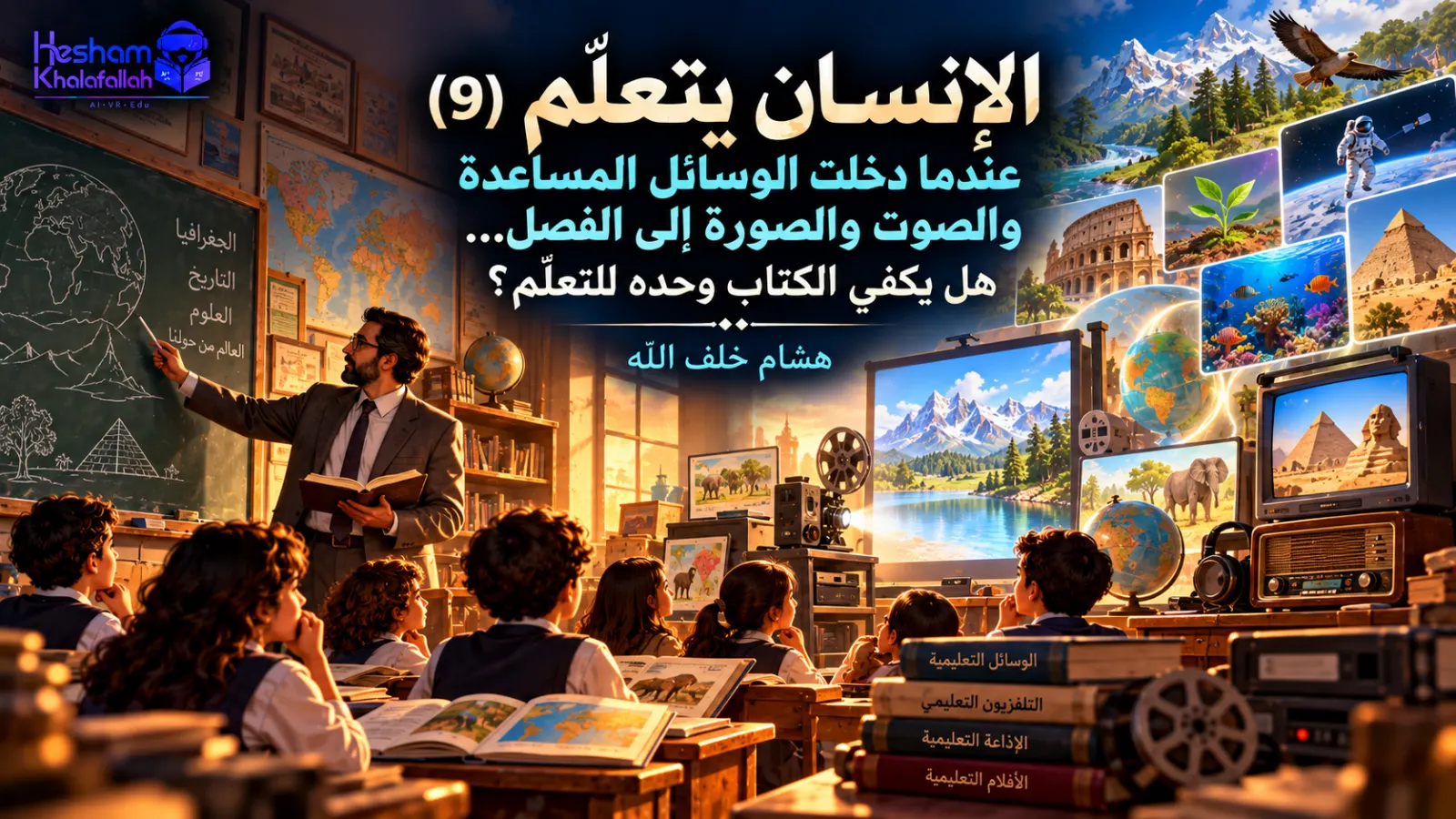
A New Element in the Education System… How Does Knowledge Reach the Learner?
In the previous articles, we gradually built a picture of the education system. We began with the learner, then the family and surrounding environment, the teacher or guide, knowledge and curriculum, followed by the school and education system, and finally the vision, policy, and planning that determine the direction of the whole system.
But one more element remained. It may appear simple, yet I believe it is extremely important:
How does the information itself reach the learner?
We may have an excellent teacher, a strong curriculum, an organized school, and a clear vision, but ultimately knowledge must travel from somewhere into the learner’s mind.
This introduces a new element into our education system:
the teaching aid—or the medium through which knowledge is transmitted.
At first, this medium was extremely simple. The teacher spoke, and the student listened. Then came writing on walls, boards, and chalkboards, followed by drawings, maps, books, pictures, and models that helped the teacher explain.
Then came a decisive stage.
For the first time, a classroom could receive a voice that was not the teacher’s voice, an image the teacher had not drawn, and a scene that had never happened in front of the students.
This was when teaching aids began to take on a new role in education.
When the Teacher Was the Teaching Medium
Imagine a geography teacher before video, digital images, or projection systems.
The teacher explains mountains, valleys, waterfalls, volcanoes, deserts, and seas to children who may live in an environment where they have never seen any of these things.
The teacher themselves may never have seen some of them except in a book or drawing.
How do you help a child imagine a towering mountain when everything around them is flat land?
How do you describe a waterfall to a child who has never seen one?
A science teacher may need to explain a chemical reaction that cannot be carried out at school, a phenomenon that occurs in space, or a structure inside the human body that students cannot see.
A history teacher must reconstruct cities, battles, and civilizations that disappeared hundreds or thousands of years ago.
A language teacher may need to teach a sound or pronunciation from a language students never hear in their surrounding environment.
The teacher had to achieve all of this largely through words, voice, analogy, drawing, and imagination.
That is why I believe the teacher at that stage was not only a transmitter of knowledge, but also an essential part of the medium carrying it.
Before students could see the world with their own eyes, the teacher had to build it inside their imagination through words.
This explains why storytelling, description, analogy, and explanation were among the teacher’s most important skills.
A teacher who could tell a story, describe, draw, and offer meaningful examples could make a distant or complex subject feel close to the learner.
Without those abilities, information could remain nothing more than words in a book, without the learner ever forming a real picture of what they meant.
But Who Taught the Teacher How to Explain?
This raises another question that stayed with me while developing this article:
If the teacher had never personally experienced what they were describing, where did their understanding come from? And how did they learn to explain it to students?
There was never one answer across every time and place.
Teachers relied on what they themselves had learned, on books and references, on earlier teachers, and on their own experience, observation, and ability to interpret.
As education systems developed, teacher preparation became more organized. Institutions and programs for preparing teachers emerged, and teaching methods, classroom management, and practical training gradually became part of professional preparation.
This matters because teaching is not simply about knowing the information.
Someone may be an excellent mathematician yet struggle to explain a mathematical concept to a child.
A scholar may know a great deal about a subject, but transferring that knowledge to another person requires a different skill.
Over time, teachers also gained access to teaching manuals, maps, drawings, models, and materials specifically designed to support explanation.
Society gradually began trying to ensure that educational quality did not depend entirely on an individual teacher’s personal gift for description.
Teaching aids began to serve an important function:
helping the teacher give visible form to what they were explaining.
From Explanation to Drawing… Then to the Image
Long before radio and television, people were already trying to make knowledge easier to understand.
The chalkboard is a teaching aid.
A drawing is a teaching aid.
A map is a teaching aid.
A model is a teaching aid.
Images inside a textbook are teaching aids.
If the teacher cannot bring a mountain into the classroom, they can draw it.
If children cannot travel to another country, a map can help them visualize it.
If something complex is difficult to explain using words alone, an illustration can make it clearer.
As printing developed, textbooks became increasingly capable of including illustrations, images, and diagrams. The book was no longer only text.
Part of the burden of explanation began to shift from the teacher’s ability to describe toward the medium being used.
But static images also had limits.
An image can show an animal, but not always how it moves.
A drawing can illustrate an experiment, but it cannot let students watch the experiment unfold.
A map can show a place, but it cannot communicate its sound, motion, and natural environment as they really are.
The need remained for something closer to the experience itself.
Then came recorded sound.
Radio.
Film.
Television.
Video.
And something fundamental changed.
The teaching aid was no longer merely helping the teacher describe the world; it began bringing part of that world into the classroom.
When Sound and Images Entered Education
Radio, television, and cinema were not originally created as educational projects.
They developed as media for communication, information, entertainment, and culture. But educators and educational institutions soon began to see a very different possibility within them.
If radio could carry music and news into thousands of homes, why could it not carry a lesson?
If film could take viewers into a forest, factory, or distant country, why could it not help students learn geography or science?
If television could capture a child’s attention for long periods, could images, movement, and sound also be used to communicate knowledge?
Over time, audiovisual media became an increasingly visible part of education. Films, documentaries, scientific programs, and educational content were used across many subjects.
The teacher’s possibilities expanded.
They no longer had to imitate an animal’s sound; students could hear it.
They no longer had to describe the movement of a volcano only in words; students could watch it.
A dangerous or expensive scientific experiment could be filmed and shown repeatedly.
Students could see a city, environment, or civilization they had never visited.
The medium did not eliminate explanation; it transferred part of the burden of description from the teacher’s memory and imagination to images and sounds the learner could experience directly.
But… How Do We Use Something Designed for Entertainment in Education?
Here, I believe, there is a psychological and social dimension that matters just as much as the technology itself.
Families, teachers, and society initially knew radio, television, and cinema mainly as tools for news, entertainment, and leisure.
So how could something a child watched for fun suddenly become part of education?
This question feels remarkably familiar today.
We will see it again with computers.
Then the internet.
Then smartphones.
Digital games.
Social media.
And eventually artificial intelligence.
Almost every time a new tool appears outside the school, people first use it for another purpose, and then someone begins asking:
Could we use this to learn as well?
And the debate begins.
Some are excited.
Some believe the tool wastes time.
Some fear students will become distracted.
Some say the old method was better.
Others believe the new medium will make education easier and more engaging.
It is important not to describe a teacher’s hesitation automatically as resistance to progress.
They may have genuine reasons.
The tool may require preparation time.
It may require skills the teacher has never been trained to use.
It may fail in front of the students.
Ready-made content may not fit the curriculum.
The teacher may feel that the tool takes away valuable lesson time without knowing whether it will actually improve learning.
And sometimes the issue is even deeper.
A teacher who has spent years building a professional identity around being the person who knows, explains, and describes may suddenly encounter a medium that can display something more clearly than they can describe it.
And here appears a question that will return with every stage of educational development:
Does this tool help me become a better teacher… or does it reduce the need for me?
This question is not as new as we may think.
What changes from one era to another is the capability of the tool.
A School Memory… When Television Felt Like the Height of Technology
I remember that when I was in primary school, having a television and a video player inside the school library felt completely different.
Sometimes we would watch a documentary, an educational cartoon, or another visual program as part of library activities.
Today, that may sound very simple.
A child now can carry a screen containing millions of hours of video and search instantly for any animal, city, or experiment they want to see.
But at that time, walking into the library and watching educational material on television felt to us like the height of technology.
The experience was different from the book and chalkboard.
The image moved.
There was sound.
We could watch something that did not physically exist inside the school.
Suddenly, the school was no longer only explaining the world to us.
It was beginning to show us part of it.
And I think this is the real value of any technology when it enters education.
Not simply that it is new.
But that it makes something previously difficult—or impossible—possible.
Teaching Aids Help the Teacher… But They Do Not Create Learning by Themselves
A new problem then appeared.
Does simply watching an educational film mean that the student has learned?
Of course not.
A child may watch an excellent film and become more interested in the scenes than in the idea the teacher intended them to learn.
A teacher may show an excellent video and then end the lesson without discussion, questioning, or application.
The content may be engaging but unsuitable for the age or prior knowledge of the students.
This leads to a principle that I believe we will need repeatedly throughout the rest of this journey:
The attractiveness of a medium does not necessarily mean the quality of learning.
A medium can display.
But the teacher still has to decide why it is being shown, when to use it, what the student should notice, how to connect it with existing knowledge, and how to transform viewing into understanding.
This is why we can say:
The medium carries knowledge, but the teacher gives it context and meaning.
The question is no longer whether we use the medium.
It becomes:
How do we use it?
This is an important development.
The teacher is no longer expected only to know the subject and explain it.
They must also know when an image is better than words, when video is better than a drawing, and when neither is necessary at all.
The arrival of educational media did not reduce the need for teacher expertise.
It added another skill:
choosing the right medium and integrating it into the learning process.
This idea will return in every stage that follows.
The success of any educational technology depends not only on what the technology can do.
It also depends on what the teacher can do with it.
From a Medium That Talks to the Student… to a Device That Waits for a Response
Education had now reached a stage very different from where it began.
At first, the teacher described.
Then the teacher could draw, write, use maps, and use models.
Later, images, sound, film, television, and video helped bring experiences, places, and voices into the classroom that the classroom itself could never contain.
But one thing remained largely unchanged.
Most of these media spoke to the learner.
The learner watched.
Listened.
Received.
They could ask questions and discuss what they saw with the teacher, but the medium itself did not know what the learner had done and did not wait for an answer.
At the same time, another device was developing in the background.
It first appeared as a large, complex, and expensive machine for calculation and processing, then gradually became smaller and moved closer to ordinary people.
When many of us first began hearing about the “computer,” the first idea was not that it would be something we would learn with.
It was initially something new that we needed to learn about.
What is a computer?
How does it work?
How do we use it?
But then something much bigger happened.
The screen stopped merely displaying information.
It began waiting for us to click.
Type.
Choose.
Experiment.
Make mistakes.
And try again.
This is where the next stage of our “Human Learning” journey begins:
How did the computer transform from a machine we learned about… into a tool we learned with?