 Hesham Khalafallah
In my work with technology, education and virtual reality projects, I often meet enthusiastic people with an idea: a new platform, a training experience, a digital product they see as a big opportunity. And every time, I ask the same question before any talk of design or delivery: what makes us sure this idea deserves our time and our money?
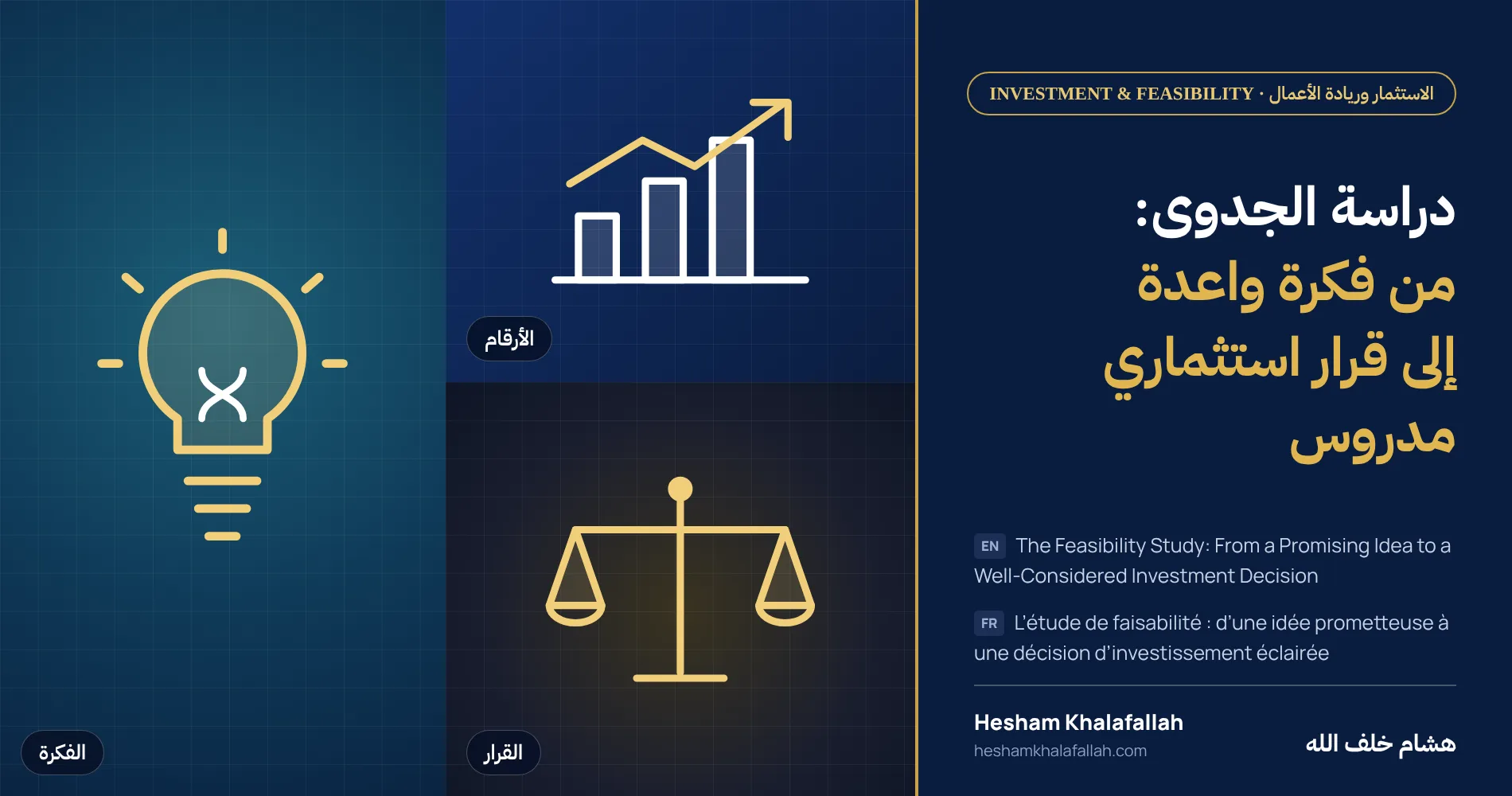
The answer does not come from enthusiasm or instinct alone, but from a good feasibility study. In my view it is not a routine paper written to satisfy a funder, but a tool that protects decision-makers from the most expensive mistake of all: starting a project they have never tested.
The first impression: “The idea is excellent!”
This is the sentence I hear most at the start of any project, and it is usually sincere, but it is not enough. An attractive idea is one thing; its ability to win paying customers, cover its costs and survive after launch is something else entirely. Enthusiasm is a good starting point, but it is not evidence.
What does a feasibility study actually answer?
A feasibility study answers four direct questions: Is there real demand? Can we deliver the idea technically and organizationally? Does it return an acceptable result for what we will spend? And what could go wrong, and what will we do then? When it answers these clearly, the decision becomes easier, whether that means going ahead or stopping.
The other side: mistakes that keep repeating
In all honesty, I should start with the mistakes I see repeated, because knowing them saves a great deal of effort:
• Enthusiasm instead of data: relying on the opinion of friends and acquaintances without asking potential customers or looking at the alternatives they use today.
• Over-optimistic costs: the cost of building is counted, while operation, maintenance, marketing and updates, which continue after launch, are forgotten.
• A study that justifies a decision already made: the numbers are built to reach a result wanted in advance, and the study loses its value.
• Only one scenario: a single optimistic plan, with no picture of what happens if revenue is late or costs rise.
• Ignoring the ability to deliver: an excellent idea without a team, experience or enough time to carry it out remains just an idea.
Six pillars you cannot do without
When I build a feasibility study or review one, I look at six connected pillars:
• Market and customer: Who exactly is the customer? What problem do we solve for them? What do they use today instead?
• Technical feasibility: Are the technology, tools and skills required available? What is a realistic delivery time?
• Organizational and legal feasibility: licenses, contracts, intellectual property, data protection, and whatever the field we are entering requires.
• Financial feasibility: fixed and variable costs, revenue forecasts, the break-even point and the payback period.
• Risks and scenarios: an optimistic, a realistic and a conservative scenario, with a plan for each.
• Execution plan: clear phases, responsibilities and measurement indicators, so the study does not stay locked on paper.
From numbers to a decision
A good study ends with a clear decision rule, not just dozens of pages. I advise setting the criteria before looking at the results: What is the lowest acceptable return? What is the longest payback period we can bear? How large a loss can we afford?
The results are then compared with these criteria, and the decision becomes one of three: go ahead, stop, or run a limited pilot that tests the riskiest assumptions at the lowest possible cost. A limited pilot is often the smartest path between enthusiasm and gambling.
A feasibility study is not an obstacle to the idea, but a test that gives it a real chance to succeed.
Conclusion
What I want readers to take away is that a “no” that comes from a feasibility study is not a failure, but money, effort and reputation that have been saved, and that a “yes” built on a study starts the project on firmer ground. Even “not yet” is a successful decision, because it names what the idea still needs in order to mature.
If your organization or team is considering a new project, in technology, education, virtual reality or elsewhere, I would be glad to build a clear feasibility study together that helps you decide with confidence.