
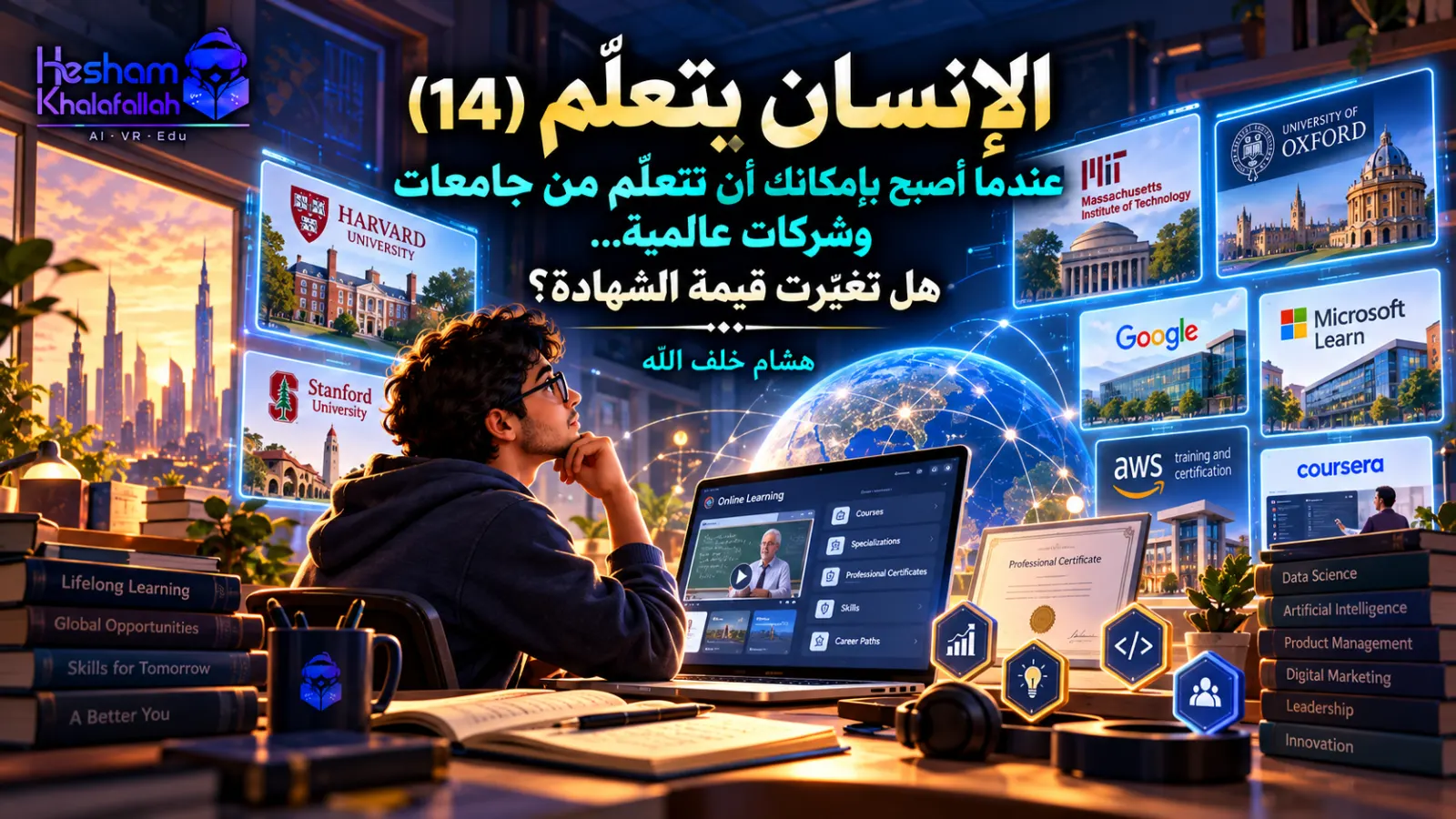
While Schools Were Changing Slowly… Another Learning Path Was Emerging
In the previous article, we reached an important paradox.
Technology entered schools. Platforms, devices, and digital textbooks appeared, yet many educational institutions continued to change slowly because transforming an entire system is far more difficult than purchasing a device or launching a platform.
But the Internet did not wait for schools to complete their transformation.
Outside traditional educational institutions, something else was taking shape.
People could enter a platform, choose a subject, and learn from a university located in another country, from an expert, or from a company operating directly in the field they wanted to enter.
And learning was no longer necessarily just a video to watch and leave.
Structured courses appeared.
Progressive learning paths.
Assessments.
Projects.
Certificates.
And complete professional programs.
Alongside formal education, another form of structured learning was beginning to develop.
It was not a school in the traditional sense.
It was not necessarily a university.
But neither was it random searching on the Internet.
It existed somewhere between these worlds.
Technology did not eliminate formal education, but it broke its monopoly over structured learning pathways.
Where Do You Learn? The Answer Is No Longer One Place
For a long time, the path was relatively clear.
If you wanted to study engineering, you went to an engineering college.
If you wanted professional training, you looked for an institute or training center.
If you wanted a qualification, you usually had to enroll in an institution with a physical location, timetable, and admissions system.
The Internet began separating the location of the institution from the location of the learner.
Then platforms such as Coursera and others emerged, allowing a person living in Cairo, Riyadh, Casablanca, or almost anywhere else to enter a program offered by a university or institution in another country.
At the same time, technology companies began creating their own academies and training pathways.
Cisco, for example, no longer depended only on universities to develop the networking and cybersecurity talent needed by the industry. Its Cisco Networking Academy has reached tens of millions of learners around the world since its launch.
Something important had changed in the education system.
The traditional educational institution was no longer the only organization capable of designing a structured learning journey.
Industry itself had entered the picture.
When the Company That Builds the Technology Also Teaches You How to Use It
This is particularly important in technology-related fields.
Technology changes quickly.
A programming language evolves.
A cloud platform changes.
A new tool appears.
An entire field such as artificial intelligence may transform faster than some academic programs can be updated.
A practical question therefore emerged:
How can someone learn a new skill without returning every time to a full university program?
Companies began creating learning pathways related directly to their own technologies and fields.
Networking.
Cybersecurity.
Cloud computing.
Data.
Programming.
Artificial intelligence.
And here we add a new participant to our education system:
The labour market and industry no longer only receive graduates from education; in some fields, they also participate in producing learning itself.
This is an important shift because the distance between what people learn and what they use at work began to shrink in some sectors.
From “Study, Then Work” to “Work and Keep Learning”
The model many of us grew up with looked roughly like this:
School → university → qualification → work.
As though education largely ended when professional life began.
But what happens when the profession itself changes every few years?
What does a programmer do when a new technology appears?
What about an engineer who needs new analytical tools?
An employee whose work now includes artificial intelligence?
Or someone who wants to change careers entirely?
Learning is no longer only preparation for life.
It increasingly becomes part of professional life itself.
Modern labour-market reports continue to highlight the growing importance of technological skills alongside adaptability, continuous learning, and the ability to respond to change.
This makes lifelong learning more than an attractive phrase.
Education no longer ends when work begins; work itself has become a reason to keep learning.
A person may return to the role of learner many times throughout life.
The Learner Began to Decide
Another important transformation took place.
In formal education, an institution largely decides:
What will you learn?
When?
In what order?
Which subjects are compulsory?
Digital platforms gave learners more room to make these decisions themselves.
I can decide:
I want to learn data analysis.
Project management.
Cybersecurity.
I want a short course.
Or a complete pathway.
I want to study two hours a week.
Or finish within two months.
I may pause and return later.
This made self-directed learning more organized.
Self-learning no longer necessarily means sitting alone with a book and trying to understand it.
A learner may enter a structured program containing videos, exercises, assessments, projects, discussions, and a certificate at the end—but the learner is the person who decided to begin and continue the journey.
Part of the decision about what to learn and when to learn moved from the institution to the learner.
That gives people enormous freedom.
But once again, it also gives them greater responsibility.
Freedom Also Requires the Ability to Continue
At university, there is a timetable.
Lectures.
Attendance.
An examination date.
A cohort moving together.
On an online platform, pressing “Start” may be extremely easy.
Continuing is harder.
Nobody always forces you to open the next lesson.
You can postpone the assignment.
Then postpone it again.
This is where another aspect of self-directed learning becomes important:
motivation, discipline, and time management.
The platform can open the door.
It cannot always make you complete the journey.
So making millions of courses available does not mean millions of people will complete deep and meaningful learning.
Once again:
Access to a learning opportunity does not necessarily mean benefiting from it.
This is the same principle we encountered when discussing Internet access.
From the Long Program… to the Specific Skill
Another transformation followed.
If I need one specific skill, must I always enter a program that lasts several years?
Sometimes, yes.
But not always.
Short courses, professional certificates, specialist pathways, and micro-credentials began to spread.
Micro-credentials can offer short, targeted learning opportunities that allow people to develop or update specific skills more quickly and flexibly.
This matters enormously for someone who is already working.
They may not be able to leave work for four years.
But they may be able to study for several months.
Add a skill.
Then return a year later to learn another.
New terms became increasingly common:
Upskilling — improving or expanding existing skills.
Reskilling — learning new skills that enable a transition to a different role or field.
In some cases, the learning program itself became shorter, more flexible, and more modular.
Has the Value of a University Degree Changed?
Here we need to be very precise.
We sometimes hear:
“Degrees no longer matter. Skills are what matter.”
Reality is more complicated.
University degrees remain extremely important in many fields.
Some professions cannot legally or professionally be practiced without formal study and recognized qualifications.
University education also provides much more than one specific skill. It may offer scientific and methodological foundations, social experience, research exposure, and broader professional development that a short course cannot replicate.
What has changed is that a degree is no longer always the only evidence of competence.
Recent labour-market research shows that employers increasingly consider practical experience and skills assessments alongside academic qualifications.
The shift, therefore, is not:
Degrees disappeared.
It is:
An academic degree is no longer always sufficient by itself to demonstrate competence; skills, experience, and what a person can actually do have become a larger part of the employment equation.
What Can You Actually Do?
This is where the idea of skills-first approaches appears.
The basic principle is to look at the capabilities required for a job and assess people more directly on whether they possess those capabilities, rather than relying only on the route through which they acquired them.
This can create more diverse learning and employment pathways, although reliable ways of verifying skills and maintaining quality are still necessary.
The nature of the question in the labour market begins to change.
From:
Where did you study?
to:
What do you know?
and then to the more important question:
What can you do with what you know?
This does not mean the first question disappears.
Instead, all three questions begin to work together.
Professional Certificates Became a Language Between Industry and the Learner
This is where certificates from companies and professional organizations became more important.
In some technology fields, a professional certification may give an employer a more specific indication of a candidate’s familiarity with a particular tool or discipline.
But these certificates are not all equal.
There is a difference between a qualification requiring substantial training, serious assessment, and practical application, and a certificate that simply confirms that someone watched a series of videos and completed a course.
We therefore need to distinguish between:
a certificate of completion,
a certificate of learning,
and a certificate of professional competence.
To a learner, all three may appear under the same word:
“Certificate.”
But their actual value may differ significantly.
This creates another question:
If certificates become easy to issue, who ensures that genuine learning exists behind the certificate?
Once again, we return to the ideas of trust and recognition that appeared earlier in formal education.
Not All Digital Certificates Have the Same Labour-Market Value
We should not become overly optimistic.
Despite the growth of online learning and professional certificates, labour markets do not treat all credentials equally.
Practical experience, direct skills assessment, academic qualifications, recognized professional certification, and online credentials can each carry different weight depending on the employer, industry, country, and role.
Simply collecting dozens of certificates does not automatically create competence or employment.
A certificate may be a useful beginning.
But learning should eventually appear somewhere else:
In a project.
A product.
Experience.
A problem you solved.
A capability you can demonstrate.
This leads to a stronger equation:
A certificate may say that you learned something; competence appears in what you can actually do with it.
Learning Platforms Opened a Real Opportunity… But We Should Read the Numbers Carefully
It is also important to recognize the positive side realistically.
Platforms such as Coursera report substantial professional and skills outcomes among surveyed learners.
These results show that online learning platforms are no longer a marginal phenomenon.
For millions of people, they have become a genuine part of professional development.
At the same time, reported outcomes should always be interpreted carefully.
Not everyone who enrolls completes a course.
Not everyone who earns a certificate gains the same skill level.
And not every learner will achieve the same career outcome.
The opportunity is real.
But the result still depends heavily on the learner, the quality of the program, the assessment, the context, and what happens after the course.
The New Path Does Not Always Need to Compete with University
I believe another mistake often appears in this discussion.
We ask:
Is Coursera an alternative to university?
Is a company certificate an alternative to an academic degree?
Will self-directed learning eliminate institutions?
Perhaps that is not the right question.
A university student can learn through an online platform at the same time.
A qualified engineer can gain a new professional certification.
A company can cooperate with a university.
And a university itself can offer short courses and micro-credentials.
The new pathway does not always need to destroy the old one.
It may complement it.
This returns us to an idea that has accompanied the entire series:
New technology does not necessarily eliminate what came before it.
Writing did not eliminate storytelling.
Books did not eliminate teachers.
The Internet did not eliminate schools.
Likewise, online platforms and professional certificates do not necessarily mean the end of university.
They may mean that we are moving from one long educational pathway to a lifelong learning journey made up of multiple stages and pathways.
Who Is the Student Now?
To me, this is one of the most beautiful consequences of this transformation.
When we hear the word “student,” we may imagine a child at school or a young adult at university.
But today the learner may be:
A forty-five-year-old employee learning artificial intelligence.
An engineer studying cybersecurity.
A manager learning data analytics.
A mother returning to the labour market after several years.
A young person completely changing careers.
Or a university student earning a professional qualification from a global company alongside formal studies.
The meaning of “learner” itself changes.
Being a learner is no longer a stage of life; it is a role a person can return to throughout life.
This may be one of the most important transformations in the history of education.
Learning began to free itself not only from place and time…
but even from the age we once associated with education.
But This Freedom Can Create Another Divide
As in every stage of our journey, the new opportunity creates a new challenge.
Who knows these platforms exist?
Who knows which program to choose?
Who understands the language in which the content is delivered?
Who has the necessary device and connectivity?
Who can afford the fees?
And who knows how to design a learning pathway for themselves?
Two people may have access to the same Internet.
One knows how to turn it into a professional opportunity.
The other does not know where to begin.
A new kind of inequality appears.
The question is no longer only:
Do you have access?
It is also:
Do you know how to turn access into a learning opportunity?
This makes guidance, mentoring, and digital literacy even more important.
Who Chooses the Path Now?
Traditional education usually provides a relatively clear path:
This year.
Then the next.
These subjects.
Then the examination.
Then the qualification.
The open learning world offers thousands of possible paths.
That is powerful.
But it can also be confusing.
Which course is better?
Which qualification carries more value?
Should I learn programming or data?
Will this skill still be useful?
Do I need a course or a practical project?
A new role may therefore become increasingly important in the future:
helping people design their own learning journeys.
When content becomes abundant, the problem may shift from a shortage of knowledge to choosing the right path among an abundance of knowledge and programs.
This is very similar to what happened with the Internet itself.
At first, the problem was access.
Then the problem became choice.
From the Learner Who Chooses a Platform… to the Learner Who Learns Without Intending To
Until now, we have still been discussing intentional learning.
I enter Coursera because I want to learn.
I enter a professional academy because I want a certificate.
I choose a course.
Enroll.
Begin.
Complete.
I know that I have entered a learning environment.
But while these platforms were growing, the Internet was undergoing another, stranger transformation.
Millions of people began writing, publishing, recording, and explaining their experiences.
Forums.
Blogs.
Videos.
Then social networks.
Suddenly, I could open my phone simply to relax…
and see someone explaining an idea.
Then another person teaching a skill.
Then someone sharing an experience from another country.
Then a scientific fact.
Then an opinion that may appear to be a fact.
I did not enter an educational platform.
But I learned something.
Or at least I believed that I had learned something.
A completely new question now emerges.
If everyone can explain and publish, and if learners receive information even when they are not actively searching for it…
Who is teaching us now?
And this begins the next stage of our Human Learning journey:
Human Learning (15): When Everyone Became a Publisher… How Did Social Networks Change the Way We Learn?