
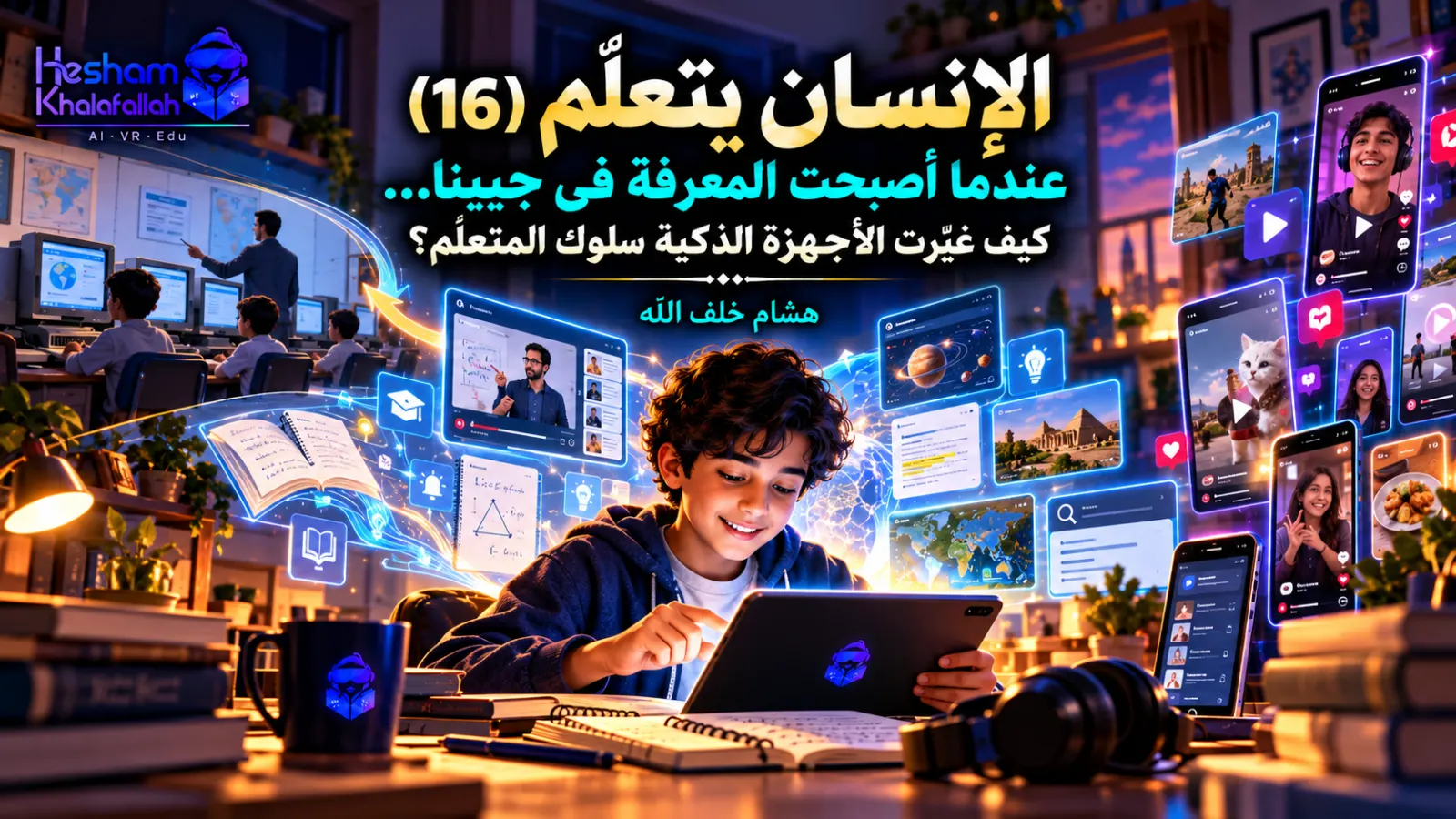
When the Computer Left the Lab
In the previous article, we reached a world in which the learner now lives between two systems: organized education led by the school, and open learning coming from the Internet, digital communities, and algorithms.
But something important was still missing.
At first, access to this world required a device in a specific place.
I remember how computers at school were associated with the computer lab. We went there at a specific time, sat in front of the machines, and left when the lesson ended.
The learner went to the technology.
But as portable computers developed, the relationship began to change.
Attempts emerged to design devices specifically for students. One important example was the Intel Classmate PC, which began shipping in several emerging markets in 2007 as a portable computer designed for education. Its designs later evolved into convertible and touch-enabled versions intended to suit children’s movement and classroom environments.
The idea was not simply to make the computer smaller.
A larger question was beginning to form:
Why should the computer remain a shared device waiting for the student inside a lab? Why could the student not have a device that moved with them?
In the computer lab, the learner went to technology; with personal devices, technology began to go with the learner.
That shift would change much of what came next.
From the Keyboard and Mouse… to Touch
Then came tablets.
In 2010, Apple introduced the iPad with a Multi-Touch screen that allowed users to interact directly with applications and content by touching the screen, in a device that was lighter and more portable than many traditional laptops of the time.
Today, this may sound completely ordinary.
But it changed the relationship between people and devices.
With a computer, a child first had to understand that moving a mouse with their hand moved something elsewhere on the screen.
With a tablet, the image is directly in front of them.
They want to select it…
they touch it.
They want to enlarge it…
they use their fingers.
They want to move…
they swipe.
They want to draw…
they draw directly on the screen.
A layer that had separated the learner from the content began to disappear.
Tablets did not only make content more portable; they also made interaction with content more direct for the learner.
We began to see one device functioning simultaneously as a book, notebook, camera, video player, voice recorder, dictionary, browser, and learning platform.
Then applications arrived, allowing the same device to take on different forms depending on what each user needed.
When the Device Became a Natural Part of a Child’s Life
I see this difference today in an experience very close to me.
My daughter is ten years old.
For her, the device is not something strange that has been added to education.
It is already part of her life.
She takes online lessons and training through it, interacts with teachers, watches explanations, answers questions, reviews material, and sometimes uses several applications or tools within the same learning experience.
And this is not unique to her.
For many families, it has become normal for a child to receive a lesson or training session from home using a smartphone, tablet, or iPad.
The teacher may be in another city.
The training may even be in another country.
A parent may no longer need to transport a child from one place to another simply to access an additional learning opportunity.
Here I see an important difference.
For our generation, technology was something that entered education.
For many children today, technology already exists—and education enters into it.
For a new generation of learners, the question is no longer: Should we use a device for learning? It is: Which part of learning will happen through it?
This does not mean that every child using a device is learning well.
It means that the device has become a natural part of the learning environment itself.
E-Learning Moved the Classroom Beyond Its Walls… and Personal Devices Made It Portable
We previously discussed how distance learning moved education beyond the limits of place.
But smartphones, tablets, and iPads added something else.
The virtual classroom no longer needed a complete desktop setup.
A learner can join a lesson from their room, review content while travelling, watch an explanation after school, upload an assignment, speak with a teacher, complete a quiz, or replay a lesson they missed.
On devices such as the iPad, applications appeared years ago that provided access to full courses, lectures, assignments, books, and tests from universities and educational institutions, illustrating early on how a mobile device could become a complete gateway into an educational experience.
And so:
E-learning moved the classroom beyond its walls, but personal devices made the classroom portable.
At this point, the change was no longer affecting place alone.
It was beginning to affect learner behavior.
The Learner No Longer Only Watches… They Expect to Interact
Perhaps this is one of the most important changes.
A child who is used to a touch-responsive screen, an application that responds to an answer, and a video that can be paused and replayed begins to form different expectations about knowledge itself.
If they do not understand a word…
they search for it.
If they do not understand the explanation…
they replay the video.
If it is too slow…
they speed it up.
If they do not like one explanation…
they look for another.
This is an extraordinary capability that was not previously available to learners in this form.
A student in a classroom cannot tell the teacher every two minutes:
Stop.
Repeat that sentence.
Go back five minutes.
Explain more slowly.
Or explain it again in a different way.
But video allows them to do exactly that.
For the first time, the learner became able to stop the teacher, replay the explanation, speed it up, and even replace it with another explanation… if that teacher is a video.
This gives learners a degree of control over the pace of learning that was not previously available with such ease.
And there is an important positive side.
A shy child who does not want to say “I didn’t understand” in front of classmates can replay the video ten times.
A faster learner can move on.
A learner who needs a visual explanation can search for one.
Learning can therefore become more closely aligned with individual pace and needs.
From Learning at Fixed Times… to Learning in Small Moments
When we learn also changed.
In the past, organized learning was usually associated with clear periods of time.
A class.
A lesson.
A study session.
A book.
Mobile devices began filling small periods that previously passed without deliberate learning.
Ten minutes of waiting.
A journey.
A break.
A few minutes before an appointment.
Those moments can now be used to review vocabulary in another language, watch a short explanation, answer several questions, review flashcards, or listen to educational content.
Learning became more divisible into smaller units, which relates to what is known as microlearning.
This can be a valuable opportunity when the content is designed for that purpose.
But we should not confuse two different things.
Breaking learning into smaller pieces so that it becomes easier to absorb.
And fragmenting attention until a person can no longer remain with a longer idea.
We can learn something small in five minutes, but not everything can be understood in five minutes.
And this brings us to one of the most important transformations worth examining.
Then Came Reels… and Our Relationship with Content Length Changed
Video itself is not new.
We previously discussed educational cinema, television, video, and later YouTube.
But continuous short-form video introduced a different behavior.
A piece of content may last only a few seconds.
Then you swipe.
Another appears.
Then another.
Then another.
Each video must capture you quickly.
If it does not…
you swipe away.
This design is not simply a change in video length.
It is a change in the way content is consumed.
Within seconds, the user decides:
Do I continue?
Or move on?
Do I like this?
Or look for something else?
The learner now lives within an environment that encourages rapid transitions, immediate responses, and constant variety.
That is why I believe the most important question is not:
Have Reels reduced the human attention span?
That would be a simpler claim than the scientific evidence allows.
The more useful question is:
Has the fast digital environment changed what learners expect from content—and from learning itself?
What Happens When Learners Expect Everything to Capture Them Immediately?
To me, this issue is more important than the length of the video itself.
If you become accustomed to removing any content that fails to attract you within the first few seconds with a simple swipe, what happens when you face a book that needs thirty pages before its idea becomes clear?
Or a mathematical problem that takes time?
A new language that requires repetition?
A lecture that demands concentration?
A skill that offers no immediate reward?
The problem may not be that the child “cannot pay attention.”
It may be that the child has become accustomed to an environment where they can instantly leave content that is not engaging.
That distinction matters.
The problem is not that videos have become short, but that learners may begin to expect every kind of knowledge to be understandable and engaging at the same speed.
Real learning does not always work that way.
Some knowledge is interesting from the first moment.
Some requires effort before it becomes interesting.
Some skills cannot be learned without repetition.
Some ideas cannot be shortened without losing their meaning.
Is Short-Form Video the Enemy of Learning?
Not necessarily.
We should avoid making the same mistake that has accompanied every new technology.
Short-form video itself can be excellent for learning.
Explaining a concept.
Showing a scientific experiment.
Demonstrating pronunciation.
Teaching a quick rule.
Introducing a new topic.
Summarizing a step.
Recent research on short explanatory videos suggests that they can support learning under certain conditions, particularly when well connected to course content, although results vary according to learners, video design, and context.
So the issue is not:
Short = bad.
The real question is:
What is the purpose of the short content?
Is it one small unit inside a learning pathway?
Or is it dozens of disconnected clips that make us feel we have learned simply because we have consumed many pieces of information?
A short video can be an excellent doorway into knowledge, but it cannot always accompany the learner to the end of the journey.
There is a major difference between watching a video that motivates me to begin exploring a subject…
and believing that the video itself made me understand the entire subject.
Between Microlearning and the “Illusion of Learning”
A person may finish twenty educational videos in half an hour and feel that they have learned a great deal.
Perhaps they really have learned some information.
But knowledge is not always the sum of separate facts.
Learning sometimes requires connection, application, repetition, error, correction, retrieval from memory, and reflection.
Every piece of information in a video may be correct, yet the learner may still fail to develop a coherent understanding.
This is an important distinction:
Breaking knowledge into smaller pieces can support learning, but fragmenting attention can prevent the learner from seeing the whole picture.
Good microlearning should be designed.
One part leads to the next.
A clear objective.
Practice.
Retrieval.
Progress.
Random movement between hundreds of clips is not a learning pathway simply because some of those clips contain useful information.
What Does Research Say About Short Videos and Attention?
We need to be careful here.
It is very easy to say that TikTok or Reels have “destroyed attention,” but science does not allow such a simple conclusion.
Some recent studies have found associations between intensive short-video use and difficulties in certain aspects of attention or self-control. Some studies have used behavioral tests and neurological measurements.
But some research also relies on specific samples or correlational designs, meaning we cannot simply conclude that short-form video alone directly causes every observed change in attention.
Other studies suggest that the relationship between social-media use and attention is not always straightforward, and that the size of some effects may be small or vary according to the type and context of use.
For me, the educational question is therefore more important than issuing a final judgment on the technology:
How do we teach a child to move between two modes?
A fast mode for discovery.
And a slower mode for understanding.
To know when one minute is enough.
When an hour is needed.
When reading is necessary.
And when an experiment is required.
That, in itself, has become a learning skill.
One Device Now Carries Learning… and Its Distractions Too
Here we encounter a paradox that was never this powerful before.
The book a student studied from did not send a notification saying:
Watch this video.
A calculator did not receive a message from a friend.
A library did not suddenly turn into a game.
But a smart device can be:
A book.
A classroom.
A library.
And at the same time:
A game.
A social network.
A messaging application.
A video platform.
A store.
A source of entertainment.
The learning tool and the learner’s sources of distraction now exist inside the same device.
UNESCO has noted that digital devices can support learning in some contexts, but can also become a source of distraction when their use is inappropriate or poorly organized. The educational impact of technology depends heavily on how it is integrated into learning, not simply on whether it is present.
This is why we are now seeing increasing international debate around mobile phones in schools. The debate reflects real concerns about distraction and inappropriate use, without proving that these devices cannot also have educational value.
This leads to a question I consider more important than simply “ban or allow”:
When does the device become a learning tool, and when does it become an obstacle to learning?
Smartphones and Tablets Changed More Than Access… They Changed Learner Independence
There is another positive side we should not ignore.
Learners can now solve many small problems independently before asking for help.
Do not know the meaning of a word?
Search.
Do not know a place?
Use a map.
Do not understand how something is done?
Watch a video.
Want to practice a language?
Use an application.
Want to hear how a word is pronounced?
Listen.
Want to document an experiment?
Record it.
Want to ask the teacher?
Send a message.
This does not mean the learner can now learn everything alone.
But the starting point has changed.
The smart device did not only put knowledge in the learner’s pocket; it also put tools for searching, experimenting, documenting, communicating, and producing content there.
When used well, this can increase learner independence.
But real independence is not merely the ability to search.
It is knowing:
What should I search for?
Where should I search?
And how do I know whether the answer I found is good?
Are We Remembering Less Because the Device Remembers for Us?
Phone numbers.
Appointments.
Directions.
Notes.
Photos.
Names.
Maps.
All of these now live inside the device.
We might say that human beings have become increasingly dependent on external memory.
But this is not entirely new.
Writing itself was a way of moving part of memory outside the mind.
Books did the same.
Libraries.
Then search engines.
What is new is that this external memory is now with us almost all the time.
So perhaps the right question is not:
Should we memorize everything people used to memorize?
But:
What must remain inside the human mind in order for us to think when information exists outside it?
As tools become better at remembering information for us, it becomes increasingly important to know what we must understand—not simply what we must memorize.
This question will become far more important when we later reach artificial intelligence.
The Learner Has Become a Multi-Screen, Multi-Source Learner
There is another reality I see in learning today.
A student may begin a lesson on Zoom or a similar platform.
The book may be a PDF.
The assignment may be on an LMS.
Additional explanation may be on YouTube.
Communication may happen in another app.
The test may be on a website.
Research may happen through Google.
Notes may be kept on the device.
The learning process no longer necessarily exists in one digital place.
The learner moves constantly between sources, screens, and applications.
This creates enormous opportunities.
But it may also create cognitive and organizational burdens.
Where is the file?
What is the password?
Where did the teacher send the assignment?
Which platform?
Which link?
And so:
The classroom is no longer one screen; it has become a network of screens and sources through which the learner moves continuously.
Those who can organize this environment benefit more from it.
Those who cannot may feel overwhelmed by it.
Technology Did Not Only Change Learner Tools… It Changed Learner Expectations
For me, this is the central idea of this article.
Today’s learner may expect content to be searchable, replayable, interactive, available at any time, supported by images or video, and replaceable with another source when the first explanation is unclear.
They may expect to comment.
Ask.
Repeat.
Choose.
These expectations did not emerge only inside school.
They were created by the learner’s entire digital life.
This creates a real challenge for education.
If a student returns from a world in which they can touch, search, replay, and choose—and then sits for forty minutes in a setting where they are expected only to listen—it is understandable that a gap may appear between the two experiences.
But the answer is not to turn school into TikTok.
The challenge is not to make education resemble entertainment platforms, but to understand the learner whose daily habits have partly been shaped by those platforms.
That distinction matters.
Education does not need to compete with every second of entertainment.
Its role is to help human beings remain capable of learning even when knowledge has not been designed to entertain them.
So Where Is the Teacher in All of This?
In the previous article, we discussed a teacher who is no longer the learner’s only source of knowledge.
Now the role expands again.
It is no longer enough to help learners choose information.
Teachers must also help them manage their digital behavior while learning.
When should I search?
When should I stop searching and begin thinking?
When is video appropriate?
When do I need longer reading?
When should I use digital tools?
When should I write by hand?
When should I open the device?
When should I close it?
How do I silence notifications?
How do I treat an online lesson with the same seriousness as a physical classroom?
How do I distinguish between watching an educational video and actually learning from it?
This gives the teacher an important new role:
The digital teacher does not only help the learner use the device; the teacher helps the learner build learning habits that prevent the device from controlling them.
That requires training and understanding from teachers themselves.
A teacher who uses technology simply because it exists may actually make the problem worse.
The app is not the goal.
The video is not the goal.
The device is not the goal.
The goal remains:
What happened to the learner?
And the Family’s Role Is No Longer Only “How Many Hours?”
This issue has become very important to me as a father.
It is easy to say:
My daughter used the iPad for two hours.
But what happened during those two hours?
Was she in a lesson?
Practicing a language?
Reading?
Speaking with a teacher?
Drawing?
Watching Reels?
Playing?
Not every hour in front of a screen is the same experience.
That does not mean time is irrelevant.
It means that the type, context, and purpose of use also matter.
So the discussion around devices should not be reduced to one question:
How many hours?
It should also include:
What are you doing? Why? With whom? And what happens afterward?
The family’s role therefore becomes less dependent on prohibition alone and more focused on building habits.
Time for learning.
Time for entertainment.
Time without devices.
Awareness of notifications.
The ability to stop.
And conversation about what the child watches and learns.
There Is a New Digital Divide Too
At first, the divide was:
Who has a computer and who does not?
Then:
Who has Internet access?
Then:
How fast is the connection?
Today, almost everyone may have some kind of smartphone, but the opportunities are still unequal.
An old phone versus a modern device.
A small screen versus a suitable tablet.
Limited data versus fast Internet.
A child with a personal device versus one who shares a device with the family.
A quiet home for study versus a home with no suitable learning space.
Therefore:
Owning a device is the beginning of access, not a guarantee of equal learning opportunity.
This is a principle that has repeated itself throughout the series.
Every time technology solves one problem, another layer of questions appears.
So Have Smart Devices Made Learners Better?
I do not think the answer can simply be “yes” or “no.”
Smart devices have given learners capabilities that did not previously exist in the same form.
Access.
Flexibility.
Repeated explanations.
Interaction.
Learning from anywhere.
Communication with distant teachers.
Content creation.
Documentation.
Learning at one’s own pace.
But at the same time, they introduced new challenges.
Distraction.
Constant switching.
Notifications.
Dependence on instant answers.
Confusing the consumption of content with learning.
Expecting knowledge to always be short, entertaining, and immediate.
The device itself does not create a good learner or a poor learner.
The tool expands what the learner is capable of doing, but it does not determine what the learner will choose to do with that capability.
And here we return to an idea that has accompanied this entire series:
Good educational technology is not the newest technology; it is technology that helps solve a real learning problem without creating a greater one.
From the Screen We Carry… to the World We Can Enter
But smart devices were hiding another transformation.
They were not merely screens.
Inside them were cameras.
Microphones.
Sensors.
Location services.
Motion detection.
The ability to know the device’s direction, position, and something about what it was seeing.
Over time, it became possible not only to display knowledge on a screen.
We could place digital elements over the real world.
Or take the learner into a completely virtual environment.
Instead of looking at a picture of the heart…
the learner could see a three-dimensional model.
Instead of reading about a historical place…
the learner could feel as though they were standing inside it.
Instead of watching a dangerous experiment on video…
the learner could train inside a simulated environment.
And another question began to emerge.
If books allowed us to read about knowledge, video allowed us to watch it, and computers allowed us to interact with it…
what happens when we can actually enter it?
And this begins the next stage of our Human Learning journey:
Human Learning (17): When the Learner Entered Knowledge… How Did Virtual and Augmented Reality Change the Learning Experience?
The sentence that, for me, summarizes this entire stage is:
Smartphones and tablets did not simply put knowledge in the human pocket; they changed learner expectations, behavior, search habits, interaction, and attention. The new challenge in education is therefore not only how to use the device, but how to help learners remain the ones using it… rather than allowing the device to lead the way they learn.