
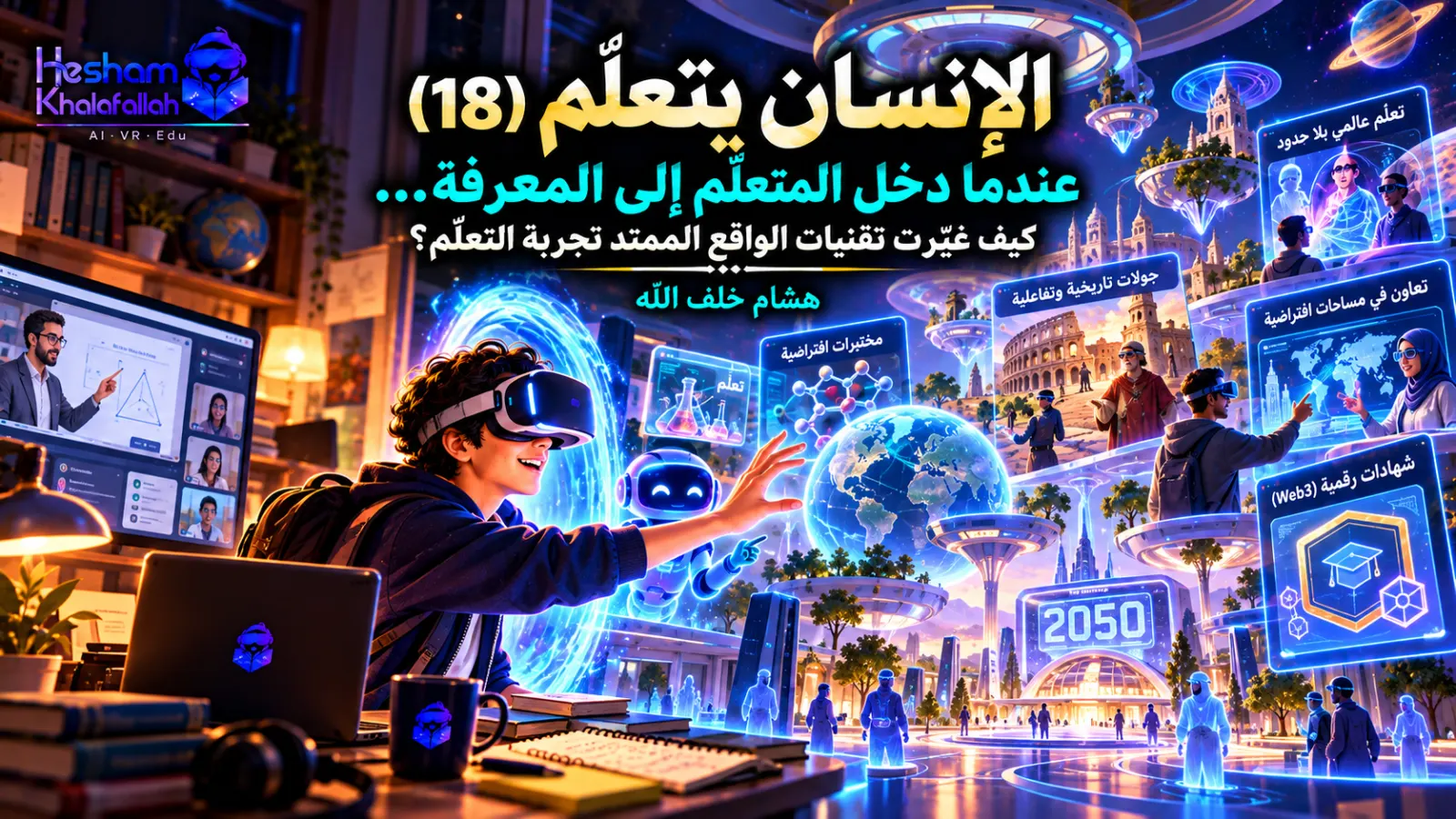
From Watching Knowledge… to Entering It
Throughout the previous articles in this series, we have followed knowledge through one transformation after another.
Books allowed people to read about it. Images and video allowed them to see it. Computers made interaction possible. The Internet opened the world. Smartphones and tablets allowed knowledge to travel with us. Artificial intelligence then began to converse with the learner, explain ideas, and adapt responses to individual needs.
Extended reality introduces a different question:
What if we no longer placed knowledge only in front of the learner… but placed the learner inside it?
Instead of simply reading about a historical site, a student may move through it virtually. Instead of looking at a two-dimensional diagram of the human heart, they may explore a three-dimensional model from different angles. Instead of watching a dangerous or expensive practical exercise, they may experience part of it through a safe simulation.
The transformation is not only in the format of the content; it is in the learner’s position within the learning experience itself.
This is where the idea of Immersive Learning begins.
Virtual, Augmented, and Mixed Reality… Different Tools for a Common Idea
There is no need to turn this into a technical lesson, but it is useful to distinguish the concepts simply.
In Virtual Reality (VR), the user enters a fully digital environment. Augmented Reality (AR) keeps the user in the real world while adding digital information and objects to it. Mixed Reality (MR) introduces deeper forms of interaction between physical and digital elements, while Extended Reality (XR) serves as a broader umbrella for these technologies.
As for the metaverse, in an educational context I do not see it simply as a headset or an avatar moving through a three-dimensional city. Its real value begins when we have a social, interactive digital environment where people can enter, learn, work, collaborate, practice, and create.
This is also where we must avoid one of the mistakes that accompanied early conversations about the metaverse:
A three-dimensional world is not the objective.
The real question is:
What will the learner actually do inside it?
Distance Education Moved the Lecture… But What About the Experience?
For me, this is one of the strongest reasons to explore immersive technologies in education.
Distance education proved that a large part of the educational process could continue outside the physical institution.
A teacher could speak from one place. Students could join from other places. The screen could carry sound and video. Platforms could deliver learning materials. Assignments and assessments could move online.
But a harder challenge remained:
How do we move the practical side of learning?
It is relatively easy to move a theoretical lecture online.
But how do we move the chemistry laboratory?
How do we recreate a maintenance workshop?
How does a medical student practice a procedure that requires hands-on experience?
How does an engineering student learn to operate equipment or respond to a failure scenario?
How do we send a learner on an educational field visit when they cannot physically reach the place?
A clear gap remained between transferring information and transferring experience.
Distance education succeeded to a large extent in moving content and communication beyond the classroom, but the harder challenge remained: how do we move the experience itself?
Simulation and extended reality open a different door.
What If We Did Not Move the Lesson to the Learner… but Moved the Learner to the Environment?
A video can tell the learner:
Watch the laboratory.
A simulation can say:
Enter the laboratory.
A video can demonstrate how a machine works.
An interactive environment may allow the learner to approach it, select a tool, perform a step, make a decision, and see what happens next.
This, to me, is one of the most important possibilities for the future of distance education.
The next step is not only to move the classroom onto a screen, but to rebuild parts of the learning environment around the learner.
That does not mean virtual environments will become exact copies of real schools or replace every physical experience.
Some things remain difficult to reproduce: human relationships, the physical sense of place, direct interaction with real materials and equipment, and the broader social life of an educational institution.
But immersive technologies can reconstruct some of the spatial, interactive, and practical elements that conventional distance learning struggles to provide.
Research in recent years has also suggested that immersive virtual reality can be particularly useful in learning contexts that rely on active engagement and practical application, especially when simulation is carefully matched to the educational objective.
When Mistakes Become a Safe Part of Learning
One of the things that interests me most about simulation is not that it looks impressive.
It is that it can give the learner something much more important:
the opportunity to make mistakes.
Some mistakes in the real world are expensive.
Some are dangerous.
Some cannot easily be repeated for training purposes.
Inside a simulation, the learner can try.
Choose the wrong option.
See the result.
Go back.
Try again.
Repeat the scenario many times.
This makes simulation particularly relevant to fields such as technical training, maintenance, engineering, selected forms of healthcare training, safety, emergency response, and equipment operation.
The real value of simulation is not simply that it makes learning more exciting; it is that it allows learners to experiment, make mistakes, and learn from those mistakes in situations where real-world errors may be difficult or dangerous.
This brings us closer to Learning by Doing.
But technological enthusiasm still requires humility.
Not every type of training can be transferred into virtual reality, and not every skill can be mastered without eventually moving into the physical world.
Simulation may be an important stage of training.
It is not necessarily the final stage.
When a Crisis Prevents Access to School
This is where the idea becomes even more important.
We have seen how major crises can make access to educational institutions difficult or impossible.
A pandemic.
A natural disaster.
Conflict.
Security conditions.
Extreme geographical distance.
Or simply the absence of a specialized laboratory or training facility where the learner lives.
In such circumstances, distance education can maintain communication and access to content, but some disciplines cannot survive on lectures alone.
This is why I believe extended reality and simulation can become an important part of educational continuity systems.
Not as a magical answer to every crisis, but as a practical solution for some forms of learning that video conferencing alone cannot adequately reproduce.
When a crisis prevents access to the real learning environment, immersive environments may allow parts of practical learning to continue in ways that ordinary video-based distance education cannot.
This leads me to think differently about the future of distance education.
Perhaps the objective is not to replace school.
Perhaps it is to preserve access to some of the experiences of school when access to the building itself becomes impossible.
My Experience with MetaLife… When Does a Virtual World Actually Become Learning?
When I began working in the metaverse and extended reality through MetaLife Metaverse, one question interested me more than the visual appearance of the virtual world itself:
What will the human being actually do inside it?
It is relatively easy to build something that looks impressive.
A hall.
A building.
A museum.
A classroom.
Virtual characters.
Screens inside a digital world.
But once the initial sense of wonder fades, the educational question remains:
What did the user actually learn?
Working in this field made the distinction clearer to me between something that looks educational because it exists inside a three-dimensional environment and a learning experience intentionally designed to make the learner do something that leads to understanding.
A student may enter a three-dimensional world and then watch a one-hour video inside it.
Is that immersive learning?
Technically, the learner may be inside a metaverse environment.
Educationally, perhaps we have only moved the screen into a more beautiful room.
If we transfer the traditional lecture into a three-dimensional room, we may simply have digitized the classroom again without redesigning learning.
The real value begins when the learner can explore, experiment, make decisions, solve problems, collaborate, and discover the consequences of their actions.
One of the most important lessons I have taken from working in this field is:
Do not begin by designing the virtual world; begin by designing what you want the learner to do inside it.
Can a Learner Feel “At School” While Being Far Away?
Traditional distance education sometimes faces a problem that has little to do with the quality of the content itself.
A learner may be technically connected…
but psychologically distant.
Small boxes on a screen.
Muted microphones.
Cameras that may be switched off.
The student remains at home and can move to another window or application at any moment.
Immersive technologies attempt to strengthen something often described as Presence: the sense that the user is actually located within an environment and with other people, rather than simply observing them from outside.
This opens interesting possibilities for distance learning.
Students may enter a shared space, move within it, approach objects, work together around a model or task, and interact in ways that more closely resemble being in a place than joining a conventional video meeting.
But presence must not be confused with learning.
Feeling as though the learner is inside the classroom is not enough; what matters is what the learner does there and what they understand when they leave.
Immersion is not an objective by itself.
As we have repeated throughout this series:
The attractiveness of a technology does not necessarily mean the quality of the learning is high.
Where Is the Teacher in the Virtual World?
The teacher does not disappear when the learner puts on a headset.
In many ways, the teacher may become even more important.
Before the experience, the teacher defines the objective:
What should the learner notice?
During the experience, the teacher guides attention:
What happens if you try this?
Why did you make that decision?
What do you see?
Afterward comes a critical stage:
What did we learn from what happened?
A learner may have an extraordinary experience and leave excited, yet still be unable to explain what it meant.
An immersive experience does not become learning simply because the learner lived through it; it becomes learning when it supports observation, interpretation, connection, and application.
Once again, we return to the evolving role of the teacher.
Technology increases the number of possible experiences.
The teacher helps transform experience into learning.
Not Every Lesson Needs a Virtual World
I believe this point is essential, especially because I work in this field.
I do not want enthusiasm for the metaverse or extended reality to become a reason to use them everywhere.
Sometimes a book is better.
Sometimes an image is better.
Sometimes video is enough.
Sometimes a direct conversation with a teacher is the right solution.
If I need to build an entire three-dimensional world to explain something that could have been communicated clearly with one simple diagram in two minutes, I may not have improved education.
I may only have made it more expensive.
Not everything that can be turned into a virtual experience should be turned into one; the real question is always: what educational problem does this technology solve?
To me, this principle matters more than the name of the technology itself.
We Are in 2026… and Perhaps We Are Still Looking at the Beginning
When we look at virtual reality and the metaverse today, the limitations are easy to see.
Devices remain relatively expensive in many markets.
Some headsets are not comfortable for extended use.
High-quality 3D environments require time, specialized skills, and production teams.
High-quality connectivity is not equally available everywhere.
Platforms and experiences remain fragmented.
But I believe it would be a mistake to judge the entire future of the technology by what it looks like in 2026.
Judging the future of extended reality through today’s devices may be similar to judging the entire future of the Internet through the experience of using it at the beginning of the millennium.
At the beginning of the century, the Internet was already expanding among the public. Then came successive generations of mobile connectivity, smartphones, cloud computing, video streaming, and platforms.
By 2025, around 6 billion people—approximately 74% of the world’s population—were using the Internet, while 5G coverage had reached around 55% of the global population.
The speed of the connection was not the only thing that changed.
The device changed.
Content changed.
Cloud computing changed.
Human behavior changed.
The digital economy changed.
The way we work and learn changed.
This makes me ask:
If a quarter century transformed the Internet from a limited experience in front of a computer into a network that accompanies billions of people throughout their day, what might the next quarter century do to extended reality?
2050… Not a Prediction, but a Question About Direction
I cannot say exactly what education will look like in 2050.
I do not think anyone can.
But from my perspective, if connectivity, computing, artificial intelligence, devices, and digital interfaces continue to evolve, it is difficult to imagine that the extended reality we use twenty-five years from now will look much like what we use today.
Devices may become dramatically lighter.
The familiar image of a large headset may disappear.
Interaction with digital environments may become more natural.
The boundary between screen and physical space may become less obvious.
Connectivity itself is moving in that direction, with future communication systems being designed around more immersive interaction and advanced digital collaboration.
So I do not see 2050 as a date when I can say:
“The metaverse will be complete.”
I see it as a question:
If this is the beginning, where could another quarter century take us?
When Extended Reality Meets Artificial Intelligence
This article connects directly to the previous one.
Extended reality can build the environment.
Artificial intelligence can add intelligence to that environment.
Imagine entering a virtual laboratory.
An AI assistant knows your current level.
It asks you questions.
Observes the choices you make.
Explains the object in front of you.
If you make a mistake, it does not immediately give you the answer. It may instead change the scenario or offer a hint.
If you are already advanced, it increases the difficulty.
The environment itself may adapt to the learner.
At that point, we no longer have simply Virtual Reality.
We have an intelligent immersive learning environment.
We might think of it this way:
Extended reality builds the environment. Artificial intelligence makes it adaptive. Connectivity links people. Data records the learning journey.
The future of education may not belong to one technology, but to the convergence of several technologies inside a single learning experience.
What Might Web3 and Blockchain Add?
Here too, we should avoid being distracted by fashionable terminology.
Virtual reality does not require blockchain to work.
A metaverse does not automatically become better because Web3 is added to it.
But one question will become increasingly important if learners move between different environments, institutions, platforms, and learning providers:
Who owns the learner’s educational identity?
Imagine a learner who completes one part of their education at a university, earns a skill from a company, completes training inside a virtual environment, and obtains a micro-credential somewhere else.
How do they carry these achievements with them?
And how can another institution verify them?
This is where ideas such as digital identity and Verifiable Credentials become important.
In May 2025, Verifiable Credentials 2.0 became an official W3C Recommendation, providing standards for digitally representing credentials in a cryptographically verifiable and privacy-aware manner.
That does not mean every digital credential must use blockchain. Blockchain may be one option within some architectures, but it is not a requirement for every credential system.
The broader vision of Web3, however, raises a compelling question:
Could the learner’s record move from a file controlled by a single institution to a verifiable learning record that the learner can carry and manage across different environments?
That connects directly with a principle that has accompanied this series from the beginning:
The learner at the center.
What Might a Learning Day in 2050 Look Like?
I do not present this as a prediction.
I see it as a thought experiment.
Perhaps a student enters a digital learning environment and meets classmates from different countries.
There is a human teacher—and an AI assistant.
The student enters a laboratory.
Interacts with a model.
Conducts an experiment.
Makes a mistake.
The environment changes the scenario.
The student works with a team.
Completes the task.
The skill they demonstrated is then added to a digital record that can be verified.
They move into another learning environment without starting their educational identity from zero.
At that point, school may become less tied to one building, curriculum less tied to one book, certification less tied to one sheet of paper, and learning less tied to one identical pathway for everyone.
Will all of this happen exactly this way?
Probably not.
But a person using the Internet at the beginning of the millennium could not have described in detail a future in which one phone would combine a camera, navigation, video, banking, work, education, communication, and artificial intelligence.
That is why I do not like judging the future by the limitations of the present.
MetaLife, for Me… One Step in a Much Longer Journey
This is why, when I look at my work with MetaLife Metaverse today, I do not see it as the final image of immersive education.
I see it as part of a journey of experimentation and learning.
How do we build the environment?
How does the user enter it?
How do we give them a reason to interact?
How do we make the world more than a visual scene?
How do we connect place with content?
How do we use artificial intelligence inside it?
And how do we end with an experience that creates real value for the human being?
To me, these questions matter more than the size of the world or the number of buildings inside it.
Because the educational metaverse will not succeed simply when we can reproduce a virtual school that looks like a real school.
It may succeed when we begin creating learning experiences that could not have been delivered in the same way inside the physical school at all.
Technology becomes more valuable when it does not merely imitate what we already do, but enables us to do something that was previously difficult or impossible.
Perhaps We Are Still in the First Chapter of the Story
In 2026, I do not believe we have reached the final form of extended reality in education.
Perhaps we are still somewhere near the opening pages of the story.
That makes me optimistic—but also cautious.
Because the future will not be determined by network speed and devices alone.
It will also depend on questions such as:
Do we design good learning experiences?
Do we train teachers?
Do we make access equitable?
Do we protect learner data?
Do we know when to use a virtual environment and when not to?
Do we measure what the learner actually learned, or only how impressed they were by the technology?
And once again, I return to the principle that has accompanied this entire series:
Good educational technology is not the newest technology; it is technology that solves a real learning problem without creating a greater one.
If distance education liberated learning from place, extended reality introduces another question:
Can we rebuild the place itself when learning needs it?
Perhaps the future of distance education is not to eliminate the school, but to preserve access to some of its experiences even when reaching the building becomes impossible.
And by 2050, perhaps the question itself will have changed.
We may no longer ask only:
Where does the student learn?
We may instead ask:
What environment does this learner need right now in order to learn this particular thing?
And this opens the next stage in the Human Learning journey.
Because these environments do not only allow us to see the learner…
they can also begin to see what the learner does inside them: where they go, what they choose, where they make mistakes, what they repeat, and how long they take.
And this leads us to the next question:
Human Learning (19): When the System Began to See the Learner Through Data… Can Education Understand Each Human Being Better?