 Hesham Khalafallah
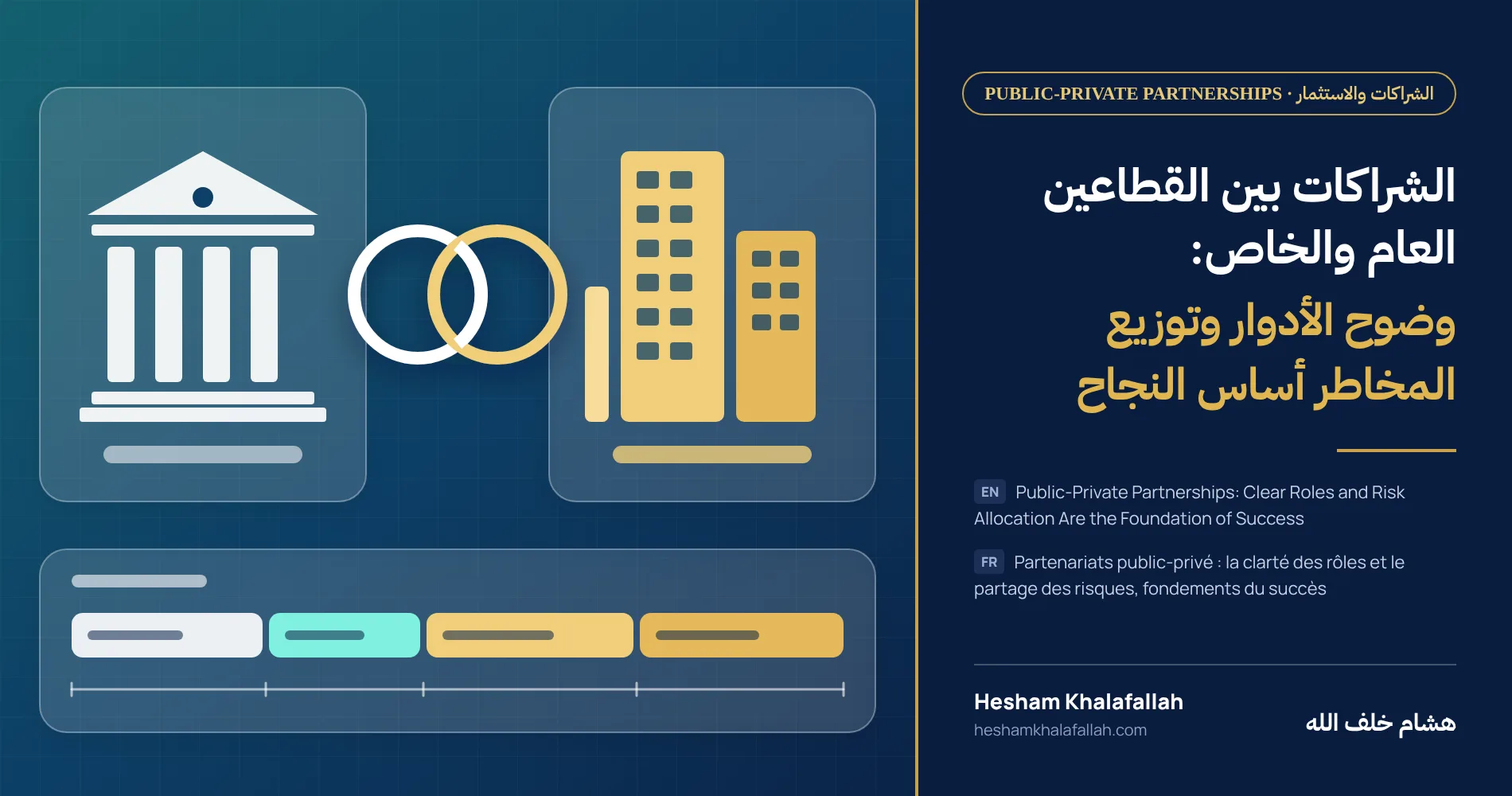
In my work on projects in technology, education and services, I have noticed that a public-private partnership usually begins with shared enthusiasm: a government body with a need and a public priority, and a private company with the experience and the ability to deliver and finance. Each side sees in the other what it lacks.
But enthusiasm alone does not build a successful partnership. What decides the outcome, in my view, comes down to two questions that are simple to phrase and hard to apply: Are each party’s roles clear? And are the risks fairly allocated to whoever is best able to manage them?
The first impression: “The private sector funds, the government monitors”
This short picture is common, but it does not describe a real partnership. A partnership is not funding from one side and oversight from the other, but a considered distribution of responsibilities over the life of the project: planning, design, delivery, operation and maintenance, with a clear financial and service return for each stage.
Why do clear roles matter?
When clear boundaries are missing, gray areas appear, and in them decisions stall and the parties trade blame. Who approves changes? Who bears the delay in approvals? Who answers to the beneficiaries? These are questions to settle in the contract before they become disputes in delivery.
The other side: mistakes that keep repeating in partnerships
In all honesty, I should start with the mistakes I see repeated, because knowing them protects a partnership before it begins:
• Goals that were never agreed: one side sees the goal as a public service at the lowest cost, the other as a fair return, with no open discussion of it.
• Passing all risks to one party: it feels comfortable for the party that passed them on, but it raises the cost and weakens the willingness to continue.
• A general contract that does not cover hard cases: such as changes in legislation, delays in land and permits, or fluctuating costs.
• No measurable performance indicators: quality becomes a matter of opinion, and there is nothing on which to hold the parties objectively accountable.
• Neglecting governance after signing: no monitoring committee and no dispute mechanism, so small problems pile up until they become large.
The rule of risk allocation: to whoever can best manage it
The principle I rely on is that each risk is borne by the party best able to control or reduce it at the lowest cost. A risk does not disappear by being transferred, but it is managed more efficiently when it sits with whoever has the right tools:
• Design, delivery and operating risks: usually closer to the private partner, because it runs these activities day to day.
• Regulatory, legislative and permitting risks: usually closer to the public body, because it holds the decision.
• Demand and revenue risks: need a separate discussion, and may be shared between the two sides depending on the nature of the project.
• Financial and funding-rate risks: studied carefully, with a mechanism for sharing the impact of a major change.
• Force majeure and unforeseen circumstances: stated explicitly, with clear procedures for handling them.
Five elements of a partnership that works
• A written shared goal: phrased clearly before the contractual detail, and known to everyone.
• A responsibility matrix: a table setting out who plans, who delivers, who approves, who operates and who bears each risk.
• Performance indicators and result-linked payment: the service is actually measured, and part of the payment depends on its quality.
• A mechanism for adjustment and dispute resolution: one that allows rebalancing when circumstances change without reaching a break.
• Clear governance and transparency: a joint committee, regular follow-up and open reporting to the stakeholders.
From agreement to result
A good partnership does not end with signing the contract; it begins with it. What matters most is disciplined delivery: regular follow-up meetings, performance reports, periodic risk reviews, and the ability to admit a problem early instead of hiding it.
I advise the parties to begin with a limited pilot or a clear first phase, which builds trust and exposes the contract’s weak points before expansion. Trust between parties is built through shared experience, not through texts alone.
A successful partnership is not one free of risk, but one in which each side knows its role and its risk and has the tools to manage it.
Conclusion
What I want readers to take away is that clear roles and fair risk allocation are not legal details left to the lawyers, but the heart on which a partnership stands. When they are in place, the partnership turns from a cautious relationship between two sides into a joint project that truly serves people.
If your public body or company is considering a new partnership, in technology, education, services or elsewhere, I would be glad to build together a clear roles and risk matrix that lays the foundation for balanced and lasting cooperation.